Department of Social and Preventive Medicine, Université de Montréal, Montréal, Canada.
BMC Pregnancy Childbirth. 2012 Oct 29;12:118. doi: 10.1186/1471-2393-12-118.
In Mali and Senegal, over 1% of women die giving birth in hospital. At some hospitals, over a third of infants are stillborn. Many deaths are due to substandard medical practices. Criterion-based clinical audits (CBCA) are increasingly used to measure and improve obstetrical care in resource-limited settings, but their measurement properties have not been formally evaluated. In 2011, we published a systematic review of obstetrical CBCA highlighting insufficient considerations of validity and reliability. The objective of this study is to develop an obstetrical CBCA adapted to the West African context and assess its reliability and validity. This work was conducted as a sub-study within a cluster randomized trial known as QUARITE.
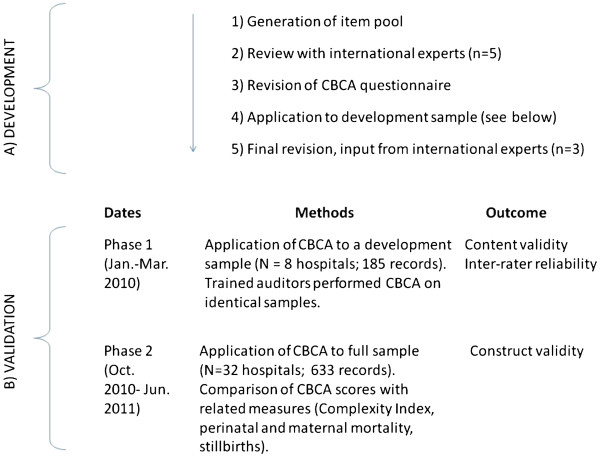
Criteria were selected based on extensive literature review and expert opinion. Early 2010, two auditors applied the CBCA to identical samples at 8 sites in Mali and Senegal (n = 185) to evaluate inter-rater reliability. In 2010-11, we conducted CBCA at 32 hospitals to assess construct validity (n = 633 patients). We correlated hospital characteristics (resource availability, facility perinatal and maternal mortality) with mean hospital CBCA scores. We used generalized estimating equations to assess whether patient CBCA scores were associated with perinatal mortality.
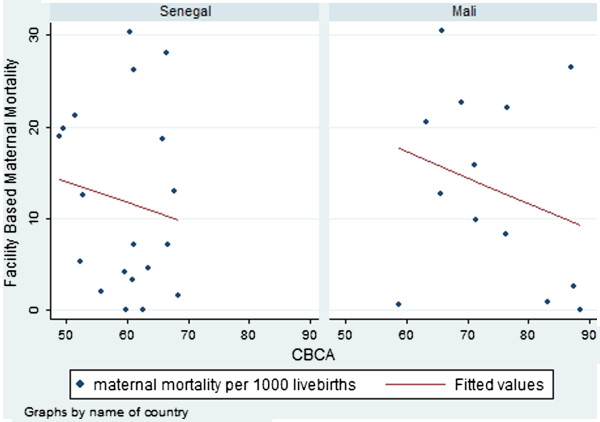
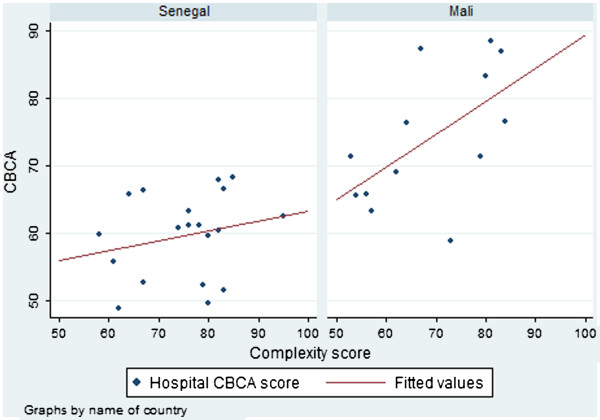
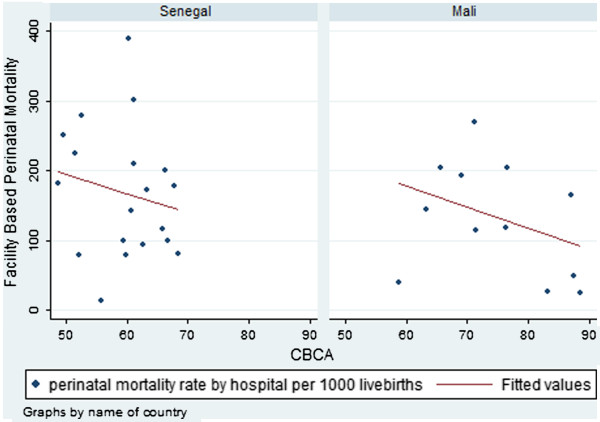
Results demonstrate substantial (ICC = 0.67, 95% CI 0.54; 0.76) to elevated inter-rater reliability (ICC = 0.84, 95% CI 0.77; 0.89) in Senegal and Mali, respectively. Resource availability positively correlated with mean hospital CBCA scores and maternal and perinatal mortality were inversely correlated with hospital CBCA scores. Poor CBCA scores, adjusted for hospital and patient characteristics, were significantly associated with perinatal mortality (OR 1.84, 95% CI 1.01-3.34).
Our CBCA has substantial inter-rater reliability and there is compelling evidence of its validity as the tool performs according to theory.
Current Controlled Trials ISRCTN46950658.
在马里和塞内加尔,超过 1%的产妇在医院分娩时死亡。在一些医院,超过三分之一的婴儿是死产。许多死亡是由于医疗标准不达标造成的。基于标准的临床审核(CBCA)越来越多地用于衡量和改善资源有限环境下的产科护理,但它们的测量特性尚未经过正式评估。2011 年,我们发表了一篇关于产科 CBCA 的系统综述,强调了有效性和可靠性的考虑不足。本研究的目的是开发一种适应西非环境的产科 CBCA,并评估其可靠性和有效性。这项工作是在一项名为 QUARITE 的集群随机试验的子研究中进行的。
根据广泛的文献回顾和专家意见选择标准。2010 年初,两名审核员在马里和塞内加尔的 8 个地点(n=185)对相同的样本应用 CBCA,以评估评分者间可靠性。2010-11 年,我们在 32 家医院进行了 CBCA,以评估结构有效性(n=633 名患者)。我们将医院特征(资源可用性、围产期和孕产妇死亡率)与医院 CBCA 平均评分相关联。我们使用广义估计方程评估患者 CBCA 评分是否与围产期死亡率相关。
结果表明,塞内加尔和马里的评分者间可靠性分别为中等(ICC=0.67,95%CI 0.54-0.76)和较高(ICC=0.84,95%CI 0.77-0.89)。资源可用性与医院 CBCA 平均评分呈正相关,而孕产妇和围产期死亡率与医院 CBCA 评分呈负相关。调整医院和患者特征后,较差的 CBCA 评分与围产期死亡率显著相关(OR 1.84,95%CI 1.01-3.34)。
我们的 CBCA 具有中等的评分者间可靠性,并且有强有力的证据表明该工具的有效性符合理论。
当前对照试验 ISRCTN46950658。