Dementia Research Centre, UCL Institute of Neurology, University College London, London, United Kingdom.
Cortex. 2013 Jul-Aug;49(7):1844-55. doi: 10.1016/j.cortex.2012.09.011. Epub 2012 Oct 5.
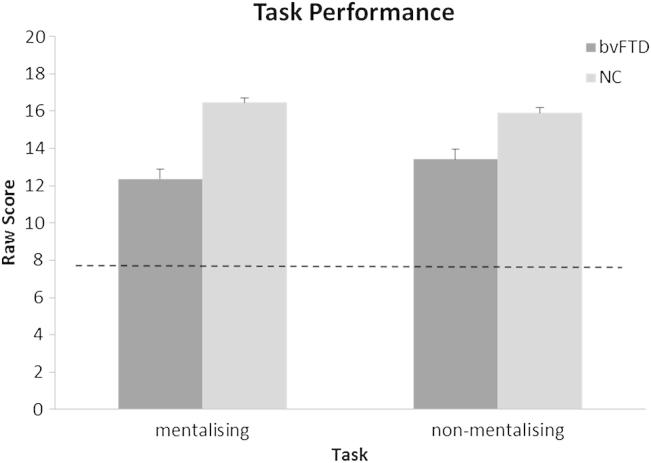
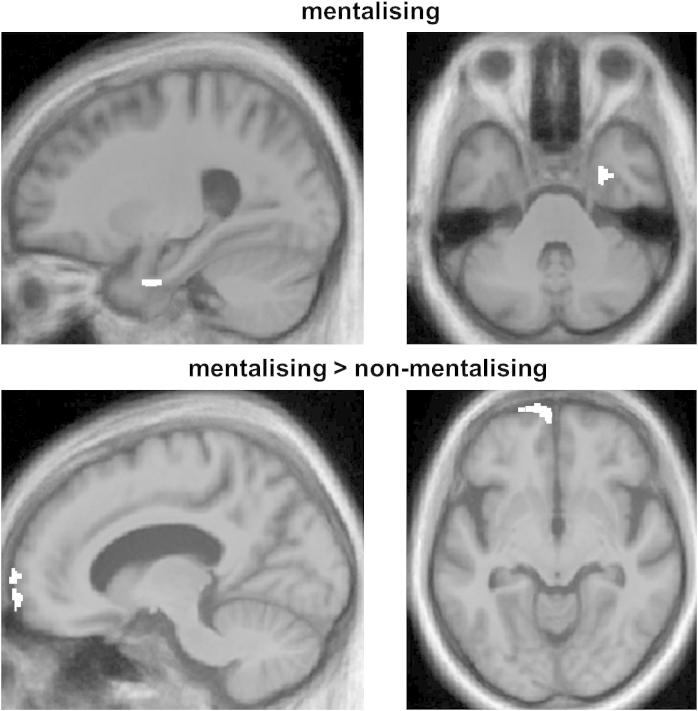
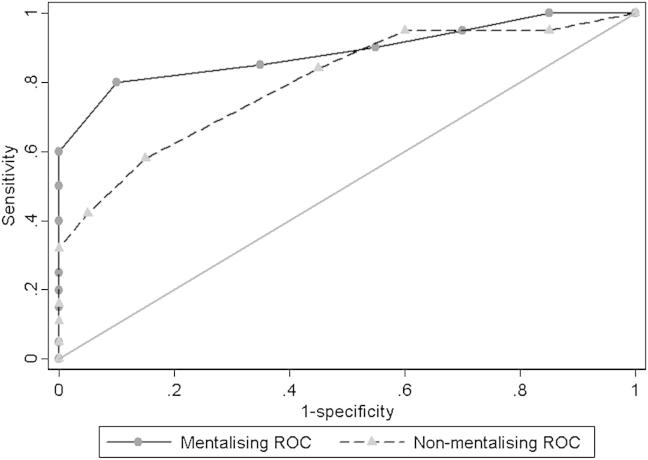
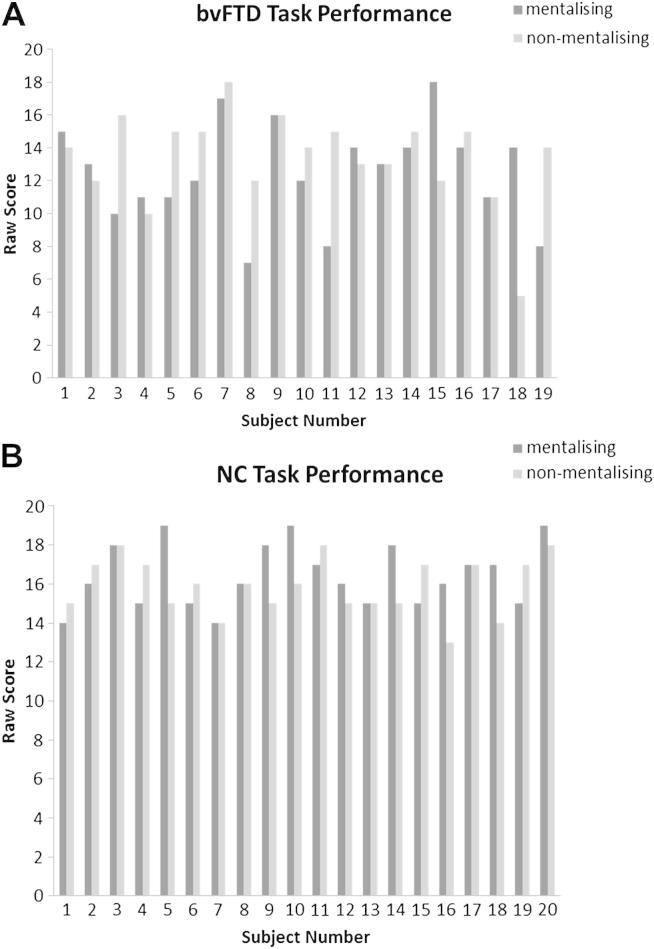
Despite considerable recent interest, the biological basis and clinical diagnosis of behavioural variant frontotemporal dementia (bvFTD) pose unresolved problems. Mentalising (the cognitive capacity to interpret the behaviour of oneself and others in terms of mental states) is impaired as a prominent feature of bvFTD, consistent with involvement of brain regions including ventro-medial prefrontal cortex (PFC), orbitofrontal cortex and anterior temporal lobes. Here, we investigated mentalising ability in a cohort of patients with bvFTD using a novel modality: music. We constructed a novel neuropsychological battery requiring attribution of affective mental or non-mental associations to musical stimuli. Mentalising performance of patients with bvFTD (n = 20) was assessed in relation to matched healthy control subjects (n = 20); patients also had a comprehensive assessment of behaviour and general neuropsychological functions. Neuroanatomical correlates of performance on the experimental tasks were investigated using voxel-based morphometry of patients' brain magnetic resonance imaging (MRI) scans. Compared to healthy control subjects, patients showed impaired ability to attribute mental states but not non-mental characteristics to music, and this deficit correlated with performance on a standard test of social inference and with carer ratings of patients' empathic capacity, but not with other potentially relevant measures of general neuropsychological function. Mentalising performance in the bvFTD group was associated with grey matter changes in anterior temporal lobe and ventro-medial PFC. These findings suggest that music can represent surrogate mental states and the ability to construct such mental representations is impaired in bvFTD, with potential implications for our understanding of the biology of bvFTD and human social cognition more broadly.
尽管最近人们对行为变异额颞叶痴呆(bvFTD)的生物学基础和临床诊断产生了浓厚的兴趣,但仍存在一些尚未解决的问题。心智化(根据心理状态来解释自己和他人行为的认知能力)受损是 bvFTD 的一个突出特征,这与包括腹内侧前额叶皮层(PFC)、眶额皮层和前颞叶在内的脑区的参与一致。在这里,我们使用一种新的方法——音乐,研究了一组 bvFTD 患者的心智化能力。我们构建了一个新的神经心理学测试,要求患者将情感心理或非心理关联归因于音乐刺激。我们评估了 20 名 bvFTD 患者(n = 20)和 20 名匹配的健康对照组受试者(n = 20)的心智化能力;患者还接受了行为和一般神经心理学功能的全面评估。我们使用患者大脑磁共振成像(MRI)扫描的基于体素的形态测量学来研究实验任务表现的神经解剖学相关性。与健康对照组相比,患者在归因心理状态而不是非心理特征到音乐方面的能力受损,并且这种缺陷与标准社会推理测试的表现以及患者共情能力的照顾者评分相关,但与其他一般神经心理学功能的潜在相关测量无关。bvFTD 组的心智化表现与前颞叶和腹内侧 PFC 的灰质变化有关。这些发现表明,音乐可以代表替代的心理状态,并且构建这种心理表征的能力在 bvFTD 中受损,这可能对我们更广泛地理解 bvFTD 的生物学和人类社会认知产生影响。