Department of Neurology, Halle University Medical Center, Halle (Saale), Germany.
Department of Neurology, Max Planck Institute for Human Cognitive and Brain Sciences, Leipzig, Germany.
Alzheimers Res Ther. 2024 Oct 26;16(1):237. doi: 10.1186/s13195-024-01596-4.
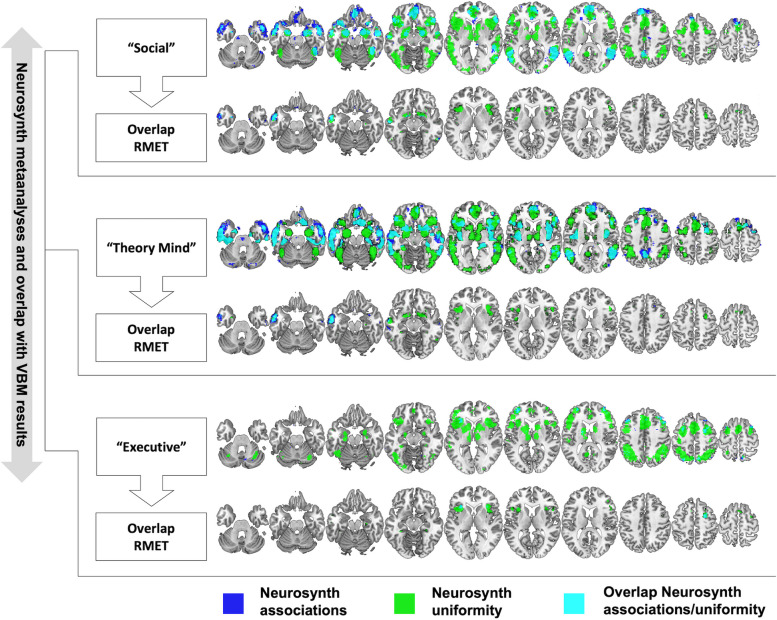
Behavioral variant frontotemporal dementia (bvFTD) is characterized by profound and early deficits in social cognition (SC) and executive functions (EF). To date it remains unclear whether deficits of the respective cognitive domains are based on the degeneration of distinct brain regions. In 103 patients with a diagnosis of bvFTD (possible/probable/definite: N = 40/58/5) from the frontotemporal lobar degeneration (FTLD) consortium Germany cohort (age 62.5±9.4 years, gender 38 female/65 male) we applied multimodal structural imaging, i.e. voxel-based morphometry, cortical thickness (CTH) and networks of structural covariance via source based morphometry. We cross-sectionally investigated associations with performance in a modified Reading the Mind in the Eyes Test (RMET; reflective of theory of mind - ToM) and five different tests reflective of EF (i.e. Hamasch-Five-Point Test, semantic and phonemic Fluency, Trail Making Test, Stroop interference). Finally, we investigated the conjunction of RMET correlates with functional networks commonly associated with SC respectively ToM and EF as extracted meta-analytically within the Neurosynth database. RMET performance was mainly associated with gray matter volume (GMV) and CTH within temporal and insular cortical regions and less within the prefrontal cortex (PFC), whereas EF performance was mainly associated with prefrontal regions (GMV and CTH). Overlap of RMET and EF associations was primarily located within the insula, adjacent subcortical structures (i.e. putamen) and the dorsolateral PFC (dlPFC). These patterns were more pronounced after adjustment for the respective other cognitive domain. Corroborative results were obtained in analyses of structural covariance networks. Overlap of RMET with meta-analytically extracted functional networks commonly associated with SC, ToM and EF was again primarily located within the temporal and insular region and the dlPFC. In addition, on a meta-analytical level, strong associations were found for temporal cortical RMET correlates with SC and ToM in particular. These data indicate a temporo-frontal dissociation of bvFTD related disturbances of ToM and EF, with atrophy of the anterior temporal lobe being critically involved in ToM deficits. The consistent overlap within the insular cortex may be attributable to the multimodal and integrative role of this region in socioemotional and cognitive processing.
行为变异型额颞叶痴呆(bvFTD)的特征是社会认知(SC)和执行功能(EF)的严重和早期缺陷。迄今为止,尚不清楚各自认知领域的缺陷是否基于不同大脑区域的退化。在德国 Frontotemporal Lobar Degeneration(FTLD)协会的 103 名 bvFTD 患者(可能/可能/确定:N=40/58/5)中,我们应用了多模态结构成像,即基于体素的形态计量学、皮质厚度(CTH)和基于源的形态计量学的结构协变网络。我们通过修改后的 Reading the Mind in the Eyes Test(RMET;反映心理理论-ToM)和 5 个不同的反映 EF 的测试(即 Hamasch-Five-Point Test、语义和语音流畅性、Trail Making Test、Stroop 干扰)来横向研究与表现的关联。最后,我们研究了 RMET 相关性与在 Neurosynth 数据库中提取的元分析中与 SC 分别与 ToM 和 EF 相关的功能网络的结合。RMET 表现主要与颞叶和岛叶皮质区域的灰质体积(GMV)和 CTH 相关,而与前额叶皮质(PFC)的相关性较小,而 EF 表现主要与前额叶区域(GMV 和 CTH)相关。RMET 和 EF 关联的重叠主要位于岛叶、相邻的皮质下结构(即壳核)和背外侧 PFC(dlPFC)。这些模式在调整各自的其他认知域后更加明显。结构协变网络分析中获得了相似的结果。RMET 与元分析提取的与 SC、ToM 和 EF 相关的功能网络的重叠再次主要位于颞叶和岛叶区域以及 dlPFC。此外,在元分析水平上,发现颞叶皮质 RMET 与 SC 和 ToM 的相关性特别强烈。这些数据表明,bvFTD 相关的 ToM 和 EF 障碍存在颞额分离,而前颞叶的萎缩与 ToM 缺陷密切相关。岛叶内的一致重叠可能归因于该区域在社会情感和认知处理中的多模态和整合作用。