Lee De-Hyung, Gold Ralf, Linker Ralf A
Department of Neurology, University of Erlangen, Schwabachanlage 6, Erlangen 91054, Germany.
Department of Neurology, Ruhr University Bochum, Gudrunstr. 56, Bochum 44791, Germany.
Int J Mol Sci. 2012;13(9):11783-11803. doi: 10.3390/ijms130911783. Epub 2012 Sep 18.
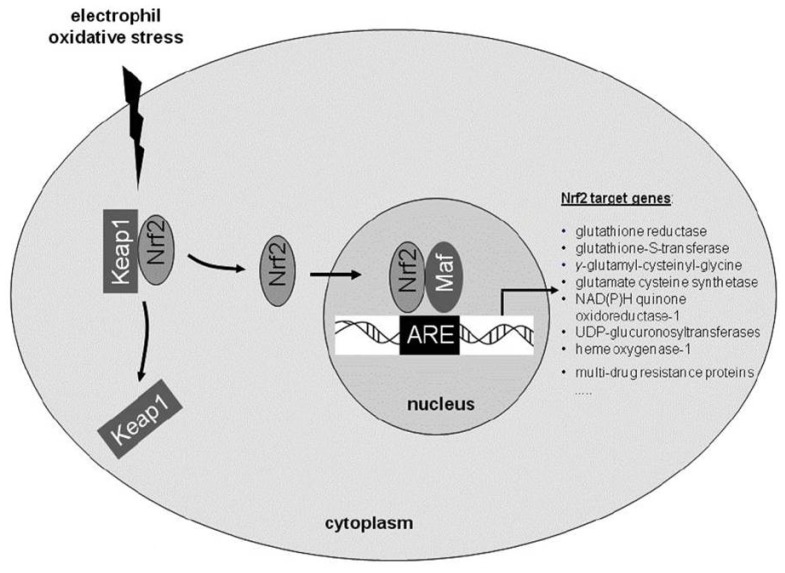
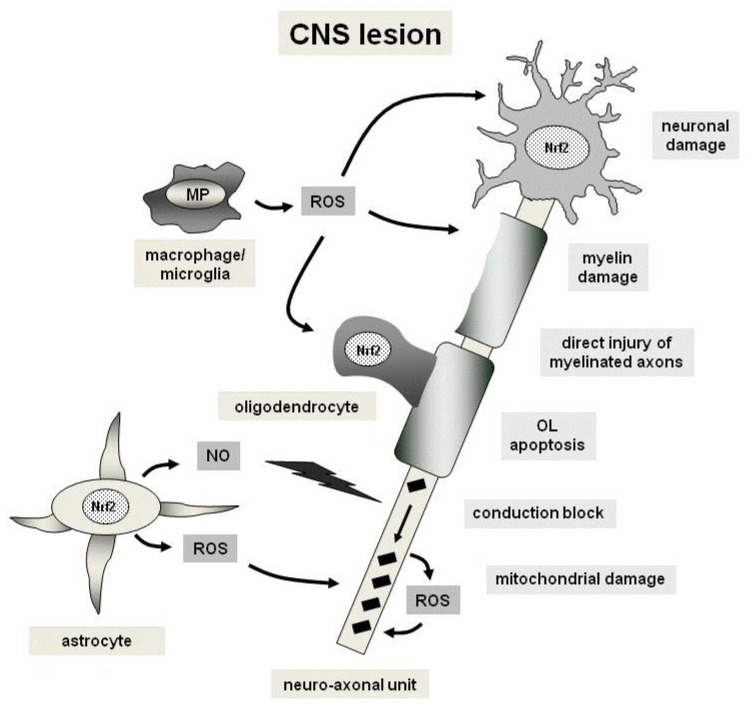
Oxidative stress plays a crucial role in many neurodegenerative conditions such as Alzheimer's disease, amyotrophic lateral sclerosis and Parkinson's as well as Huntington's disease. Inflammation and oxidative stress are also thought to promote tissue damage in multiple sclerosis (MS). Recent data point at an important role of anti-oxidative pathways for tissue protection in chronic-progressive MS, particularly involving the transcription factor nuclear factor (erythroid-derived 2)-related factor 2 (Nrf2). Thus, novel therapeutics enhancing cellular resistance to free radicals could prove useful for MS treatment. Here, fumaric acid esters (FAE) are a new, orally available treatment option which had already been tested in phase II/III MS trials demonstrating beneficial effects on relapse rates and magnetic resonance imaging markers. In vitro, application of dimethylfumarate (DMF) leads to stabilization of Nrf2, activation of Nrf2-dependent transcriptional activity and abundant synthesis of detoxifying proteins. Furthermore, application of FAE involves direct modification of the inhibitor of Nrf2, Kelch-like ECH-associated protein 1. On cellular levels, the application of FAE enhances neuronal survival and protects astrocytes against oxidative stress. Increased levels of Nrf2 are detected in the central nervous system of DMF treated mice suffering from experimental autoimmune encephalomyelitis (EAE), an animal model of MS. In EAE, DMF ameliorates the disease course and improves preservation of myelin, axons and neurons. Finally, Nrf2 is also up-regulated in the spinal cord of autopsy specimens from untreated patients with MS, probably as part of a naturally occurring anti-oxidative response. In summary, oxidative stress and anti-oxidative pathways are important players in MS pathophysiology and constitute a promising target for future MS therapies like FAE.
氧化应激在许多神经退行性疾病中起着关键作用,如阿尔茨海默病、肌萎缩侧索硬化症、帕金森病以及亨廷顿病。炎症和氧化应激也被认为会促进多发性硬化症(MS)中的组织损伤。最近的数据表明抗氧化途径在慢性进展性MS的组织保护中起重要作用,特别是涉及转录因子核因子(红系衍生2)相关因子2(Nrf2)。因此,增强细胞对自由基抗性的新型疗法可能对MS治疗有用。在这里,富马酸酯(FAE)是一种新的口服可用治疗选择,已在II/III期MS试验中进行了测试,证明对复发率和磁共振成像标志物有有益影响。在体外,富马酸二甲酯(DMF)的应用导致Nrf2稳定,Nrf2依赖性转录活性激活以及解毒蛋白的大量合成。此外,FAE的应用涉及对Nrf2抑制剂 Kelch样ECH相关蛋白1的直接修饰。在细胞水平上,FAE的应用可提高神经元存活率并保护星形胶质细胞免受氧化应激。在患有实验性自身免疫性脑脊髓炎(EAE,MS的动物模型)的DMF处理小鼠的中枢神经系统中检测到Nrf2水平升高。在EAE中,DMF改善疾病进程并改善髓鞘、轴突和神经元的保存。最后,在未经治疗的MS患者尸检标本的脊髓中Nrf2也上调,这可能是自然发生的抗氧化反应的一部分。总之,氧化应激和抗氧化途径是MS病理生理学中的重要因素,并构成了像FAE这样未来MS治疗的有希望的靶点。