Institute of Medical Microbiology and Hygiene, University of Tübingen, Tübingen, Germany.
Malar J. 2012 Oct 30;11:363. doi: 10.1186/1475-2875-11-363.
Plasmodium knowlesi malaria causes severe disease in up to 10% of cases in Malaysian Borneo and has a mortality rate of 1 - 2%. However, laboratory markers with the ability to identify patients at risk of developing complications have not yet been assessed as they have for other species of Plasmodium.
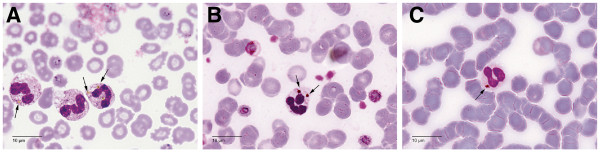
A case control study was undertaken in two hospitals in Sarikei and Sibu, Malaysian Borneo. One hundred and ten patients with uncomplicated (n = 93) and severe (n = 17) P. knowlesi malaria were studied. Standardized pigment-containing neutrophil (PCN) count, parasite density and platelet counts were determined and analysed by logistic regression and receiver operating characteristic (ROC) analysis.
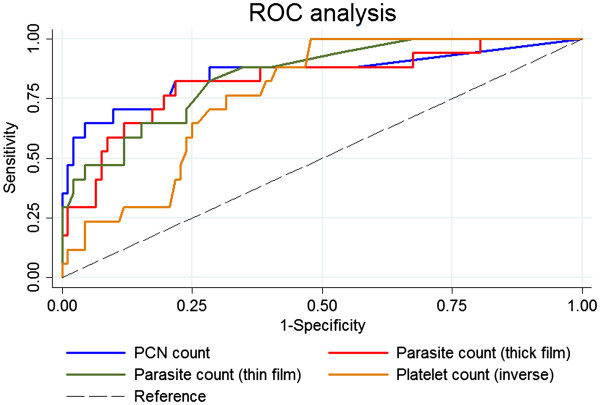
The PCN count was strongly associated with risk of disease severity. Patients with high parasite density (≥ 35,000/μl) or with thrombocytopaenia (≤ 45,000/μl) were also more likely to develop complications (odds ratio (OR) = 9.93 and OR = 5.27, respectively). The PCN count yielded the highest area under the ROC curve (AUC) estimate among all markers of severity (AUC = 0.8561, 95% confidence interval: 0.7328, 0.9794). However, the difference between all parameter AUC estimates was not statistically significant (Wald test, p = 0.73).
Counting PCN is labour-intensive and not superior in predicting severity over parasitaemia and platelet counts. Parasite and platelet counts are simpler tests with an acceptable degree of precision. Any adult patient diagnosed with P. knowlesi malaria and having a parasite count ≥ 35,000/μl or ≥ 1% or a platelet count ≤ 45,000/μl can be regarded at risk of developing complications and should be managed according to current WHO guidelines for the treatment of severe malaria.
在马来西亚婆罗洲,约 10%的间日疟原虫疟疾病例会引发严重疾病,死亡率为 1-2%。然而,目前尚未评估其他疟原虫物种所具有的能够识别发生并发症风险的实验室标志物。
在马来西亚婆罗洲的诗巫和泗里街的两家医院进行了一项病例对照研究。共研究了 110 例无并发症(n=93)和严重(n=17)间日疟原虫疟疾患者。通过逻辑回归和接收者操作特征(ROC)分析来测定并分析标准化含色素中性粒细胞(PCN)计数、寄生虫密度和血小板计数。
PCN 计数与疾病严重程度的风险密切相关。高寄生虫密度(≥35,000/μl)或血小板减少症(≤45,000/μl)的患者也更有可能发生并发症(比值比(OR)=9.93 和 OR=5.27)。PCN 计数在所有严重程度标志物中产生了最高的 ROC 曲线下面积(AUC)估计值(AUC=0.8561,95%置信区间:0.7328,0.9794)。然而,所有参数 AUC 估计值之间的差异无统计学意义(Wald 检验,p=0.73)。
计数 PCN 工作量大,在预测严重程度方面并不优于寄生虫计数和血小板计数。寄生虫和血小板计数是更简单的测试,具有可接受的精度。任何被诊断患有间日疟原虫疟疾的成年患者,若寄生虫计数≥35,000/μl 或≥1%,或血小板计数≤45,000/μl,都可能有发生并发症的风险,应根据世界卫生组织目前关于严重疟疾治疗的指南进行治疗。