• 文献检索
  • 文档翻译
  • 深度研究
  • 学术资讯
  • Suppr Zotero 插件Zotero 插件
  • 邀请有礼
  • 套餐&价格
  • 历史记录
应用&插件
Suppr Zotero 插件Zotero 插件浏览器插件Mac 客户端Windows 客户端微信小程序
定价
高级版会员购买积分包购买API积分包
服务
文献检索文档翻译深度研究API 文档MCP 服务
关于我们
关于 Suppr公司介绍联系我们用户协议隐私条款
关注我们

Suppr 超能文献

核心技术专利:CN118964589B侵权必究
粤ICP备2023148730 号-1Suppr @ 2026

文献检索

告别复杂PubMed语法,用中文像聊天一样搜索,搜遍4000万医学文献。AI智能推荐,让科研检索更轻松。

立即免费搜索

文件翻译

保留排版,准确专业,支持PDF/Word/PPT等文件格式,支持 12+语言互译。

免费翻译文档

深度研究

AI帮你快速写综述,25分钟生成高质量综述,智能提取关键信息,辅助科研写作。

立即免费体验

级联判别组织病理学中的正常、异常和混杂类别:前列腺癌 Gleason 分级。

Cascaded discrimination of normal, abnormal, and confounder classes in histopathology: Gleason grading of prostate cancer.

机构信息

Ibris, Inc., Monmouth Junction, New Jersey, USA.

出版信息

BMC Bioinformatics. 2012 Oct 30;13:282. doi: 10.1186/1471-2105-13-282.

DOI:10.1186/1471-2105-13-282
PMID:23110677
原文链接:https://pmc.ncbi.nlm.nih.gov/articles/PMC3563463/
Abstract

BACKGROUND

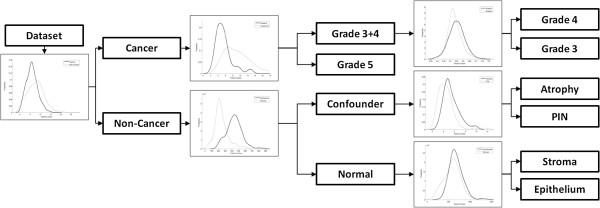
Automated classification of histopathology involves identification of multiple classes, including benign, cancerous, and confounder categories. The confounder tissue classes can often mimic and share attributes with both the diseased and normal tissue classes, and can be particularly difficult to identify, both manually and by automated classifiers. In the case of prostate cancer, they may be several confounding tissue types present in a biopsy sample, posing as major sources of diagnostic error for pathologists. Two common multi-class approaches are one-shot classification (OSC), where all classes are identified simultaneously, and one-versus-all (OVA), where a "target" class is distinguished from all "non-target" classes. OSC is typically unable to handle discrimination of classes of varying similarity (e.g. with images of prostate atrophy and high grade cancer), while OVA forces several heterogeneous classes into a single "non-target" class. In this work, we present a cascaded (CAS) approach to classifying prostate biopsy tissue samples, where images from different classes are grouped to maximize intra-group homogeneity while maximizing inter-group heterogeneity.

RESULTS

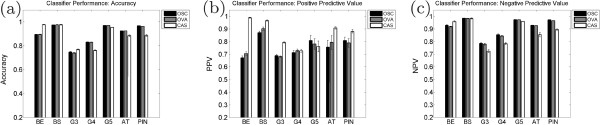
We apply the CAS approach to categorize 2000 tissue samples taken from 214 patient studies into seven classes: epithelium, stroma, atrophy, prostatic intraepithelial neoplasia (PIN), and prostate cancer Gleason grades 3, 4, and 5. A series of increasingly granular binary classifiers are used to split the different tissue classes until the images have been categorized into a single unique class. Our automatically-extracted image feature set includes architectural features based on location of the nuclei within the tissue sample as well as texture features extracted on a per-pixel level. The CAS strategy yields a positive predictive value (PPV) of 0.86 in classifying the 2000 tissue images into one of 7 classes, compared with the OVA (0.77 PPV) and OSC approaches (0.76 PPV).

CONCLUSIONS

Use of the CAS strategy increases the PPV for a multi-category classification system over two common alternative strategies. In classification problems such as histopathology, where multiple class groups exist with varying degrees of heterogeneity, the CAS system can intelligently assign class labels to objects by performing multiple binary classifications according to domain knowledge.

摘要

背景

组织病理学的自动分类涉及到多个类别的识别,包括良性、恶性和混杂类别。混杂组织类别通常可以模仿和共享与病变组织和正常组织类别的属性,并且无论是手动还是通过自动分类器都特别难以识别。在前列腺癌的情况下,活检样本中可能存在几种混杂组织类型,它们可能成为病理学家诊断错误的主要来源。两种常见的多类方法是一次性分类(OSC),其中所有类别同时被识别,以及一对多(OVA),其中一个“目标”类别与所有“非目标”类别区分开来。OSC 通常无法处理不同相似性类别的区分(例如,前列腺萎缩和高级别癌症的图像),而 OVA 则将几个异构类强制归入单个“非目标”类。在这项工作中,我们提出了一种级联(CAS)方法来对前列腺活检组织样本进行分类,其中来自不同类别的图像被分组以最大化组内同质性,同时最大化组间异质性。

结果

我们应用 CAS 方法将 214 项研究中的 2000 个组织样本分为七类:上皮、基质、萎缩、前列腺上皮内瘤变(PIN)和前列腺癌 Gleason 分级 3、4 和 5。一系列越来越细粒度的二进制分类器用于分割不同的组织类别,直到图像被分类为单个唯一类别。我们自动提取的图像特征集包括基于细胞核在组织样本中的位置的结构特征以及逐像素提取的纹理特征。与 OVA(0.77 PPV)和 OSC 方法(0.76 PPV)相比,CAS 策略在将 2000 个组织图像分类为 7 个类别之一时,产生了 0.86 的阳性预测值(PPV)。

结论

在组织病理学等多类别分类系统中,与两种常见的替代策略相比,使用 CAS 策略可以提高多类别分类系统的阳性预测值。在存在具有不同程度异质性的多个类别组的分类问题中,CAS 系统可以根据领域知识通过执行多次二进制分类来智能地为对象分配类别标签。
https://cdn.ncbi.nlm.nih.gov/pmc/blobs/9d82/3563463/da1e89826478/1471-2105-13-282-12.jpg
https://cdn.ncbi.nlm.nih.gov/pmc/blobs/9d82/3563463/88495edfe911/1471-2105-13-282-1.jpg
https://cdn.ncbi.nlm.nih.gov/pmc/blobs/9d82/3563463/8605bf8dd7a7/1471-2105-13-282-2.jpg
https://cdn.ncbi.nlm.nih.gov/pmc/blobs/9d82/3563463/65b00888a073/1471-2105-13-282-3.jpg
https://cdn.ncbi.nlm.nih.gov/pmc/blobs/9d82/3563463/9fc2a2878b5a/1471-2105-13-282-4.jpg
https://cdn.ncbi.nlm.nih.gov/pmc/blobs/9d82/3563463/6354278042d9/1471-2105-13-282-5.jpg
https://cdn.ncbi.nlm.nih.gov/pmc/blobs/9d82/3563463/3fbb282356cf/1471-2105-13-282-6.jpg
https://cdn.ncbi.nlm.nih.gov/pmc/blobs/9d82/3563463/0e8816d0e7b3/1471-2105-13-282-7.jpg
https://cdn.ncbi.nlm.nih.gov/pmc/blobs/9d82/3563463/38027618abca/1471-2105-13-282-8.jpg
https://cdn.ncbi.nlm.nih.gov/pmc/blobs/9d82/3563463/ddd68b4dd809/1471-2105-13-282-9.jpg
https://cdn.ncbi.nlm.nih.gov/pmc/blobs/9d82/3563463/15d6d3e3d148/1471-2105-13-282-10.jpg
https://cdn.ncbi.nlm.nih.gov/pmc/blobs/9d82/3563463/cbccc516f865/1471-2105-13-282-11.jpg
https://cdn.ncbi.nlm.nih.gov/pmc/blobs/9d82/3563463/da1e89826478/1471-2105-13-282-12.jpg
https://cdn.ncbi.nlm.nih.gov/pmc/blobs/9d82/3563463/88495edfe911/1471-2105-13-282-1.jpg
https://cdn.ncbi.nlm.nih.gov/pmc/blobs/9d82/3563463/8605bf8dd7a7/1471-2105-13-282-2.jpg
https://cdn.ncbi.nlm.nih.gov/pmc/blobs/9d82/3563463/65b00888a073/1471-2105-13-282-3.jpg
https://cdn.ncbi.nlm.nih.gov/pmc/blobs/9d82/3563463/9fc2a2878b5a/1471-2105-13-282-4.jpg
https://cdn.ncbi.nlm.nih.gov/pmc/blobs/9d82/3563463/6354278042d9/1471-2105-13-282-5.jpg
https://cdn.ncbi.nlm.nih.gov/pmc/blobs/9d82/3563463/3fbb282356cf/1471-2105-13-282-6.jpg
https://cdn.ncbi.nlm.nih.gov/pmc/blobs/9d82/3563463/0e8816d0e7b3/1471-2105-13-282-7.jpg
https://cdn.ncbi.nlm.nih.gov/pmc/blobs/9d82/3563463/38027618abca/1471-2105-13-282-8.jpg
https://cdn.ncbi.nlm.nih.gov/pmc/blobs/9d82/3563463/ddd68b4dd809/1471-2105-13-282-9.jpg
https://cdn.ncbi.nlm.nih.gov/pmc/blobs/9d82/3563463/15d6d3e3d148/1471-2105-13-282-10.jpg
https://cdn.ncbi.nlm.nih.gov/pmc/blobs/9d82/3563463/cbccc516f865/1471-2105-13-282-11.jpg
https://cdn.ncbi.nlm.nih.gov/pmc/blobs/9d82/3563463/da1e89826478/1471-2105-13-282-12.jpg

相似文献

1
Cascaded discrimination of normal, abnormal, and confounder classes in histopathology: Gleason grading of prostate cancer.级联判别组织病理学中的正常、异常和混杂类别:前列腺癌 Gleason 分级。
BMC Bioinformatics. 2012 Oct 30;13:282. doi: 10.1186/1471-2105-13-282.
2
Deep Learning-Based Gleason Grading of Prostate Cancer From Histopathology Images-Role of Multiscale Decision Aggregation and Data Augmentation.基于深度学习的前列腺癌组织病理图像 Gleason 分级——多尺度决策聚合和数据增强的作用。
IEEE J Biomed Health Inform. 2020 May;24(5):1413-1426. doi: 10.1109/JBHI.2019.2944643. Epub 2019 Sep 30.
3
Computerized Classification of Prostate Cancer Gleason Scores from Whole Slide Images.基于全切片图像的前列腺癌 Gleason 评分的计算机分类。
IEEE/ACM Trans Comput Biol Bioinform. 2020 Nov-Dec;17(6):1871-1882. doi: 10.1109/TCBB.2019.2941195. Epub 2020 Dec 8.
4
Comparison of Artificial Intelligence Techniques to Evaluate Performance of a Classifier for Automatic Grading of Prostate Cancer From Digitized Histopathologic Images.比较人工智能技术评估分类器在从数字化组织病理学图像自动分级前列腺癌方面的性能。
JAMA Netw Open. 2019 Mar 1;2(3):e190442. doi: 10.1001/jamanetworkopen.2019.0442.
5
Androgen receptor expression in prostatic intraepithelial neoplasia and cancer.雄激素受体在前列腺上皮内瘤变和癌中的表达。
J Urol. 1999 Apr;161(4):1229-32.
6
Current prostate biopsy interpretation: criteria for cancer, atypical small acinar proliferation, high-grade prostatic intraepithelial neoplasia, and use of immunostains.当前前列腺活检解读:癌症、非典型小腺泡增生、高级别前列腺上皮内瘤变的诊断标准及免疫组化染色的应用
Arch Pathol Lab Med. 2006 Jun;130(6):835-43. doi: 10.5858/2006-130-835-CPBICF.
7
Do not misinterpret intraductal carcinoma of the prostate as high-grade prostatic intraepithelial neoplasia!
Eur Urol. 2012 Sep;62(3):518-22. doi: 10.1016/j.eururo.2012.05.062. Epub 2012 Jun 5.
8
More advantages in detecting bone and soft tissue metastases from prostate cancer using F-PSMA PET/CT.使用F-PSMA PET/CT检测前列腺癌骨和软组织转移方面有更多优势。
Hell J Nucl Med. 2019 Jan-Apr;22(1):6-9. doi: 10.1967/s002449910952. Epub 2019 Mar 7.
9
Automatic grading of prostate cancer in digitized histopathology images: Learning from multiple experts.基于多位专家的学习:数字化组织病理学图像中前列腺癌的自动分级。
Med Image Anal. 2018 Dec;50:167-180. doi: 10.1016/j.media.2018.09.005. Epub 2018 Sep 24.
10
Histopathology reporting of prostate needle biopsies. 2005 update.前列腺穿刺活检的组织病理学报告。2005年更新版。
Virchows Arch. 2006 Jul;449(1):1-13. doi: 10.1007/s00428-006-0190-9. Epub 2006 Apr 22.

引用本文的文献

1
Effectiveness of ChatGPT 4.0 in Telemedicine-Based Management of Metastatic Prostate Carcinoma.ChatGPT 4.0在基于远程医疗的转移性前列腺癌管理中的有效性。
Diagnostics (Basel). 2024 Aug 29;14(17):1899. doi: 10.3390/diagnostics14171899.
2
Transfer Learning with Pretrained Convolutional Neural Network for Automated Gleason Grading of Prostate Cancer Tissue Microarrays.利用预训练卷积神经网络进行迁移学习以实现前列腺癌组织微阵列的自动Gleason分级
J Med Signals Sens. 2024 Feb 14;14:4. doi: 10.4103/jmss.jmss_42_22. eCollection 2024.
3
Computational pathology: A survey review and the way forward.

本文引用的文献

1
Adaptive Mixtures of Local Experts.局部专家的自适应混合模型
Neural Comput. 1991 Spring;3(1):79-87. doi: 10.1162/neco.1991.3.1.79.
2
Computer aided diagnostic tools aim to empower rather than replace pathologists: Lessons learned from computational chess.计算机辅助诊断工具旨在增强病理学家的能力而非取代他们:从计算机国际象棋中汲取的经验教训。
J Pathol Inform. 2011;2:25. doi: 10.4103/2153-3539.82050. Epub 2011 Jun 14.
3
Histopathological image analysis: a review.组织病理学图像分析:综述。
计算病理学:综述与未来发展方向
J Pathol Inform. 2024 Jan 14;15:100357. doi: 10.1016/j.jpi.2023.100357. eCollection 2024 Dec.
4
Artificial Intelligence for Clinical Diagnosis and Treatment of Prostate Cancer.用于前列腺癌临床诊断与治疗的人工智能
Cancers (Basel). 2022 Nov 14;14(22):5595. doi: 10.3390/cancers14225595.
5
Computer extracted gland features from H&E predicts prostate cancer recurrence comparably to a genomic companion diagnostic test: a large multi-site study.计算机从苏木精和伊红染色切片中提取的腺体特征预测前列腺癌复发的能力与基因组伴随诊断测试相当:一项大型多中心研究。
NPJ Precis Oncol. 2021 May 3;5(1):35. doi: 10.1038/s41698-021-00174-3.
6
Predicting Metastasis Risk in Pancreatic Neuroendocrine Tumors Using Deep Learning Image Analysis.使用深度学习图像分析预测胰腺神经内分泌肿瘤的转移风险
Front Oncol. 2021 Feb 25;10:593211. doi: 10.3389/fonc.2020.593211. eCollection 2020.
7
Deep Learning-Based Object Detection, Localisation and Tracking for Smart Wheelchair Healthcare Mobility.基于深度学习的智能轮椅医疗移动对象检测、定位与跟踪。
Int J Environ Res Public Health. 2020 Dec 24;18(1):91. doi: 10.3390/ijerph18010091.
8
Reimagining T Staging Through Artificial Intelligence and Machine Learning Image Processing Approaches in Digital Pathology.人工智能和机器学习图像处理方法在数字病理学中的 T 分期再构想。
JCO Clin Cancer Inform. 2020 Nov;4:1039-1050. doi: 10.1200/CCI.20.00110.
9
Combining texture features of whole slide images improves prognostic prediction of recurrence-free survival for cutaneous melanoma patients.整合全切片图像的纹理特征可改善皮肤黑色素瘤患者无复发生存预后的预测。
World J Surg Oncol. 2020 Jun 16;18(1):130. doi: 10.1186/s12957-020-01909-5.
10
Nuclear shape, architecture and orientation features from H&E images are able to predict recurrence in node-negative gastric adenocarcinoma.核的形状、结构和方位特征来自 H&E 图像,能够预测淋巴结阴性胃腺癌的复发。
J Transl Med. 2019 Mar 18;17(1):92. doi: 10.1186/s12967-019-1839-x.
IEEE Rev Biomed Eng. 2009;2:147-71. doi: 10.1109/RBME.2009.2034865. Epub 2009 Oct 30.
4
A boosted Bayesian multiresolution classifier for prostate cancer detection from digitized needle biopsies.基于提升贝叶斯多分辨率分类器的前列腺癌数字化针吸活检诊断
IEEE Trans Biomed Eng. 2012 May;59(5):1205-18. doi: 10.1109/TBME.2010.2053540. Epub 2010 Jun 21.
5
Integrated diagnostics: a conceptual framework with examples.整合诊断:概念框架及实例
Clin Chem Lab Med. 2010 Jul;48(7):989-98. doi: 10.1515/CCLM.2010.193.
6
Computerized image-based detection and grading of lymphocytic infiltration in HER2+ breast cancer histopathology.基于计算机的图像检测和分级 HER2+ 乳腺癌组织病理学中的淋巴细胞浸润。
IEEE Trans Biomed Eng. 2010 Mar;57(3):642-53. doi: 10.1109/TBME.2009.2035305. Epub 2009 Oct 30.
7
Improving accuracy in astrocytomas grading by integrating a robust least squares mapping driven support vector machine classifier into a two level grade classification scheme.通过将稳健最小二乘映射驱动的支持向量机分类器集成到两级分级分类方案中提高星形细胞瘤分级的准确性。
Comput Methods Programs Biomed. 2008 Jun;90(3):251-61. doi: 10.1016/j.cmpb.2008.01.006. Epub 2008 Mar 17.
8
Multifeature prostate cancer diagnosis and Gleason grading of histological images.组织学图像的多特征前列腺癌诊断与Gleason分级
IEEE Trans Med Imaging. 2007 Oct;26(10):1366-78. doi: 10.1109/TMI.2007.898536.
9
An image analysis approach for automatic malignancy determination of prostate pathological images.一种用于前列腺病理图像恶性肿瘤自动判定的图像分析方法。
Cytometry B Clin Cytom. 2007 Jul;72(4):227-40. doi: 10.1002/cyto.b.20162.
10
Prostate biopsy and optimization of cancer yield.前列腺活检与癌症检出率的优化。
Eur Urol. 2006 Mar;49(3):415-7. doi: 10.1016/j.eururo.2005.12.052. Epub 2006 Jan 18.