Vector Entomology Unit, Institute of Parasitology, Vetsuisse Faculty, University of Zürich, Winterthurerstrasse 266a, Zürich 8057, Switzerland.
Parasit Vectors. 2012 Oct 31;5:246. doi: 10.1186/1756-3305-5-246.
Culicoides biting midges are incriminated as biological vectors of a number of viruses, e.g. bluetongue virus. In order to define vector-free periods/areas and to assess the vectorial role of the various Culicoides species, a comprehensive knowledge on their spatio-temporal occurrence is required.
Biting midges were monitored on farm sites with livestock in the defined climatic regions, including high altitudes, of Switzerland by overnight trapping at 12 locations once a week over three years using UV-light traps. Based on morphological features, they were separated into three groups (i.e. Obsoletus, Pulicaris, other Culicoides spp.), and identification to the species level was achieved by protein profiling using MALDI-TOF mass spectrometry.
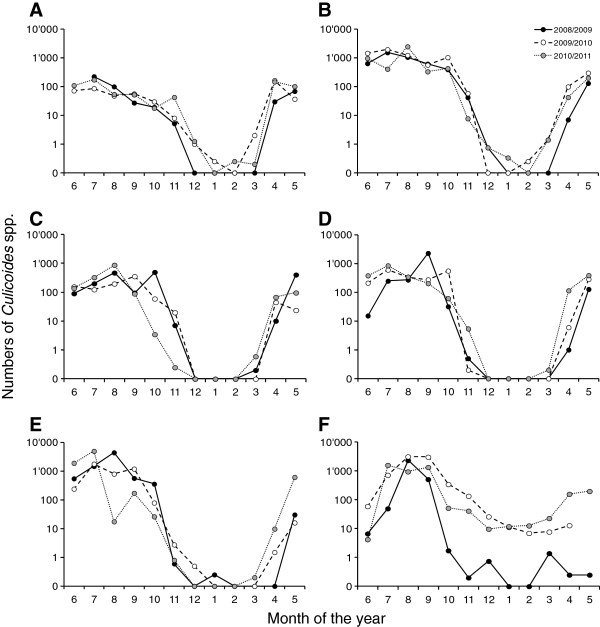
Around 550,000 biting midges in total were collected, revealing a dominance (82 to 99%) of the Obsoletus group species up to an altitude of 1,200 m and of the Pulicaris group species above 1,500 m (85% at the highest trapping site at 2,130 m). The maximum number of midges collected in a summer night (756 to 19,682) as well as the total number of midges caught over three years (from 6,933 to 149,439) varied highly among the sites, whereas the annual variation in total midge abundance at the locations was statistically insignificant. MALDI-TOF MS of 100 randomly selected individual biting midges per trapping site yielded high quality spectra for 1,187 of the 1,200 (98.9%) specimens of which 1,173 could be assigned to one of the 15 Culicoides species for which biomarker mass sets are available in the reference database.
There are no biting midge-free zones in all of the agriculturally utilized areas (including alpine summer pastures) of Switzerland. Annual variations of midge numbers at the sampled locations were low, indicating that monitoring of midges should preferably be done by investigating a large number of sites for one season instead of few locations for extended periods of time. High throughput species identification of midges by MALDI-TOF MS is feasible, and this technique adds to other recently developed methods for the identification of midges (PCRs in various formats, interactive identification keys), facilitating epidemiological and biological in-depth studies of these important insects.
致倦库蚊是多种病毒的生物传播媒介,如蓝舌病病毒。为了确定无媒介期/区,并评估各种库蠓的媒介作用,需要全面了解其时空发生情况。
在瑞士的定义气候区(包括高海拔地区)的牲畜养殖场点,通过每周一次在 12 个地点使用紫外线诱捕器进行夜间诱捕,在三年期间进行了蚊虫监测。根据形态特征,将它们分为三组(即:蠓属、库蠓属、其他库蠓属),并通过基质辅助激光解吸电离飞行时间质谱法(MALDI-TOF MS)进行蛋白分析来确定到种的水平。
总共收集了约 55 万只蚊虫,结果显示,在 1200 米以下的高度,Obsoletus 组的物种占主导地位(82%至 99%),在 1500 米以上的高度,Pulicaris 组的物种占主导地位(在海拔 2130 米的最高诱捕点占 85%)。夏季夜晚每夜采集的蚊虫数量最多(756 至 19682 只)以及三年间捕获的蚊虫总数(从 6933 至 149439 只)在各地点之间差异很大,而各地点的蚊虫总数年际变化在统计学上并不显著。对每个诱捕点随机选择的 100 只单个致倦库蚊进行 MALDI-TOF MS 分析,1200 个样本中的 1187 个(98.9%)获得了高质量的光谱,其中 1173 个可分配到 15 种库蠓之一,这些库蠓在参考数据库中都有生物标志物质量集。
在瑞士所有农业利用地区(包括高山夏季牧场)都没有无媒介蚊区。采样地点的蚊虫数量年度变化很小,这表明监测蚊虫最好通过对一个季节的大量地点进行调查,而不是对多个地点进行长时间的调查。MALDI-TOF MS 对蚊虫进行高通量种鉴定是可行的,并且该技术补充了其他最近开发的蚊虫鉴定方法(各种形式的 PCR、交互式鉴定键),有利于对这些重要昆虫进行流行病学和生物学的深入研究。