Immunization Unit, Robert Koch Institute, Berlin, Germany.
BMC Public Health. 2012 Oct 31;12:938. doi: 10.1186/1471-2458-12-938.
In Germany, annual vaccination against seasonal influenza is recommended for certain target groups (e.g. persons aged ≥60 years, chronically ill persons, healthcare workers (HCW)). In season 2009/10, vaccination against pandemic influenza A(H1N1)pdm09, which was controversially discussed in the public, was recommended for the whole population. The objectives of this study were to assess vaccination coverage for seasonal (seasons 2008/09-2010/11) and pandemic influenza (season 2009/10), to identify predictors of and barriers to pandemic vaccine uptake and whether the controversial discussions on pandemic vaccination has had a negative impact on seasonal influenza vaccine uptake in Germany.
We analysed data from the 'German Health Update' (GEDA10) telephone survey (n=22,050) and a smaller GEDA10-follow-up survey (n=2,493), which were both representative of the general population aged ≥18 years living in Germany.
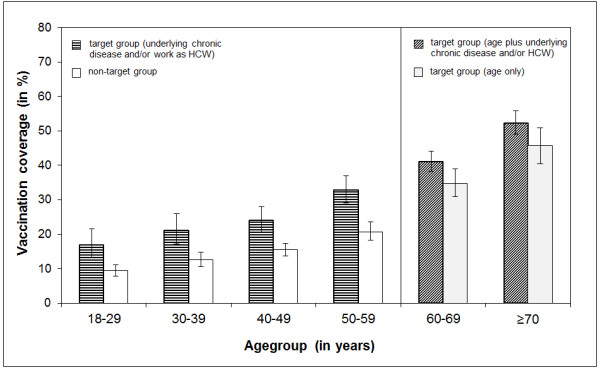
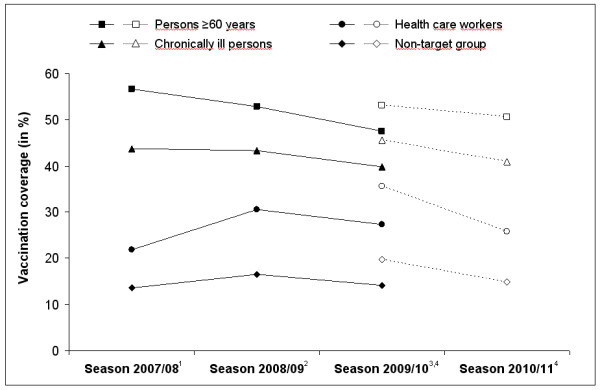
Overall only 8.8% of the adult population in Germany received a vaccination against pandemic influenza. High socioeconomic status, having received a seasonal influenza shot in the previous season, and belonging to a target group for seasonal influenza vaccination were independently associated with the uptake of pandemic vaccines. The main reasons for not receiving a pandemic vaccination were 'fear of side effects' and the opinion that 'vaccination was not necessary'. Seasonal influenza vaccine uptake in the pre-pandemic season 2008/09 was 52.8% among persons aged ≥60 years; 30.5% among HCW, and 43.3% among chronically ill persons. A decrease in vaccination coverage was observed across all target groups in the first post-pandemic season 2010/11 (50.6%, 25.8%, and 41.0% vaccination coverage, respectively).
Seasonal influenza vaccination coverage in Germany remains in all target groups below 75%, which is a declared goal of the European Union. Our results suggest that controversial public discussions about safety and the benefits of pandemic influenza vaccination may have contributed to both a very low uptake of pandemic vaccines and a decreased uptake of seasonal influenza vaccines in the first post-pandemic season. In the upcoming years, the uptake of seasonal influenza vaccines should be carefully monitored in all target groups to identify if this trend continues and to guide public health authorities in developing more effective vaccination and communication strategies for seasonal influenza vaccination.
在德国,建议为某些目标人群(如≥60 岁人群、慢性病患者、医护人员(HCW))接种季节性流感疫苗。在 2009/10 年流感季节,公众对大流行流感 A(H1N1)pdm09 疫苗的接种存在争议,该疫苗也被推荐用于全人群接种。本研究的目的是评估季节性流感(2008/09 年至 2010/11 年)和大流行流感(2009/10 年)疫苗的接种率,确定大流行流感疫苗接种的预测因素和障碍,以及公众对大流行流感疫苗接种的争议是否对德国季节性流感疫苗接种率产生负面影响。
我们分析了来自“德国健康更新”(GEDA10)电话调查(n=22050)和一项较小的 GEDA10 随访调查(n=2493)的数据,这两项调查均代表了居住在德国的≥18 岁的一般人群。
总体而言,德国只有 8.8%的成年人口接种了大流行流感疫苗。高社会经济地位、上一季接种季节性流感疫苗以及属于季节性流感疫苗接种目标人群,与大流行疫苗接种呈独立相关。未接种大流行疫苗的主要原因是“担心副作用”和“认为疫苗不必要”。在 2008/09 年的大流行前流感季节,≥60 岁人群中季节性流感疫苗接种率为 52.8%;医护人员为 30.5%;慢性病患者为 43.3%。在 2010/11 年第一个大流行后流感季节,所有目标人群的疫苗接种率均呈下降趋势(分别为 50.6%、25.8%和 41.0%)。
德国所有目标人群的季节性流感疫苗接种率仍低于 75%,这是欧盟的既定目标。我们的研究结果表明,公众对大流行流感疫苗的安全性和益处的争议可能导致大流行流感疫苗接种率非常低,并且在第一个大流行后流感季节季节性流感疫苗接种率下降。在未来几年,应在所有目标人群中仔细监测季节性流感疫苗的接种情况,以确定这种趋势是否持续,并为季节性流感疫苗接种指导公共卫生当局制定更有效的疫苗接种和沟通策略。