Chengdu Institute of Biology, Chinese Academy of Sciences, Chengdu, 610041, China.
BMC Genomics. 2012 Nov 1;13:588. doi: 10.1186/1471-2164-13-588.
Understanding how organisms adapt to high-elevation environments at a genome scale provides novel insights into the process of adaptive evolution. Previous studies have mainly focused on endothermic organisms, while poikilothermic species may have evolved different mechanisms to cope with high-elevation environments. In this context, we sequenced transcriptomes of a pair of closely related anuran species, Rana chensinensis and R. kukunoris, which inhabit respective low- and high-elevation habitats. By comparing the two transcriptomes, we identified candidate genes that may be involved in high-elevation adaption in poikilothermic species.
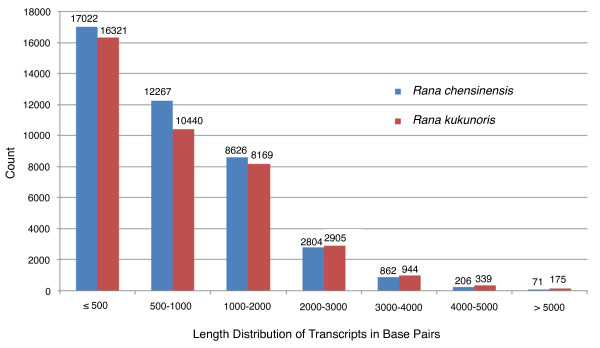
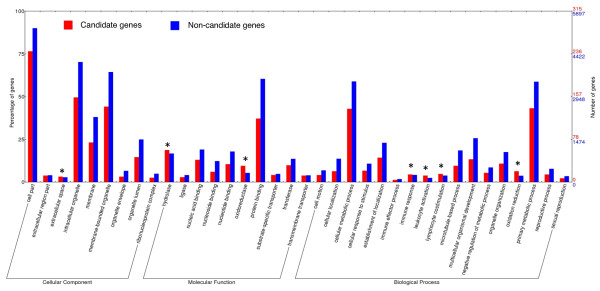
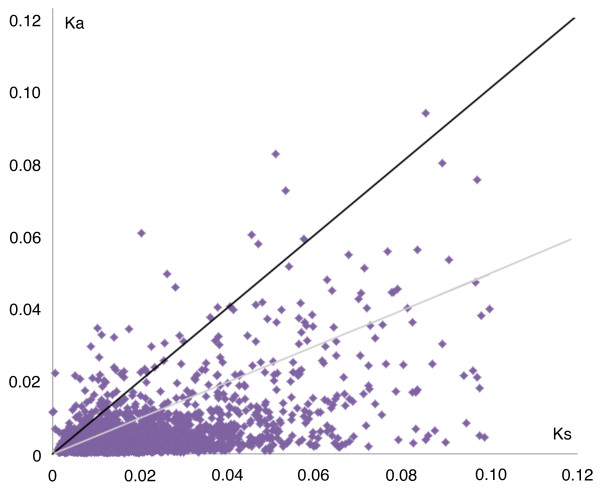
Over 66 million sequence reads from each transcriptome were generated. A total of 41,858 and 39,293 transcripts for each species were obtained by de novo assembly. By comparing the orthologous transcripts, we identified 125 protein-coding genes that have likely experienced strong positive selection (Ka/Ks>1). In addition, 335 genes that may bear a signature of positive selection (1≥Ka/Ks>0.5) were also recognized. By considering their functions, fourteen candidate genes were determined to be likely involved in high-elevation adaptation, including two CYP genes, USP-1, and several others.
We identified a set of candidate genes that may have promoted adaptation of R. kukunoris to its high-elevation environment. These include several genes that have previously been associated with oxygen binding, response to UV radiation, and repair of free radical injury. Detailed molecular, physiological, and phenotypic studies are required to better understand the roles of these genes in improving the performance of R. kukunoris in a high-elevation environment. We have evidence for both convergent and divergent evolution between endothermic and poikilothemic species, but additional research across a wide range of organisms will be necessary to comprehend the complexity of high-elevation adaptation.
从基因组尺度理解生物体如何适应高海拔环境,为适应性进化的过程提供了新的见解。以前的研究主要集中在内温动物上,而变温动物可能已经进化出不同的机制来应对高海拔环境。在这种情况下,我们对栖息在低海拔和高海拔生境中的一对亲缘关系密切的蛙类物种,中华大蟾蜍和华西雨蛙,进行了转录组测序。通过比较这两个转录组,我们鉴定出了可能参与变温动物高海拔适应的候选基因。
从每个转录组中生成了超过 6600 万个序列读段。通过从头组装,每个物种分别获得了 41858 和 39293 个转录本。通过比较同源转录本,我们鉴定出了 125 个可能经历了强烈正选择(Ka/Ks>1)的蛋白质编码基因。此外,还识别出了 335 个可能具有正选择特征(1≥Ka/Ks>0.5)的基因。考虑到它们的功能,确定了 14 个候选基因可能参与了高海拔适应,包括两个 CYP 基因、USP-1 和其他几个基因。
我们鉴定出了一组候选基因,它们可能促进了华西雨蛙对其高海拔环境的适应。这些基因包括一些以前与氧结合、对紫外线辐射的反应以及自由基损伤修复有关的基因。详细的分子、生理和表型研究是必要的,以更好地理解这些基因在提高华西雨蛙在高海拔环境中的表现中的作用。我们有证据表明,内温动物和变温动物之间存在趋同进化和分歧进化,但需要对广泛的生物进行更多的研究,才能理解高海拔适应的复杂性。