Nanomedicine and Drug Delivery Laboratory, Department of Pharmaceutical Sciences, University of Colorado Anschutz Medical Campus, Aurora, Colorado, USA.
PLoS One. 2012;7(10):e48188. doi: 10.1371/journal.pone.0048188. Epub 2012 Oct 31.
To determine whether exposure of sodium fluorescein (NaF) to the choroid-retina region in the posterior segment of the eye is greater with suprachoroidal injection when compared to intravitreal and transscleral routes.
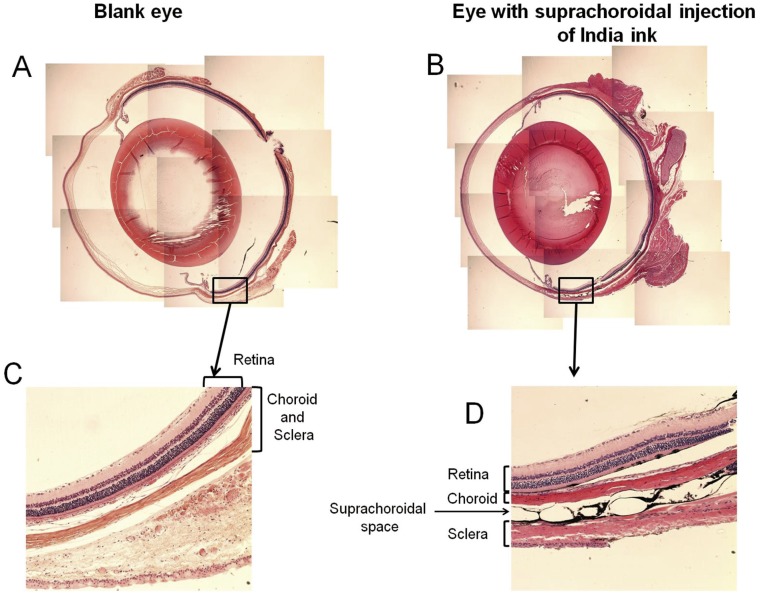
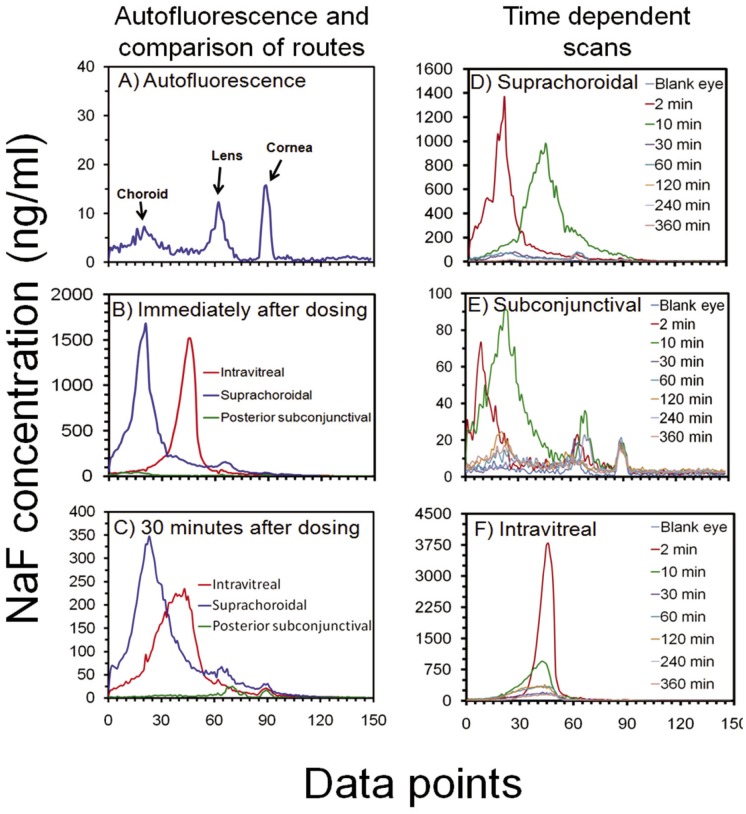
Suprachoroidal injection, a new approach for drug delivery to the posterior segment of the eye was validated using a 34 G needle and Indian ink injections in Sprague Dawley rats, followed by histology. Delivery of NaF was compared in Sprague Dawley rats after suprachoroidal, posterior subconjunctival, or intravitreal injections. NaF levels were monitored noninvasively up to 6 hours using Fluorotron Master™, an ocular fluorophotometer Pharmacokinetic parameters were estimated using WinNonlin.
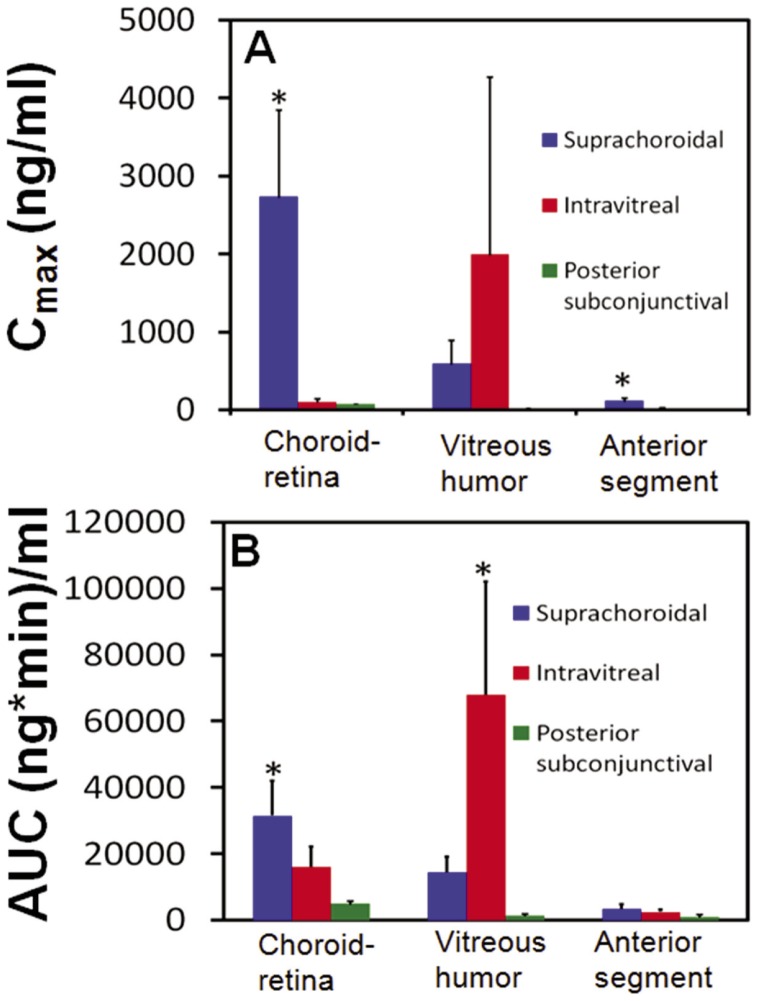
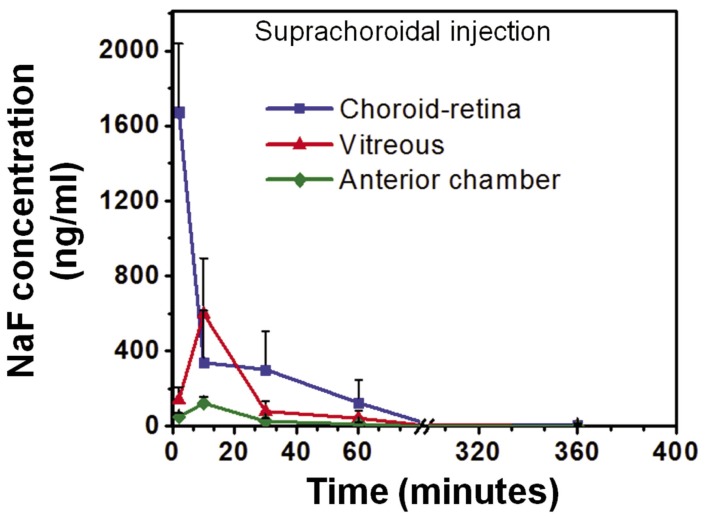
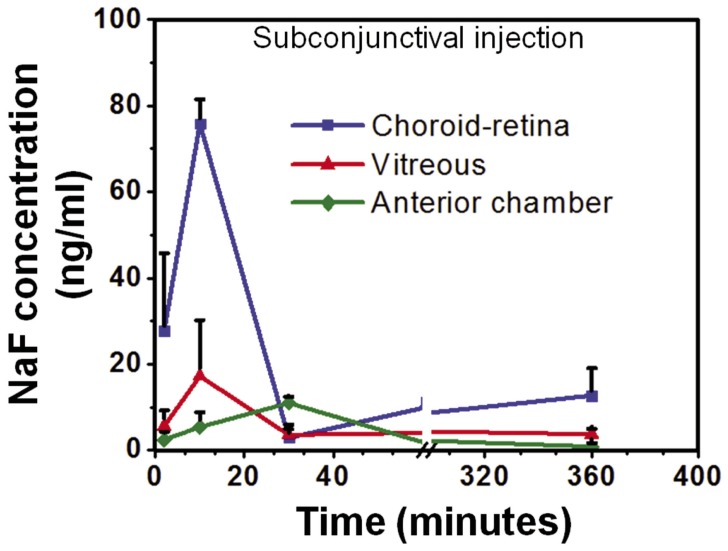
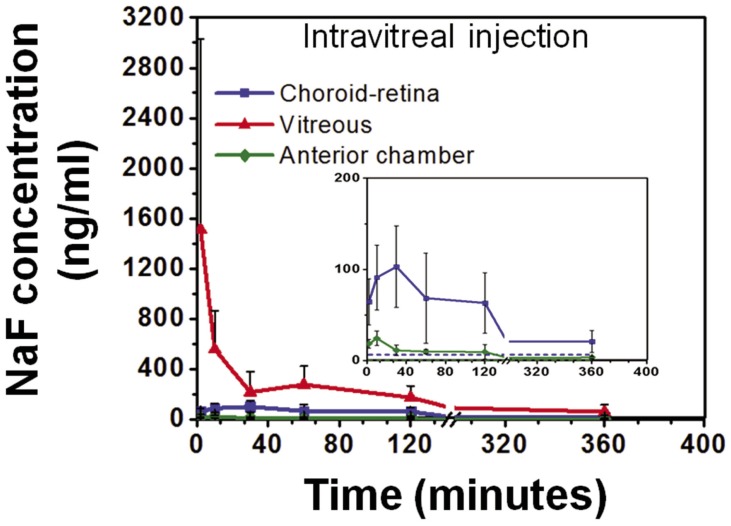
Histological analysis indicated localization of India ink to the suprachoroidal space below sclera, following injection. NaF delivery to choroid-retina was in the order: suprachoroidal > intravitreal >posterior subconjunctival injection. Peak NaF concentration (C(max)) in choroid-retina was 36-fold (p = 0.001) and 25-fold (p = 0.001) higher after suprachoroidal (2744±1111 ng/ml) injection when compared to posterior subconjunctival (76±6 ng/ml) and intravitreal (108±39 ng/ml) injections, respectively. NaF exposure (AUC(0-360min)) to choroid-retina after suprachoroidal injection was 6-fold (p = 0.001) and 2-fold (p = 0.03) higher than posterior subconjunctival and intravitreal injections, respectively. Choroid-retina T(max) was observed immediately after dosing with suprachoroidal injections and at 10 and 27.5 minutes, respectively, with subconjunctival and intravitreal injections.
Suprachoroidal injections are feasible in a rat model. Suprachoroidal injections resulted in the highest bioavailability, that is, the extent and rate of delivery of NaF to choroid-retina, when compared to intravitreal and posterior subconjunctival injections. Ocular fluorophotometry is useful for noninvasive monitoring of NaF in rats following administration by various routes including suprachoroidal route.
比较玻璃体内和巩膜隧道注射途径,确定与后段脉络膜视网膜相比,玻璃下注射时钠荧光素(NaF)暴露于脉络膜视网膜区域是否更大。
采用 34G 针头和印度墨水注射验证了一种新的眼后段药物输送方法-玻璃下注射,随后进行了组织学研究。在 Sprague Dawley 大鼠中比较了玻璃下、后结膜下或玻璃体内注射后 NaF 的递送。使用 Fluorotron MasterTM (一种眼部荧光光度计)在 6 小时内进行非侵入性监测,使用 WinNonlin 估算药代动力学参数。
组织学分析表明,注射后印度墨水定位于巩膜下的玻璃下间隙。脉络膜视网膜的 NaF 递呈顺序为:玻璃下>玻璃体内>后结膜下注射。玻璃下注射后脉络膜视网膜的 NaF 峰值浓度(C(max))高 36 倍(p=0.001)和 25 倍(p=0.001),分别为 2744±1111ng/ml)与后结膜下(76±6ng/ml)和玻璃体内(108±39ng/ml)注射相比。玻璃下注射后脉络膜视网膜的 NaF 暴露量(AUC(0-360min))高 6 倍(p=0.001)和 2 倍(p=0.03),分别与后结膜下和玻璃体内注射相比。玻璃下注射后即刻观察到脉络膜视网膜 T(max),而结膜下和玻璃体内注射分别在 10 分钟和 27.5 分钟观察到。
玻璃下注射在大鼠模型中是可行的。与玻璃体内和后结膜下注射相比,玻璃下注射导致 NaF 向脉络膜视网膜的生物利用度最高,即 NaF 向脉络膜视网膜的递送程度和速率最高。眼荧光光度法可用于通过各种途径(包括玻璃下途径)给药后在大鼠中对 NaF 进行非侵入性监测。