INRA, UMR 1332 Biologie du Fruit et Pathologie, Villenave d'Ornon, France.
PLoS One. 2012;7(10):e48606. doi: 10.1371/journal.pone.0048606. Epub 2012 Oct 31.
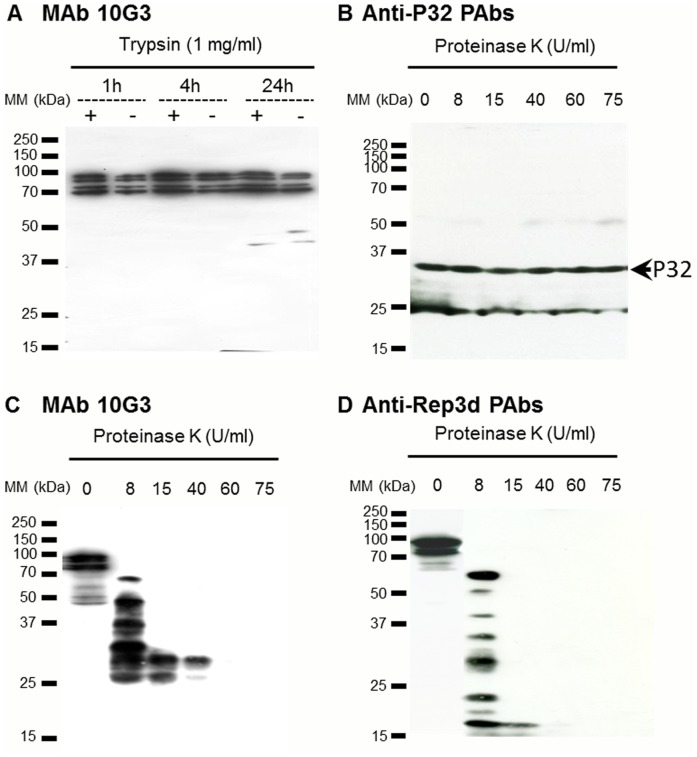
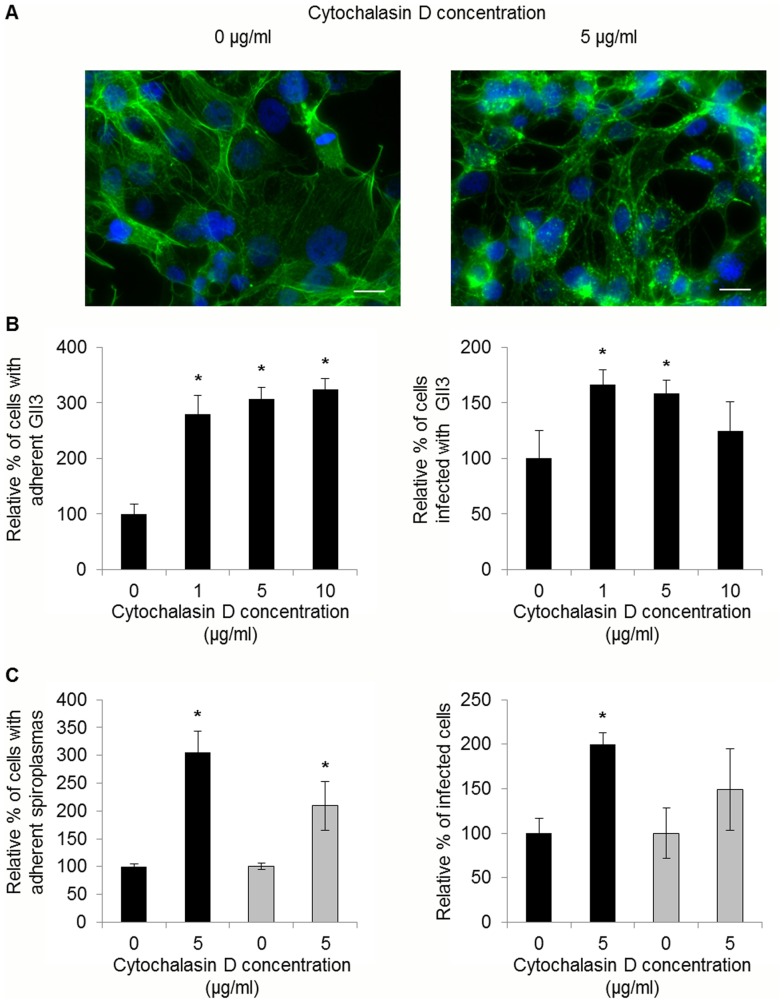
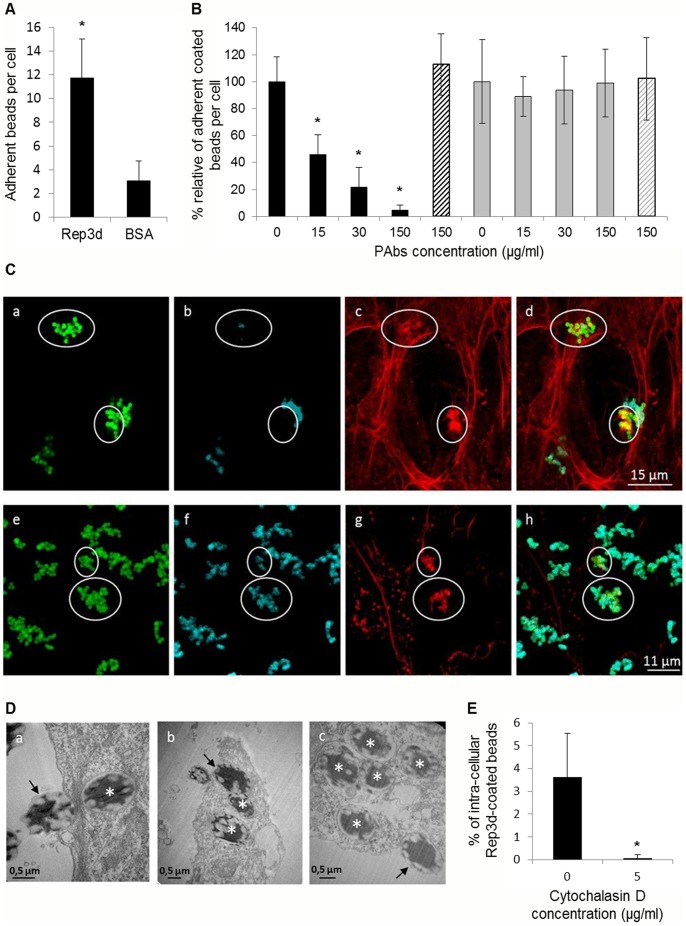
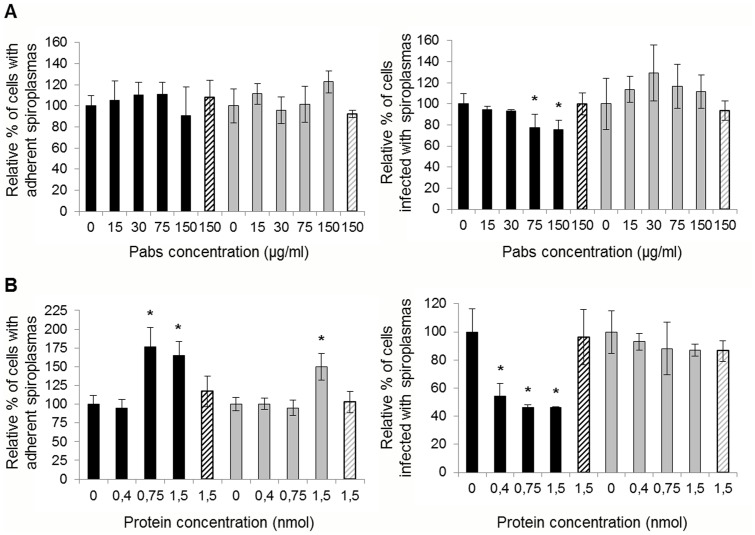
Spiroplasma citri is a plant pathogenic mollicute transmitted by the leafhopper vector Circulifer haematoceps. Successful transmission requires the spiroplasmas to cross the intestinal epithelium and salivary gland barriers through endocytosis mediated by receptor-ligand interactions. To characterize these interactions we studied the adhesion and invasion capabilities of a S. citri mutant using the Ciha-1 leafhopper cell line. S. citri GII3 wild-type contains 7 plasmids, 5 of which (pSci1 to 5) encode 8 related adhesins (ScARPs). As compared to the wild-type strain GII3, the S. citri mutant G/6 lacking pSci1 to 5 was affected in its ability to adhere and enter into the Ciha-1 cells. Proteolysis analyses, Triton X-114 partitioning and agglutination assays showed that the N-terminal part of ScARP3d, consisting of repeated sequences, was exposed to the spiroplasma surface whereas the C-terminal part was anchored into the membrane. Latex beads cytadherence assays showed the ScARP3d repeat domain (Rep3d) to be involved, and internalization of the Rep3d-coated beads to be actin-dependent. These data suggested that ScARP3d, via its Rep3d domain, was implicated in adhesion of S. citri GII3 to insect cells. Inhibition tests using anti-Rep3d antibodies and competitive assays with recombinant Rep3d both resulted in a decrease of insect cells invasion by the spiroplasmas. Unexpectedly, treatment of Ciha-1 cells with the actin polymerisation inhibitor cytochalasin D increased adhesion and consequently entry of S. citri GII3. For the ScARPs-less mutant G/6, only adhesion was enhanced though to a lesser extent following cytochalasin D treatment. All together these results strongly suggest a role of ScARPs, and particularly ScARP3d, in adhesion and invasion of the leafhopper cells by S. citri.
柑橘螺原体是一种植物病原柔膜体,通过叶蝉传播。成功的传播需要螺原体通过受体-配体相互作用介导的内吞作用穿过肠上皮和唾液腺屏障。为了表征这些相互作用,我们使用 Ciha-1 叶蝉细胞系研究了 S. citri GII3 突变体的粘附和入侵能力。S. citri GII3 野生型含有 7 个质粒,其中 5 个(pSci1 到 5)编码 8 种相关的粘附素(ScARPs)。与野生型菌株 GII3 相比,缺乏 pSci1 到 5 的 S. citri 突变体 G/6 在粘附和进入 Ciha-1 细胞的能力上受到影响。蛋白水解分析、Triton X-114 分配和凝集试验表明,ScARP3d 的 N 端由重复序列组成,暴露于螺原体表面,而 C 端则锚定在膜上。乳胶珠细胞粘附试验表明 ScARP3d 重复结构域(Rep3d)参与其中,Rep3d 包被的珠内吞作用依赖于肌动蛋白。这些数据表明,ScARP3d 通过其 Rep3d 结构域参与了 S. citri GII3 与昆虫细胞的粘附。使用抗 Rep3d 抗体的抑制试验和重组 Rep3d 的竞争试验均导致昆虫细胞被螺原体入侵减少。出乎意料的是,用肌动蛋白聚合抑制剂细胞松弛素 D 处理 Ciha-1 细胞会增强 S. citri GII3 的粘附,进而进入细胞。对于没有 ScARPs 的突变体 G/6,只有粘附作用增强,尽管在用细胞松弛素 D 处理后增强程度较小。所有这些结果都强烈表明 ScARPs,特别是 ScARP3d,在 S. citri 对叶蝉细胞的粘附和入侵中起作用。