Section of Microbiology, MRC Centre for Molecular Bacteriology and Infection, Imperial College London, Armstrong Road, London SW7 2AZ, UK.
Cell Microbiol. 2013 Mar;15(3):395-402. doi: 10.1111/cmi.12063. Epub 2012 Dec 2.
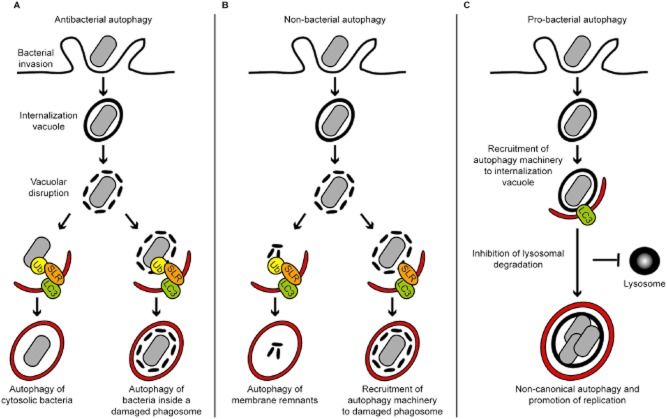
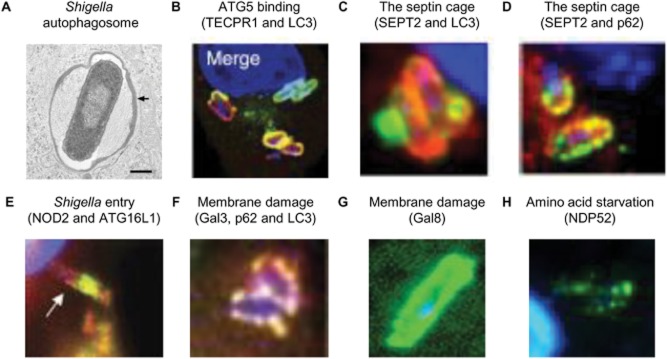
Autophagy, an intracellular degradation process highly conserved from yeast to humans, is viewed as an important defence mechanism to clear intracellular bacteria. However, recent work has shown that autophagy may have different roles during different bacterial infections that restrict bacterial replication (antibacterial autophagy), act in cell autonomous signalling (non-bacterial autophagy) or support bacterial replication (pro-bacterial autophagy). This review will focus on newfound interactions of autophagy and pathogenic bacteria, highlighting that, in addition to delivering bacteria to the lysosome, autophagy responding to bacterial invasion may have a much broader role in mediating disease outcome.
自噬是一种从酵母到人高度保守的细胞内降解过程,被认为是清除细胞内细菌的重要防御机制。然而,最近的研究表明,自噬在不同的细菌感染中可能具有不同的作用,限制细菌复制(抗菌自噬)、在细胞自主信号转导中发挥作用(非细菌自噬)或支持细菌复制(促细菌自噬)。本综述将重点介绍自噬与致病菌之间的新发现的相互作用,强调自噬对细菌入侵的反应除了将细菌递送到溶酶体之外,在介导疾病结局方面可能具有更广泛的作用。