Program in Cell Biology, The Hospital for Sick Children, Toronto, Ontario M5G1X8, Canada.
1] Program in Cell Biology, The Hospital for Sick Children, Toronto, Ontario M5G1X8, Canada. [2] Department of Molecular Genetics, University of Toronto, Toronto, Ontario M5S1A8, Canada. [3] Institute of Medical Science, University of Toronto, Toronto, Ontario M5S1A8, Canada.
Nat Rev Microbiol. 2014 Feb;12(2):101-14. doi: 10.1038/nrmicro3160. Epub 2014 Jan 2.
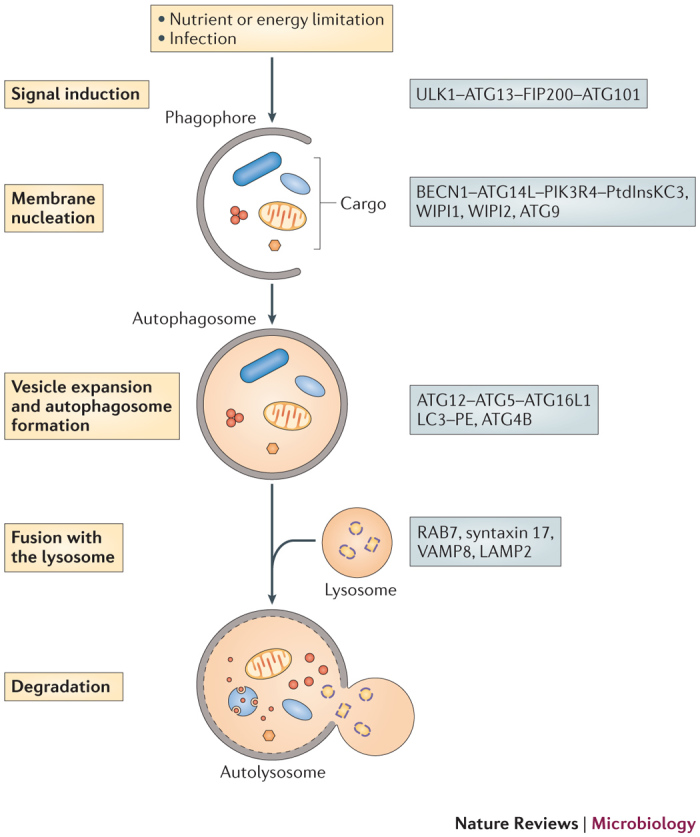
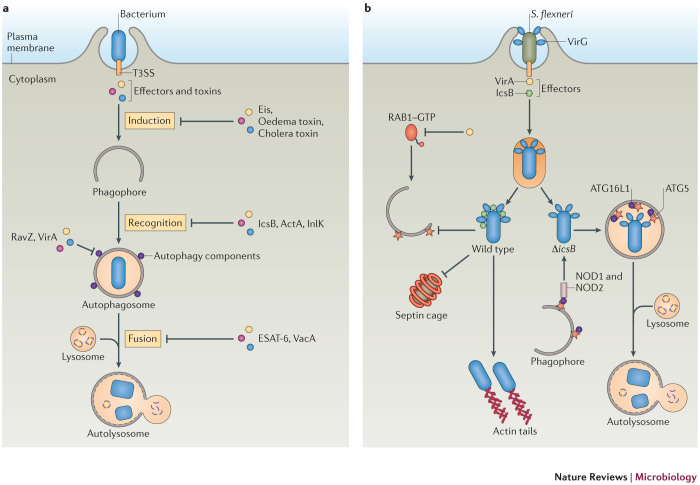
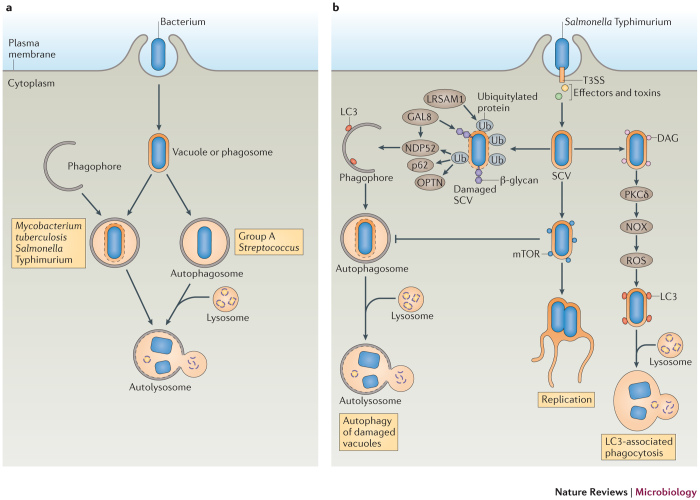
Autophagy is a cellular process that targets proteins, lipids and organelles to lysosomes for degradation, but it has also been shown to combat infection with various pathogenic bacteria. In turn, bacteria have developed diverse strategies to avoid autophagy by interfering with autophagy signalling or the autophagy machinery and, in some cases, they even exploit autophagy for their growth. In this Review, we discuss canonical and non-canonical autophagy pathways and our current knowledge of antibacterial autophagy, with a focus on the interplay between bacterial factors and autophagy components.
自噬是一种将蛋白质、脂质和细胞器靶向到溶酶体进行降解的细胞过程,但它也被证明可以抵抗各种致病性细菌的感染。反过来,细菌已经开发出多种策略来通过干扰自噬信号或自噬机制来避免自噬,在某些情况下,它们甚至利用自噬来促进自身生长。在这篇综述中,我们讨论了经典和非经典的自噬途径,以及我们目前对抗菌自噬的认识,重点是细菌因子和自噬成分之间的相互作用。