Thrombosis Research Unit, Aalborg University, Aalborg, Denmark.
BMJ. 2012 Nov 5;345:e7097. doi: 10.1136/bmj.e7097.
To do an indirect comparison analysis of apixaban against dabigatran etexilate (2 doses) and rivaroxaban (1 dose), as well as of rivaroxaban against dabigatranetexilate (2 doses), for their relative efficacy and safety against each other, with particular focus on the secondary prevention population for stroke prevention in atrial fibrillation. A secondary objective was to do the same analysis in the primary prevention cohort.
Indirect treatment comparisons of phase III clinical trials of stroke prevention in atrial fibrillation, with a focus on the secondary prevention cohorts. A secondary analysis was done on the primary prevention cohort.
Medline and Central (up to June 2012), clinical trials registers, conference proceedings, and websites of regulatory agencies.
Randomised controlled trials of rivaroxaban, dabigatran, or apixaban compared with warfarin for stroke prevention in atrial fibrillation.
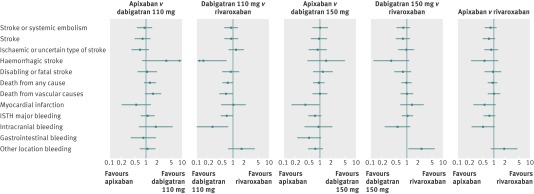
In the secondary prevention (previous stroke) subgroup, when apixaban was compared with dabigatran (110 mg and 150 mg twice daily) for efficacy and safety endpoints, the only significant difference seen was less myocardial infarction (hazard ratio 0.39, 95% confidence interval 0.16 to 0.95) with apixaban compared with dabigatran 150 mg twice daily. No significant differences were seen in efficacy and most safety endpoints between apixaban or dabigatran 150 mg twice daily versus rivaroxaban. Less haemorrhagic stroke (hazard ratio 0.15, 0.03 to 0.66), vascular death (0.64, 0.42 to 0.99), major bleeding (0.68, 0.47 to 0.99), and intracranial bleeding (0.27, 0.10 to 0.73) were seen with dabigatran 110 mg twice daily versus rivaroxaban. In the primary prevention (no previous stroke) subgroup, apixaban was superior to dabigatran 110 mg twice daily for disabling or fatal stroke (hazard ratio 0.59, 0.36 to 0.97). Compared with dabigatran 150 mg twice daily, apixaban was associated with more stroke (hazard ratio 1.45, 1.01 to 2.08) and with less major bleeding (0.75, 0.60 to 0.94), gastrointestinal bleeding (0.61, 0.42 to 0.89), and other location bleeding (0.74, 0.58 to 0.94). Compared with rivaroxaban, dabigatran 110 mg twice daily was associated with more myocardial infarction events. No significant differences were seen for the main efficacy and safety endpoints between dabigatran 150 mg twice daily and rivaroxaban, or in efficacy endpoints between apixaban and rivaroxaban. Apixaban was associated with less major bleeding (hazard ratio 0.61, 0.48 to 0.78) than rivaroxaban.
For secondary prevention, apixaban, rivaroxaban, and dabigatran had broadly similar efficacy for the main endpoints, although the endpoints of haemorrhagic stroke, vascular death, major bleeding, and intracranial bleeding were less common with dabigatran 110 mg twice daily than with rivaroxaban. For primary prevention, the three drugs showed some differences in relation to efficacy and bleeding. These results are hypothesis generating and should be confirmed in a head to head randomised trial.
通过间接比较分析,评估阿哌沙班相对于达比加群酯(2 种剂量)和利伐沙班(1 种剂量),以及利伐沙班相对于达比加群酯(2 种剂量)的相对疗效和安全性,重点关注心房颤动卒中预防的二级预防人群。次要目标是在初级预防队列中进行相同的分析。
对心房颤动卒中预防的 III 期临床试验进行间接治疗比较,重点关注二级预防队列。对初级预防队列进行了二次分析。
Medline 和 Central(截至 2012 年 6 月)、临床试验注册处、会议记录和监管机构的网站。
比较利伐沙班、达比加群或阿哌沙班与华法林在心房颤动卒中预防中的随机对照试验。
在二级预防(既往卒中)亚组中,当阿哌沙班与达比加群(110mg 和 150mg,每日 2 次)比较疗效和安全性终点时,与达比加群 150mg 每日 2 次相比,阿哌沙班唯一显著差异是心肌梗死发生率较低(风险比 0.39,95%置信区间 0.16 至 0.95)。与达比加群 150mg 每日 2 次相比,阿哌沙班或达比加群 150mg 每日 2 次与利伐沙班在疗效和大多数安全性终点方面无显著差异。与利伐沙班相比,达比加群 110mg 每日 2 次出血性卒中和血管性死亡发生率较低(风险比 0.15,0.03 至 0.66;0.64,0.42 至 0.99)、大出血发生率较低(风险比 0.68,0.47 至 0.99)、颅内出血发生率较低(风险比 0.27,0.10 至 0.73)。在初级预防(无既往卒中)亚组中,阿哌沙班在致残性或致死性卒中方面优于达比加群 110mg 每日 2 次(风险比 0.59,0.36 至 0.97)。与达比加群 150mg 每日 2 次相比,阿哌沙班与更多的卒中(风险比 1.45,1.01 至 2.08)和较少的大出血(风险比 0.75,0.60 至 0.94)、胃肠道出血(风险比 0.61,0.42 至 0.89)和其他部位出血(风险比 0.74,0.58 至 0.94)相关。与利伐沙班相比,达比加群 110mg 每日 2 次与更多的心肌梗死事件相关。达比加群 150mg 每日 2 次与利伐沙班或阿哌沙班与利伐沙班之间在主要疗效和安全性终点方面无显著差异,阿哌沙班与利伐沙班相比,大出血发生率较低(风险比 0.61,0.48 至 0.78)。
对于二级预防,阿哌沙班、利伐沙班和达比加群在主要终点方面具有相似的疗效,尽管出血性卒中和血管性死亡、大出血和颅内出血的终点在达比加群 110mg 每日 2 次治疗组中比利伐沙班更常见。对于初级预防,三种药物在疗效和出血方面存在一些差异。这些结果只是假设性的,需要在头对头随机试验中得到证实。
