Institute of Biogeochemistry and Pollutant Dynamics, ETH Zurich, Zurich, Switzerland.
PLoS Comput Biol. 2012;8(10):e1002735. doi: 10.1371/journal.pcbi.1002735. Epub 2012 Oct 25.
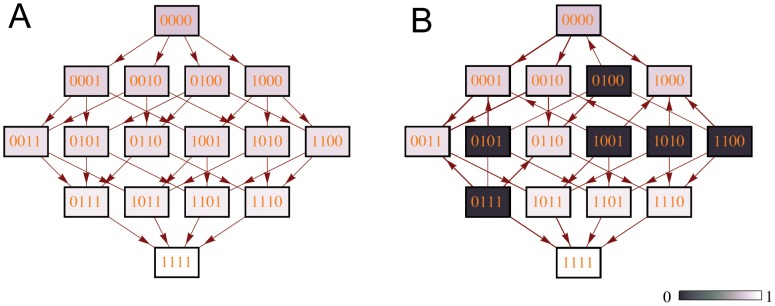
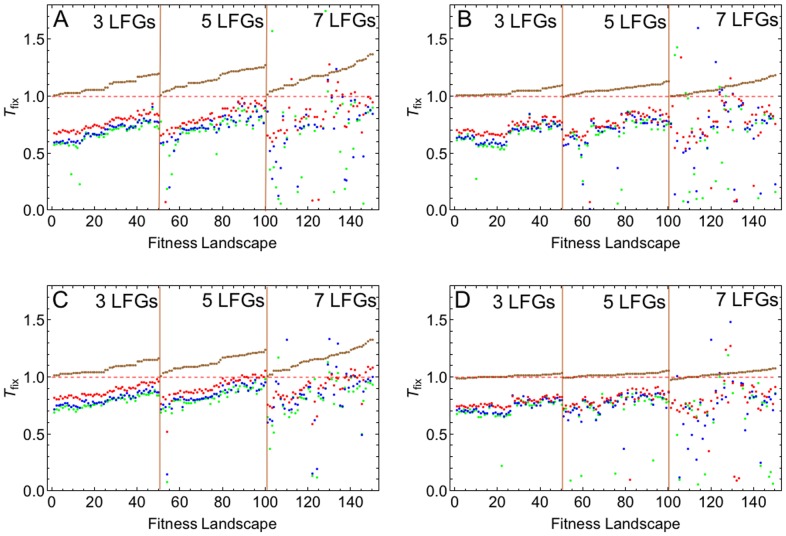
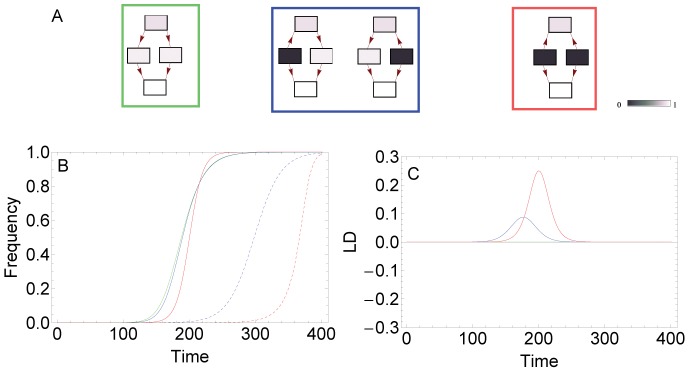
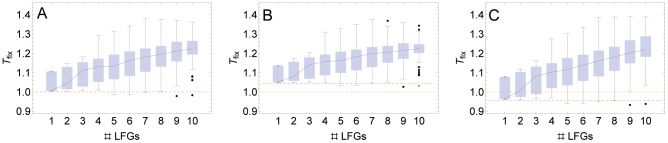
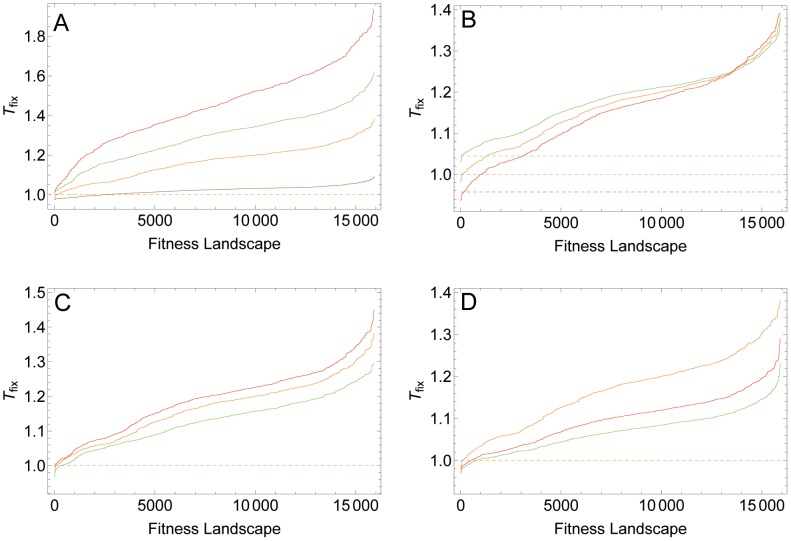
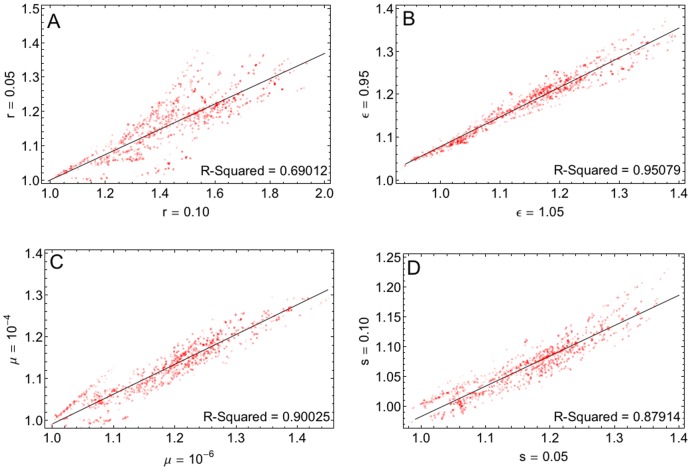
There is ample empirical evidence revealing that fitness landscapes are often complex: the fitness effect of a newly arisen mutation can depend strongly on the allelic state at other loci. However, little is known about the effects of recombination on adaptation on such fitness landscapes. Here, we investigate how recombination influences the rate of adaptation on a special type of complex fitness landscapes. On these landscapes, the mutational trajectories from the least to the most fit genotype are interrupted by genotypes with low relative fitness. We study the dynamics of adapting populations on landscapes with different compositions and numbers of low fitness genotypes, with and without recombination. Our results of the deterministic model (assuming an infinite population size) show that recombination generally decelerates adaptation on these landscapes. However, in finite populations, this deceleration is outweighed by the accelerating Fisher-Muller effect under certain conditions. We conclude that recombination has complex effects on adaptation that are highly dependent on the particular fitness landscape, population size and recombination rate.
有大量的经验证据表明,适应度景观通常是复杂的:新出现的突变的适应度效应可能强烈依赖于其他基因座的等位基因状态。然而,关于重组对这种适应度景观上的适应性的影响知之甚少。在这里,我们研究了重组如何影响特殊类型的复杂适应度景观上的适应速度。在这些景观上,从最适应到最适应的基因型的突变轨迹被相对适应度较低的基因型打断。我们研究了在具有不同组成和不同数量的低适应度基因型的景观上的适应种群的动力学,以及有无重组。我们的确定性模型(假设无限大的种群大小)的结果表明,重组通常会减缓这些景观上的适应性。然而,在有限的种群中,在某些条件下,重组的Fisher-Muller 效应的加速超过了这种减速。我们的结论是,重组对适应性的影响是复杂的,高度依赖于特定的适应度景观、种群大小和重组率。