Practice Support and Quality, British Columbia Medical Association,Vancouver, BC, Canada.
BMC Med Educ. 2012 Nov 9;12:110. doi: 10.1186/1472-6920-12-110.
An innovative program, the Practice Support Program (PSP), for full-service family physicians and their medical office assistants in primary care practices was recently introduced in British Columbia, Canada. The PSP was jointly approved by both government and physician groups, and is a dynamic, interactive, educational and supportive program that offers peer-to-peer training to physicians and their office staff. Topic areas range from clinical tools/skills to office management relevant to General Practitioner (GP) practices and "doable in real GP time". PSP learning modules consist of three half-day learning sessions interspersed with 6-8 week action periods. At the end of the third learning session, all participants were asked to complete a pen-and-paper survey that asked them to rate (a) their satisfaction with the learning module components, including the content and (b) the perceived impact the learning has had on their practices and patients.
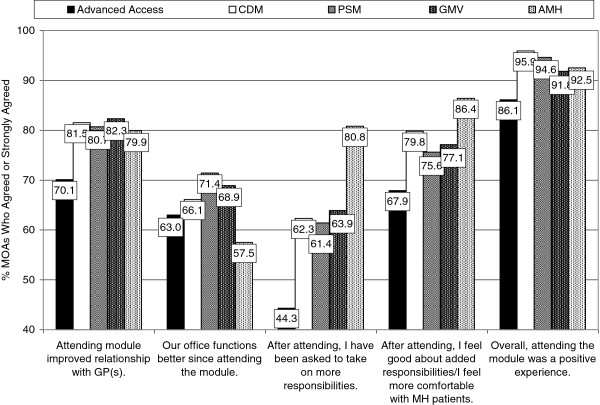
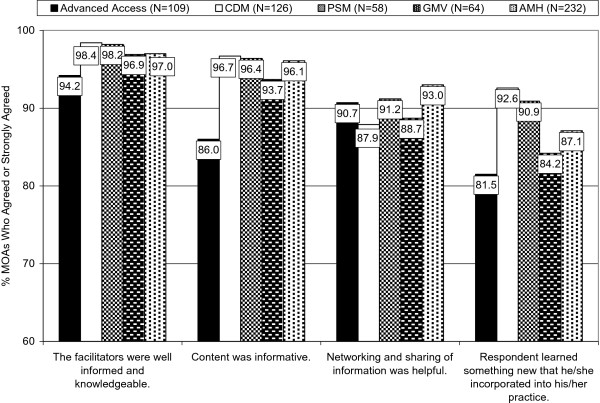
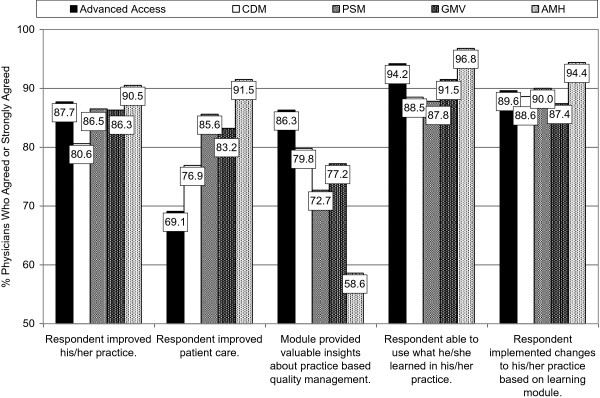
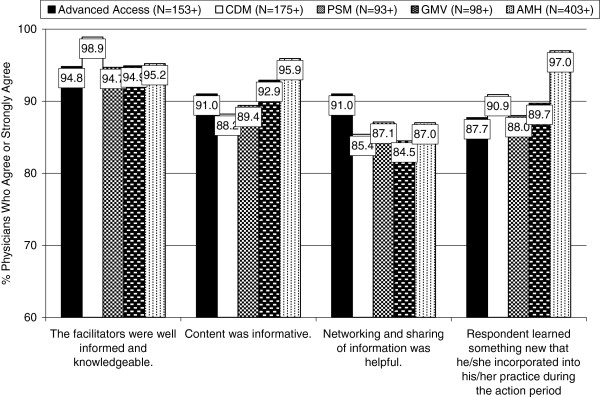
A total of 887 GPs (response rates ranging from 26.0% to 60.2% across three years) and 405 MOAs (response rates from 21.3% to 49.8%) provided responses on a pen-and-paper survey administered at the last learning session of the learning module. The survey asked respondents to rate (a) their satisfaction with the learning module components, including the content and (b) the perceived impact the learning has had on their practices and patients. The psychometric properties (Chronbach's alphas) of the satisfaction and impact scales ranged from .82 to .94.
Evaluation findings from the first three years of the PSP indicated consistently high satisfaction ratings and perceived impact on GP practices and patients, regardless of physician characteristics (gender, age group) or work-related variables (e.g., time worked in family practice). The Advanced Access Learning Module, which offers tools to improve office efficiencies, decreased wait times for urgent, regular and third next available appointments by an average of 1.2, 3.3, and by 3.4 days across all physicians. For the Chronic Disease Management module, over 87% of all GP respondents developed a CDM patient registry and reported being able to take better care of their patients. After attending the Adult Mental Health module: 94.1% of GPs agreed that they felt more comfortable helping patients who required mental health care; over 82% agreed that their skills and their confidence in diagnosing and treating mental health conditions had improved; and 41.0% agreed that their frequency of prescribing medications, if appropriate, had decreased. Additionally for the Adult Mental Health module, a 3-6 month follow-up survey of the GPs indicated that the implemented changes were sustained over time.
GP and medical office assistant participant ratings show that the PSP learning modules were consistently successful in providing GPs and their staff with new learning that was relevant and could be implemented and used in "real-GP-time".
在加拿大不列颠哥伦比亚省,最近推出了一项针对全科医生及其医疗办公室助理的创新计划——实践支持计划(PSP)。该计划得到了政府和医生团体的共同认可,是一个动态的、互动的、教育性的和支持性的项目,为医生及其办公室工作人员提供同行培训。主题领域从临床工具/技能到与全科医生实践相关的办公室管理,“在实际的全科医生时间内可行”。PSP 学习模块由三个半天的学习课程组成,穿插着 6-8 周的行动期。在第三次学习课程结束时,所有参与者都被要求完成一份纸笔调查,要求他们(a)对学习模块组件的满意度进行评分,包括内容,以及(b)对学习对其实践和患者的影响的感知程度进行评分。
共有 887 名全科医生(三年间的回复率从 26.0%到 60.2%不等)和 405 名医疗办公室助理(回复率从 21.3%到 49.8%不等)在学习模块的最后一次学习课程上对纸笔调查做出了回应。调查要求受访者对(a)学习模块组件的满意度进行评分,包括内容,以及(b)对学习对其实践和患者的影响的感知程度进行评分。满意度和影响量表的心理测量学特性(Chronbach's alphas)范围从.82 到.94。
PSP 前三年的评估结果表明,无论医生的特征(性别、年龄组)或工作相关变量(例如,在家庭实践中工作的时间)如何,满意度和对全科医生实践和患者的感知影响始终很高。高级访问学习模块提供了提高办公室效率的工具,将紧急、常规和第三个可预约的预约等待时间平均减少了 1.2、3.3 和 3.4 天。对于慢性疾病管理模块,超过 87%的全科医生建立了慢性疾病管理患者登记册,并报告说能够更好地照顾他们的患者。参加成人心理健康模块后:94.1%的全科医生表示他们更愿意帮助需要心理健康护理的患者;超过 82%的人同意他们的技能和诊断和治疗心理健康状况的信心有所提高;41.0%的人同意他们的药物处方频率(如果合适)有所降低。此外,对于成人心理健康模块,对全科医生进行了 3-6 个月的随访调查,结果表明实施的变革随着时间的推移得以持续。
全科医生和医疗办公室助理的参与者评分表明,PSP 学习模块始终成功地为全科医生及其工作人员提供了新的学习,这些学习是相关的,可以在“实际的全科医生时间”内实施和使用。