Granzier Jeroen J M, Gegenfurtner Karl R
Department of Psychology, University of Giessen, Otto-Behaghel-Straße 10F, 35394 Giessen, Germany; e-mail:
Iperception. 2012;3(3):190-215. doi: 10.1068/i0461. Epub 2012 Apr 17.
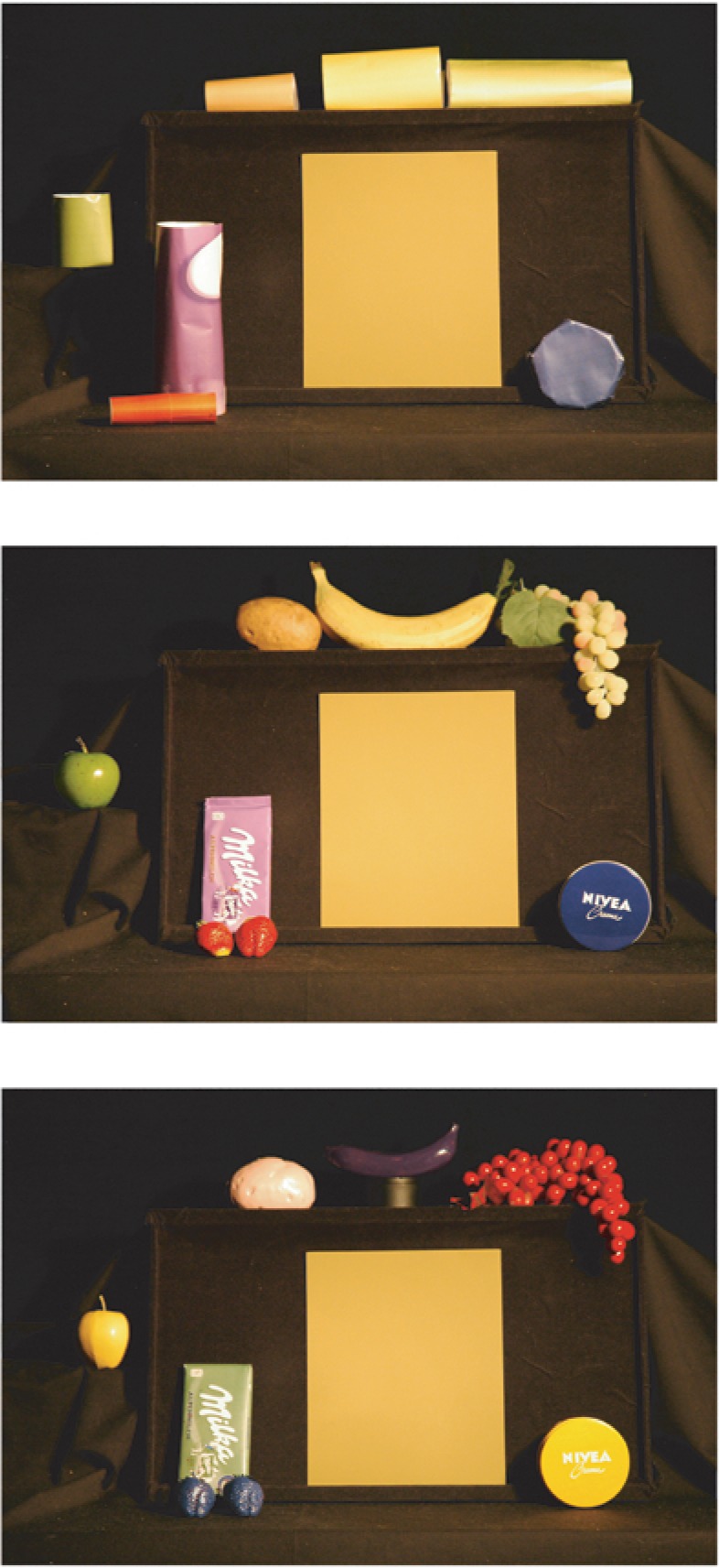
The perception of an object's colour remains constant despite large variations in the chromaticity of the illumination-colour constancy. Hering suggested that memory colours, the typical colours of objects, could help in estimating the illuminant's colour and therefore be an important factor in establishing colour constancy. Here we test whether the presence of objects with diagnostical colours (fruits, vegetables, etc) within a scene influence colour constancy for unknown coloured objects in the scene. Subjects matched one of four Munsell papers placed in a scene illuminated under either a reddish or a greenish lamp with the Munsell book of colour illuminated by a neutral lamp. The Munsell papers were embedded in four different scenes-one scene containing diagnostically coloured objects, one scene containing incongruent coloured objects, a third scene with geometrical objects of the same colour as the diagnostically coloured objects, and one scene containing non-diagnostically coloured objects (eg, a yellow coffee mug). All objects were placed against a black background. Colour constancy was on average significantly higher for the scene containing the diagnostically coloured objects compared with the other scenes tested. We conclude that the colours of familiar objects help in obtaining colour constancy for unknown objects.
尽管照明色度存在很大变化,物体颜色的感知仍保持恒定——颜色恒常性。赫林提出,记忆颜色,即物体的典型颜色,有助于估计光源的颜色,因此是建立颜色恒常性的一个重要因素。在此,我们测试场景中具有诊断性颜色的物体(水果、蔬菜等)的存在是否会影响场景中未知颜色物体的颜色恒常性。受试者将放置在红色或绿色灯光照明场景中的四张孟塞尔色纸之一,与由中性灯光照明的孟塞尔色卡进行匹配。孟塞尔色纸被嵌入四个不同的场景中——一个场景包含具有诊断性颜色的物体,一个场景包含不协调颜色的物体,第三个场景有与具有诊断性颜色的物体颜色相同的几何物体,还有一个场景包含非诊断性颜色的物体(例如一个黄色咖啡杯)。所有物体都放置在黑色背景上。与测试的其他场景相比,包含具有诊断性颜色物体的场景的颜色恒常性平均显著更高。我们得出结论,熟悉物体的颜色有助于获得未知物体的颜色恒常性。