Department of Life Sciences, National Cheng Kung University, Tainan, Taiwan.
BMC Genomics. 2012 Nov 16;13:631. doi: 10.1186/1471-2164-13-631.
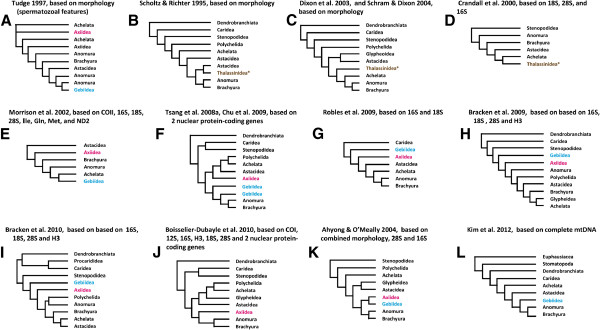
The evolutionary history and relationships of the mud shrimps (Crustacea: Decapoda: Gebiidea and Axiidea) are contentious, with previous attempts revealing mixed results. The mud shrimps were once classified in the infraorder Thalassinidea. Recent molecular phylogenetic analyses, however, suggest separation of the group into two individual infraorders, Gebiidea and Axiidea. Mitochondrial (mt) genome sequence and structure can be especially powerful in resolving higher systematic relationships that may offer new insights into the phylogeny of the mud shrimps and the other decapod infraorders, and test the hypothesis of dividing the mud shrimps into two infraorders.
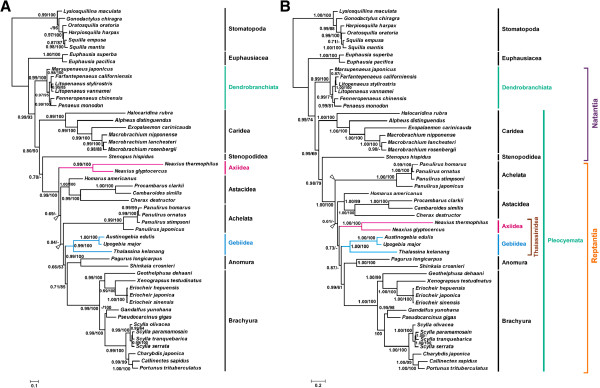
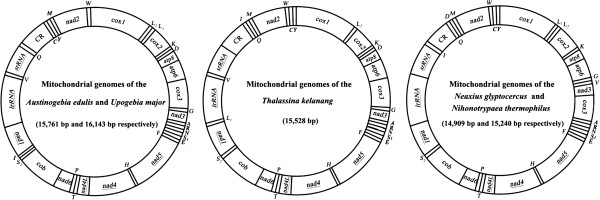
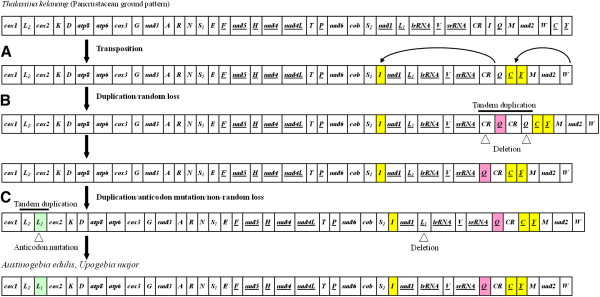
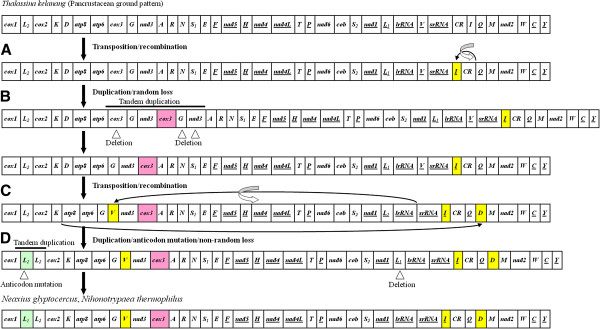
We present the complete mitochondrial genome sequences of five mud shrimps, Austinogebia edulis, Upogebia major, Thalassina kelanang (Gebiidea), Nihonotrypaea thermophilus and Neaxius glyptocercus (Axiidea). All five genomes encode a standard set of 13 protein-coding genes, two ribosomal RNA genes, 22 transfer RNA genes and a putative control region. Except for T. kelanang, mud shrimp mitochondrial genomes exhibited rearrangements and novel patterns compared to the pancrustacean ground pattern. Each of the two Gebiidea species (A. edulis and U. major) and two Axiidea species (N. glyptocercus and N. thermophiles) share unique gene order specific to their infraorders and analyses further suggest these two derived gene orders have evolved independently. Phylogenetic analyses based on the concatenated nucleotide and amino acid sequences of 13 protein-coding genes indicate the possible polyphyly of mud shrimps, supporting the division of the group into two infraorders. However, the infraordinal relationships among the Gebiidea and Axiidea, and other reptants are poorly resolved. The inclusion of mt genome from more taxa, in particular the reptant infraorders Polychelida and Glypheidea is required in further analysis.
Phylogenetic analyses on the mt genome sequences and the distinct gene orders provide further evidences for the divergence between the two mud shrimp infraorders, Gebiidea and Axiidea, corroborating previous molecular phylogeny and justifying their infraordinal status. Mitochondrial genome sequences appear to be promising markers for resolving phylogenetic issues concerning decapod crustaceans that warrant further investigations and our present study has also provided further information concerning the mt genome evolution of the Decapoda.
泥虾(甲壳纲:十足目:虾蛄目和腹胚目)的进化历史和关系存在争议,先前的尝试结果不一。泥虾曾被归类为短尾下目。然而,最近的分子系统发育分析表明,该组分为两个单独的亚目,即虾蛄目和腹胚目。线粒体(mt)基因组序列和结构在解决较高的系统关系方面特别有力,这可能为泥虾和其他十足目亚目的系统发育提供新的见解,并检验将泥虾分为两个亚目的假设。
我们展示了五种泥虾的完整线粒体基因组序列,即 Austinogebia edulis、Upogebia major、Thalassina kelanang(虾蛄目)、Nihonotrypaea thermophilus 和 Neaxius glyptocercus(腹胚目)。这五个基因组都编码了一套标准的 13 个蛋白质编码基因、两个核糖体 RNA 基因、22 个转移 RNA 基因和一个可能的控制区。除了 T. kelanang,与泛甲壳类的基本模式相比,泥虾的线粒体基因组显示出重排和新的模式。两个虾蛄目物种(A. edulis 和 U. major)和两个腹胚目物种(N. glyptocercus 和 N. thermophiles)各自具有独特的基因排列,这与它们的亚目有关,分析进一步表明这两个衍生的基因排列是独立进化的。基于 13 个蛋白质编码基因的核苷酸和氨基酸序列的联合分析表明,泥虾可能是多系的,支持将该组分为两个亚目。然而,虾蛄目和腹胚目以及其他爬行类动物的亚目关系解析度较差。进一步分析需要包括更多分类群的 mt 基因组,特别是爬行类的多螯目和 Glypheidea 目。
基于 mt 基因组序列和独特基因排列的系统发育分析为两个泥虾亚目,虾蛄目和腹胚目的分化提供了进一步的证据,证实了先前的分子系统发育,并证明了它们的亚目地位。线粒体基因组序列似乎是解决有关十足目甲壳类动物系统发育问题的有前途的标记,值得进一步研究,我们目前的研究也提供了有关十足目甲壳动物线粒体基因组进化的进一步信息。