1] Endocrinology and Genomics, Laval University, Québec City, Québec, Canada [2] Department of Nutrition, Laval University, Québec City, Québec, Canada.
Nutr Diabetes. 2012 Jan 30;2(1):e23. doi: 10.1038/nutd.2011.19.
Subcutaneous (SC) adipose tissue stearic acid (18:0) content and stearoyl-CoA desaturase-1 (SCD1)-mediated production of oleic acid (18:1) have been suggested to be altered in obesity. The objective of our study was to examine abdominal adipose tissue fatty acid content and SCD1 mRNA/protein level in women.
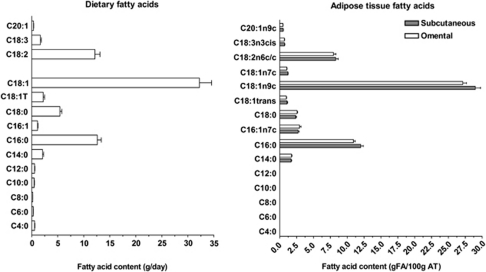
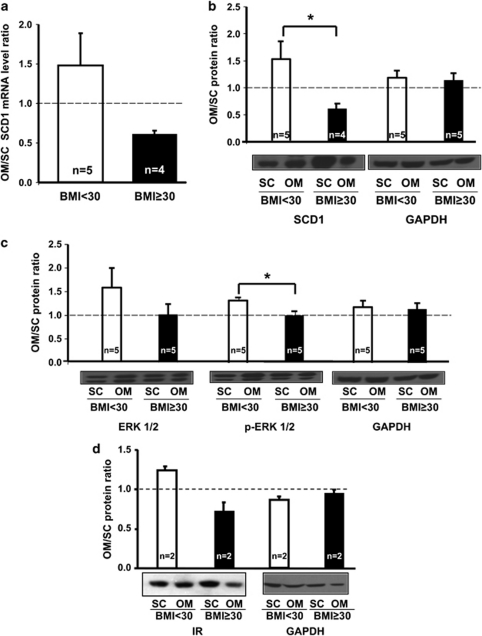
Fatty acid content was determined by capillary gas chromatography in SC and omental (OM) fat tissues from two subgroups of 10 women with either small or large OM adipocytes. Samples from 10 additional women were used to measure SCD1 mRNA and protein expression, total extracellular signal-regulated kinase 1/2 (ERK1/2) and phosphorylated ERK1/2 protein as well as insulin receptor (IR) expression levels.
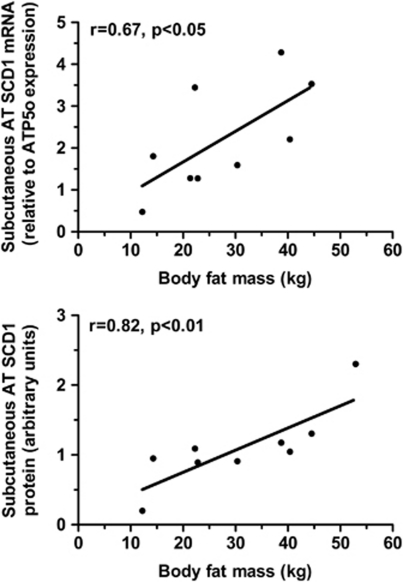
OM fat 18:0 content was significantly lower in women with large OM adipocytes compared with women who had similar adiposity, but small OM adipocytes (2.37±0.45 vs 2.75±0.30 mg per 100 g adipose tissue, respectively, P0.05). OM fat 18:0 content was negatively related to the visceral adipose tissue area (r=-0.44, P=0.05) and serum triglyceride levels (r=-0.56, P<0.05), while SC fat 18:0 content was negatively correlated with total body fat mass (BFM) (r=-0.48, P<0.05) and fasting insulin concentration (r=-0.73, P<0.005). SC adipose tissue desaturation index (18:1/18:0), SCD1 expression and protein levels were positively correlated with BFM. Moreover, obese women were characterized by a reduced OM/SC ratio of SCD1 mRNA and protein levels. A similar pattern was observed for ERK1/2 and IR expression.
The presence of large adipocytes and increased adipose mass in a given fat compartment is related to reduced 18:0 content and increased desaturation index in women, independently of dietary fat intake. The depot-specific difference in ERK1/2 expression and activation, as well as in SCD1 and IR expression in obese women is consistent with the hypothesis that they may predominantly develop SC fat, which could in turn help protect from metabolic disorders.
皮下(SC)脂肪组织硬脂酸(18:0)含量和硬脂酰辅酶 A 去饱和酶-1(SCD1)介导的油酸(18:1)生成已被认为在肥胖中发生改变。我们研究的目的是检测女性腹部脂肪组织的脂肪酸含量和 SCD1 mRNA/蛋白水平。
通过毛细管气相色谱法测定 SC 和网膜(OM)脂肪组织中脂肪酸的含量,该研究分为两个亚组,每组 10 名女性,其中 OM 脂肪细胞小或大。另外 10 名女性的样本用于测量 SCD1 mRNA 和蛋白表达、总细胞外信号调节激酶 1/2(ERK1/2)和磷酸化 ERK1/2 蛋白以及胰岛素受体(IR)表达水平。
与体脂相似但 OM 脂肪细胞较小的女性相比,OM 脂肪组织中的 18:0 含量明显较低(分别为 2.37±0.45 和 2.75±0.30mg/100g 脂肪组织,P<0.05)。OM 脂肪组织中的 18:0 含量与内脏脂肪组织面积呈负相关(r=-0.44,P=0.05)和血清甘油三酯水平(r=-0.56,P<0.05),而 SC 脂肪组织中的 18:0 含量与总身体脂肪量(BFM)(r=-0.48,P<0.05)和空腹胰岛素浓度(r=-0.73,P<0.005)呈负相关。SC 脂肪组织去饱和指数(18:1/18:0)、SCD1 表达和蛋白水平与 BFM 呈正相关。此外,肥胖女性的 OM/SC 比 SCD1 mRNA 和蛋白水平降低。ERK1/2 和 IR 表达也呈现出类似的模式。
在给定的脂肪组织中,大脂肪细胞的存在和脂肪量的增加与女性 18:0 含量的降低和去饱和指数的增加有关,这与饮食脂肪摄入无关。肥胖女性中 ERK1/2 表达和激活以及 SCD1 和 IR 表达的部位特异性差异与他们可能主要发展 SC 脂肪的假设一致,这反过来可能有助于预防代谢紊乱。