Physiology Department, Monash University, Clayton, Victoria, Australia.
PLoS One. 2012;7(11):e48577. doi: 10.1371/journal.pone.0048577. Epub 2012 Nov 14.
Recent studies on colour discrimination suggest that experience is an important factor in how a visual system processes spectral signals. In insects it has been shown that differential conditioning is important for processing fine colour discriminations. However, the visual system of many insects, including the honeybee, has a complex set of neural pathways, in which input from the long wavelength sensitive ('green') photoreceptor may be processed either as an independent achromatic signal or as part of a trichromatic opponent-colour system. Thus, a potential confound of colour learning in insects is the possibility that modulation of the 'green' photoreceptor could underlie observations.
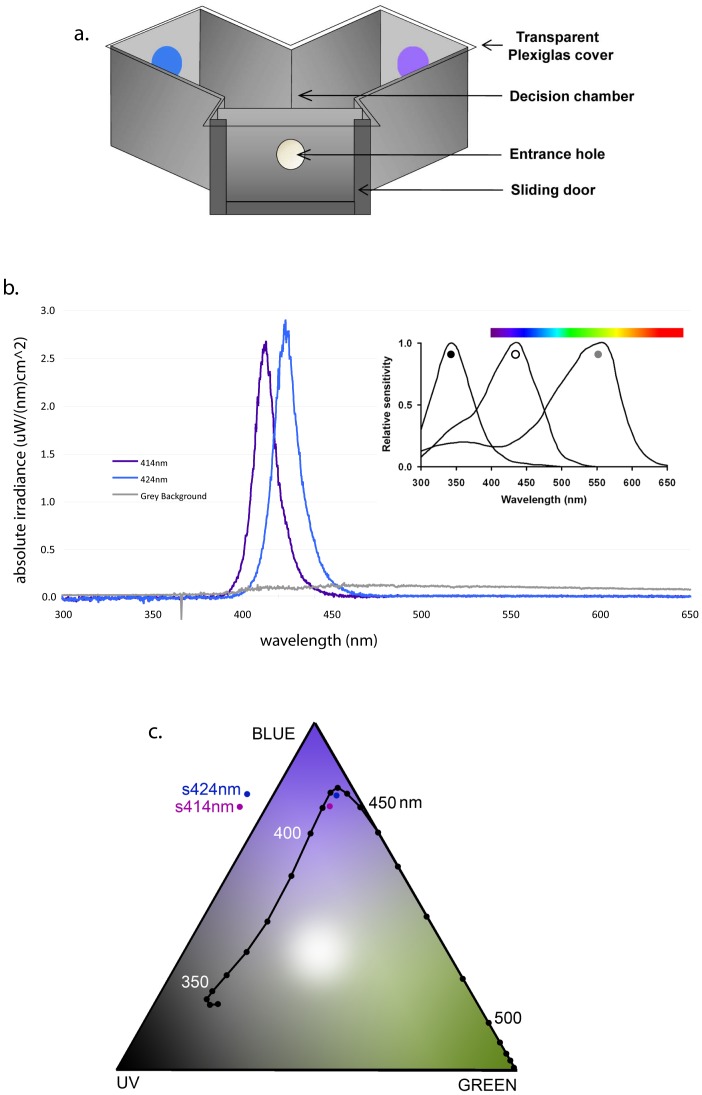
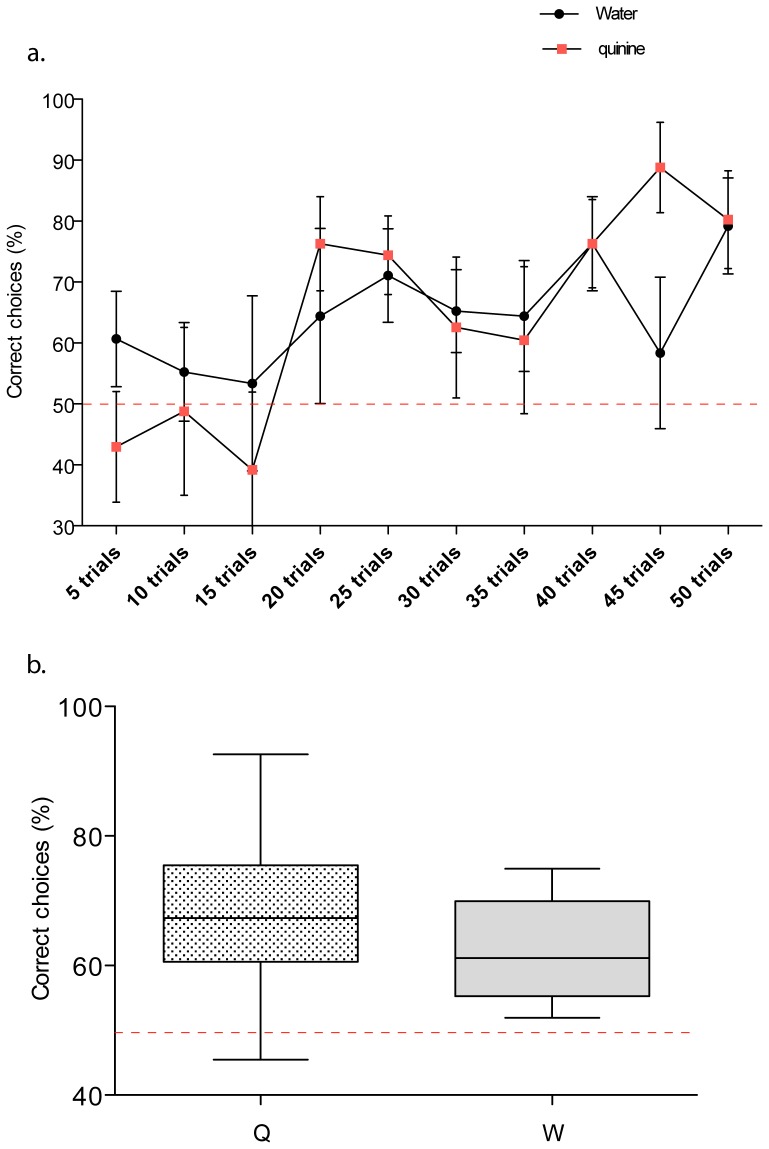
METHODOLOGY/PRINCIPAL FINDINGS: We tested honeybee vision using light emitting diodes centered on 414 and 424 nm wavelengths, which limit activation to the short-wavelength-sensitive ('UV') and medium-wavelength-sensitive ('blue') photoreceptors. The absolute irradiance spectra of stimuli was measured and modelled at both receptor and colour processing levels, and stimuli were then presented to the bees in a Y-maze at a large visual angle (26°), to ensure chromatic processing. Sixteen bees were trained over 50 trials, using either appetitive differential conditioning (N = 8), or aversive-appetitive differential conditioning (N = 8). In both cases the bees slowly learned to discriminate between the target and distractor with significantly better accuracy than would be expected by chance. Control experiments confirmed that changing stimulus intensity in transfers tests does not significantly affect bee performance, and it was possible to replicate previous findings that bees do not learn similar colour stimuli with absolute conditioning.
Our data indicate that honeybee colour vision can be tuned to relatively small spectral differences, independent of 'green' photoreceptor contrast and brightness cues. We thus show that colour vision is at least partly experience dependent, and behavioural plasticity plays an important role in how bees exploit colour information.
最近关于颜色辨别力的研究表明,经验是视觉系统处理光谱信号的重要因素。在昆虫中,已经表明差异条件作用对于精细颜色辨别力的处理很重要。然而,包括蜜蜂在内的许多昆虫的视觉系统具有一组复杂的神经通路,其中来自长波长敏感(“绿色”)光感受器的输入可以作为独立的非彩色信号处理,也可以作为三色对立色系统的一部分处理。因此,昆虫中颜色学习的一个潜在混杂因素是“绿色”光感受器的调制可能是观察结果的基础。
方法/主要发现:我们使用波长为 414 和 424nm 的发光二极管测试了蜜蜂的视觉,这些波长限制了对短波长敏感(“UV”)和中波长敏感(“蓝色”)光感受器的激活。刺激的绝对辐照度光谱在受体和颜色处理水平上进行了测量和建模,然后在 26°大视角的 Y 型迷宫中向蜜蜂呈现刺激,以确保颜色处理。使用奖赏性差异条件作用(N=8)或厌恶性-奖赏性差异条件作用(N=8),对 16 只蜜蜂进行了 50 次试验的训练。在这两种情况下,蜜蜂都缓慢地学会了区分目标和干扰物,准确性明显高于随机水平。对照实验证实,在转移测试中改变刺激强度不会显著影响蜜蜂的表现,并且可以复制以前的发现,即蜜蜂不会通过绝对条件作用学习相似的颜色刺激。
我们的数据表明,蜜蜂的颜色视觉可以调谐到相对较小的光谱差异,而不受“绿色”光感受器对比度和亮度线索的影响。因此,我们表明颜色视觉至少部分依赖于经验,行为可塑性在蜜蜂如何利用颜色信息方面起着重要作用。