
来自受唾液污染的固化粘结系统(单键)的不同去污程序的效果
Effect of different decontamination procedures from a saliva-contaminated cured bonding system (Single Bond).
作者信息
Darabi Farideh, Tavangar Maryam, Davalloo Reza
机构信息
Department of Operative Dentistry, Dental School, Guilan University of Medical Scinces, Rasht, Iran.
出版信息
Dent Res J (Isfahan). 2012 Jul;9(4):399-403.
BACKGROUND
A few studies have investigated the effect of saliva contamination of cured or uncured adhesive systems. The aim of this study was to compare the effect of different decontamination methods on the shear bond strength of composite to enamel and dentin using an adhesive contaminated after light activation.
MATERIALS AND METHODS
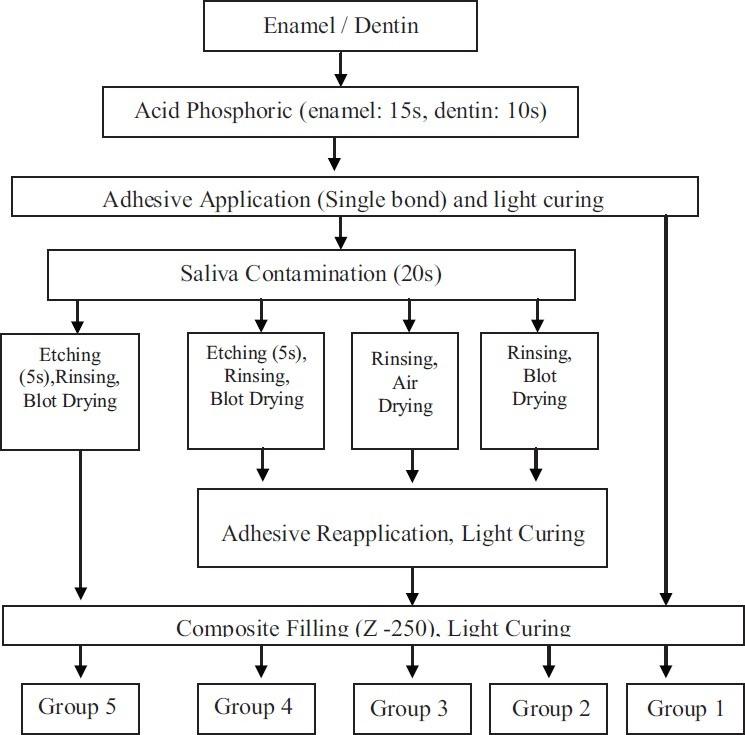
In this in vitro experimental study, 80 extracted sound human teeth, 40 premolars and 40 central incisors were selected for dentin and enamel specimen preparation. Within each of the two test groups, the teeth were randomly subdivided into five groups. The materials used consisted of single bond (3M) and Z250 (3M). Except group 1 (Control), in Groups 2-5, cured adhesive was contaminated with saliva (20 s). Decontaminating procedures were rinsing, blot-drying, rebonding (Group 2), rinsing, air-drying, rebonding (Group 3), etching, rinsing, blot-drying, rebonding (Group 4) and etching, rinsing, blot-drying (Group 5). Then, composite resin was inserted on the treated surfaces and cured. The results were subjected to one-way ANOVA and Tukey honestly significant difference (HSD) tests.
RESULTS
Group 5 (etching, rinsing, blot drying) resulted in significantly lower bond strength to both enamel and dentin surfaces in comparison with the other groups (P < 0.05).
CONCLUSION
When the adhesive was re-applied, all decontamination methods in this study seemed sufficient to decrease the adverse effect of saliva.
背景
一些研究调查了唾液污染对固化或未固化粘结系统的影响。本研究的目的是比较不同去污方法对光固化后被污染粘结剂与牙釉质和牙本质之间剪切粘结强度的影响。
材料与方法
在这项体外实验研究中,选取80颗拔除的健康人牙,40颗前磨牙和40颗中切牙用于制备牙本质和牙釉质标本。在两个测试组中的每一组内,牙齿被随机分为五组。使用的材料包括单键粘结剂(3M)和Z250树脂(3M)。除第1组(对照组)外,在第2 - 5组中,固化后的粘结剂被唾液污染(20秒)。去污程序为冲洗、吸干、重新粘结(第2组),冲洗、吹干、重新粘结(第3组),酸蚀、冲洗、吸干、重新粘结(第4组)以及酸蚀、冲洗、吸干(第5组)。然后,在处理过的表面上填入复合树脂并固化。结果进行单因素方差分析和Tukey真实显著差异(HSD)检验。
结果
与其他组相比,第5组(酸蚀、冲洗、吸干)导致与牙釉质和牙本质表面的粘结强度显著降低(P < 0.05)。
结论
当重新应用粘结剂时,本研究中的所有去污方法似乎都足以降低唾液的不利影响。
 Zotero 插件