• 文献检索
  • 文档翻译
  • 深度研究
  • 学术资讯
  • Suppr Zotero 插件Zotero 插件
  • 邀请有礼
  • 套餐&价格
  • 历史记录
应用&插件
Suppr Zotero 插件Zotero 插件浏览器插件Mac 客户端Windows 客户端微信小程序
定价
高级版会员购买积分包购买API积分包
服务
文献检索文档翻译深度研究API 文档MCP 服务
关于我们
关于 Suppr公司介绍联系我们用户协议隐私条款
关注我们

Suppr 超能文献

核心技术专利:CN118964589B侵权必究
粤ICP备2023148730 号-1Suppr @ 2026

文献检索

告别复杂PubMed语法,用中文像聊天一样搜索,搜遍4000万医学文献。AI智能推荐,让科研检索更轻松。

立即免费搜索

文件翻译

保留排版,准确专业,支持PDF/Word/PPT等文件格式,支持 12+语言互译。

免费翻译文档

深度研究

AI帮你快速写综述,25分钟生成高质量综述,智能提取关键信息,辅助科研写作。

立即免费体验

利用转基因小鼠模型研究垂体肿瘤转化基因 (PTTG) 的体内致瘤潜能,以及与 p53(+/-) 转基因小鼠杂交的影响。

Tumorigenic potential of pituitary tumor transforming gene (PTTG) in vivo investigated using a transgenic mouse model, and effects of cross breeding with p53 (+/-) transgenic mice.

机构信息

Department of Physiology and Biophysics, University of Louisville, 505 South Hancock Street, CTRB 322, Louisville, KY 40202, USA.

出版信息

BMC Cancer. 2012 Nov 20;12:532. doi: 10.1186/1471-2407-12-532.

DOI:10.1186/1471-2407-12-532
PMID:23164239
原文链接:https://pmc.ncbi.nlm.nih.gov/articles/PMC3530432/
Abstract

BACKGROUND

Pituitary tumor-transforming gene (PTTG) is an oncogene that is overexpressed in variety of tumors and exhibits characteristics of a transforming gene. Previous transgenic mouse models to access the tumorigenic potential in the pituitary and ovary have resulted in dysplasia without formation of visible tumors, possibly due to the insufficient expression of PTTG. PTTG expression level is critical for ovarian tumorigenesis in a xenograft model. Therefore, the tumorigenic function of PTTG in vivo remains unclear. We generated a transgenic mouse that overexpresses PTTG driven by the CMV promoter to determine whether PTTG functions as a transforming oncogene that is capable of initiating tumorigenesis.

METHODS

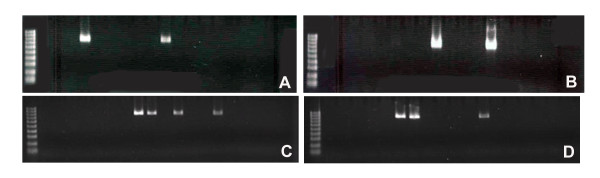
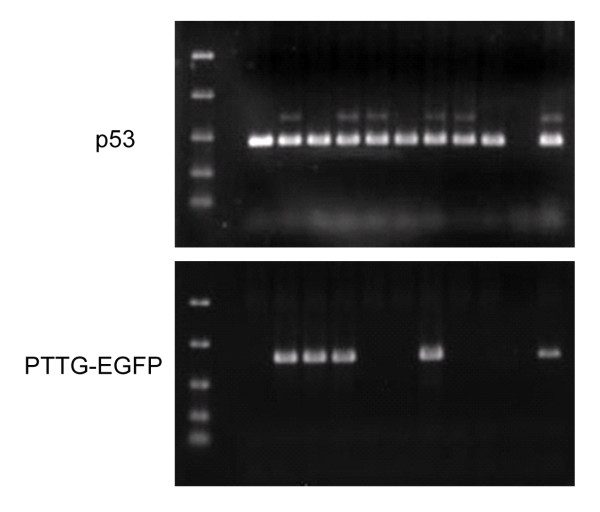
Transgenic animals were generated by microinjection of PTTG transgene into the male pronucleus of FVB 0.5 day old embryos. Expression levels of PTTG in tissues of transgenic animals were analyzed using an immunohistochemical analysis. H&E staining and immunohistostaining were performed to examine the type of tumor in transgenic and PTTG transgenic/p53+/- animals.

RESULTS

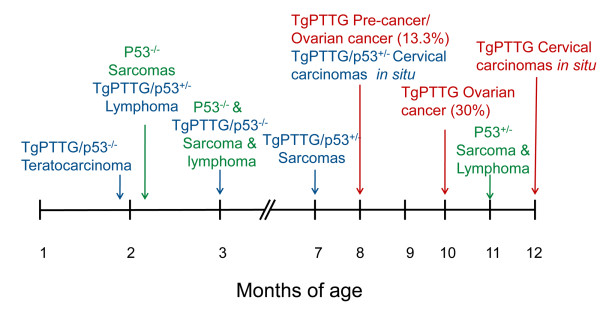
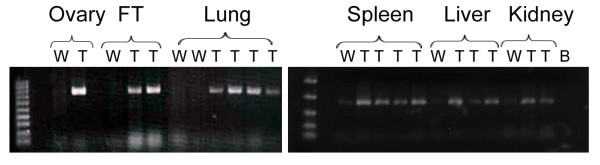
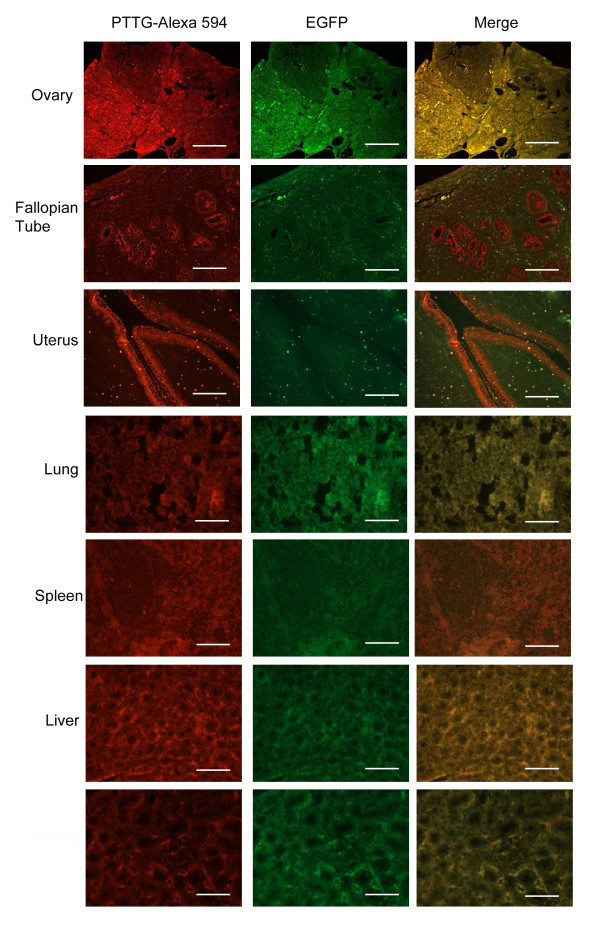
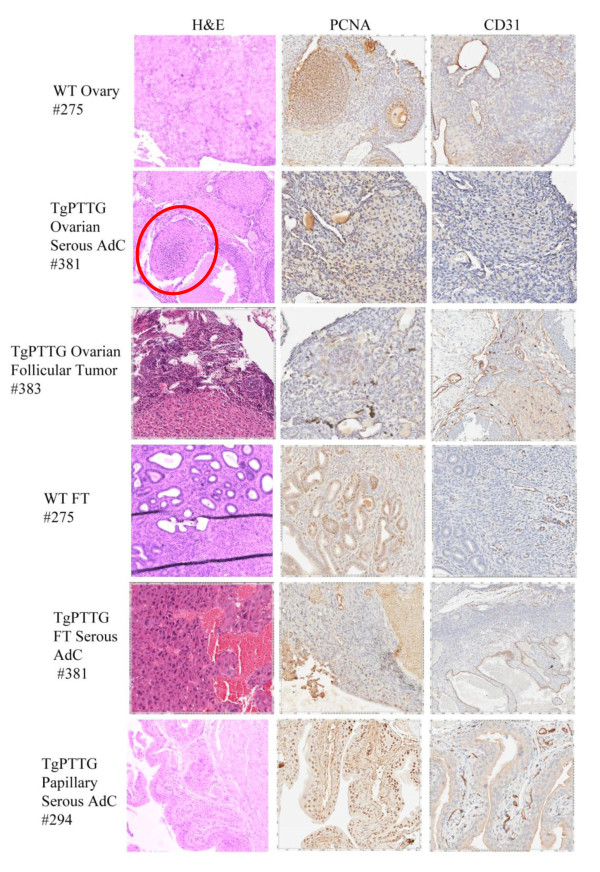
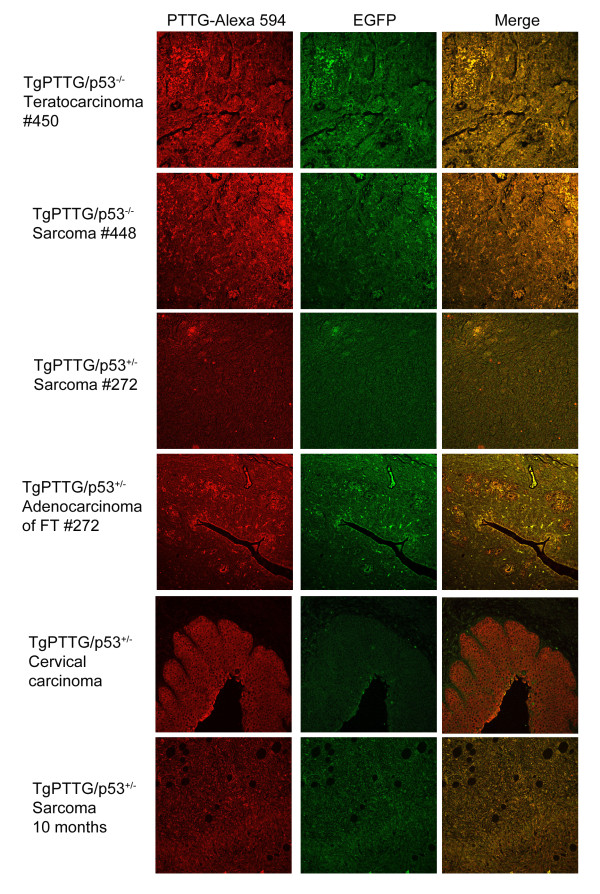
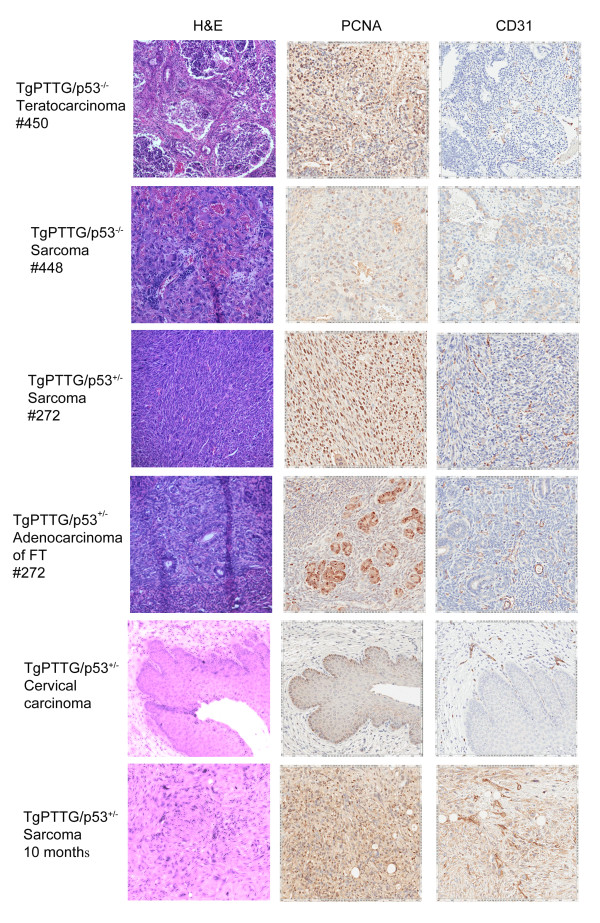
PTTG transgenic offspring (TgPTTG) were monitored for tumor development at various ages. H&E analysis was performed to identify the presence of cancer and hyperplastic conditions verified with the proliferation marker PCNA and the microvessel marker CD31. Immunohistochemistry was performed to determine transgene expression, revealing localization to the epithelium of the fallopian tube, with more generalized expression in the liver, lung, kidney, and spleen. At eight months of age, 2 out of 15 TgPTTG developed ovarian cancer, 2 out of 15 developed benign tumors, 2 out of 15 developed cervical dysplasia, and 3 out of 15 developed adenomyosis of the uterus. At ten months of age, 2 out of 10 TgPTTG developed adenocarcinoma of the ovary, 1 out of 10 developed a papillary serous adenocarcinoma, and 2 out of 10 presented with atypia of ovarian epithelial cells. Tumorigenesis is a multi-step process, often requiring multiple oncogenes and/or inactivation of tumor suppressor genes. Therefore, to understand the contribution of p53 to PTTG induced tumorigenesis, we crossbred TgPTTG to p53+/- mice and maintained those 8 to 10 months. TgPTTG/p53+/- animals developed sarcomas faster than p53+/- alone as well as different tumor types in addition to cervical carcinomas in situ in 10 out of 17 females.

CONCLUSIONS

We conclude that while PTTG is a functional transforming oncogene, it requires an additional partner to effectively promote tumorigenesis through the loss of p53 include or between function or modulation.

摘要

背景

垂体肿瘤转化基因(PTTG)是一种在多种肿瘤中过度表达的癌基因,具有转化基因的特征。以前的转基因小鼠模型旨在研究垂体和卵巢中的致瘤潜能,但只导致了发育不良而没有形成可见的肿瘤,这可能是由于 PTTG 的表达不足。PTTG 的表达水平对异种移植模型中的卵巢肿瘤发生至关重要。因此,PTTG 在体内的致瘤功能仍不清楚。我们生成了一种过表达 PTTG 的转基因小鼠,该 PTTG 由 CMV 启动子驱动,以确定 PTTG 是否作为能够引发肿瘤发生的转化致癌基因发挥作用。

方法

通过将 PTTG 转基因体微注射到 FVB 0.5 天龄胚胎的雄性原核中,生成转基因动物。使用免疫组织化学分析来分析转基因动物组织中的 PTTG 表达水平。对转基因和 PTTG 转基因/p53+/-动物进行 H&E 染色和免疫组织化学染色,以检查肿瘤类型。

结果

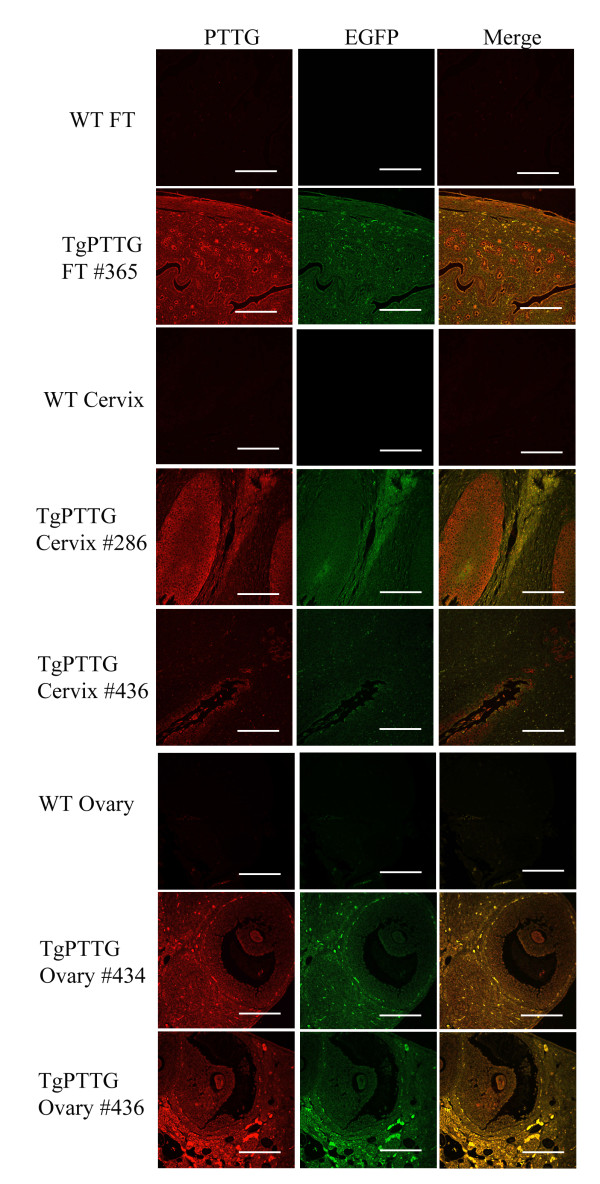
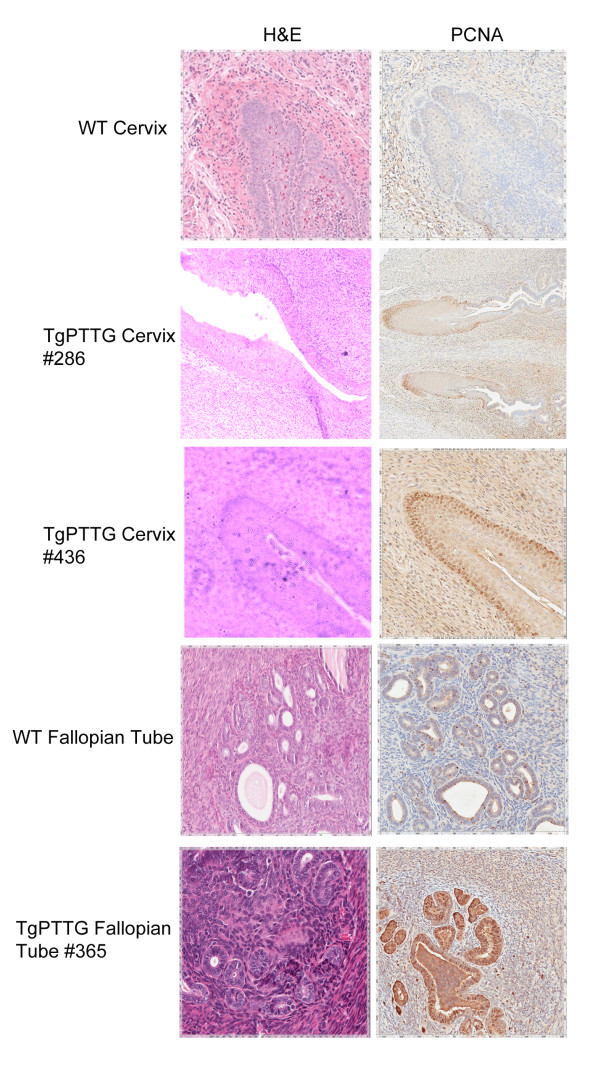
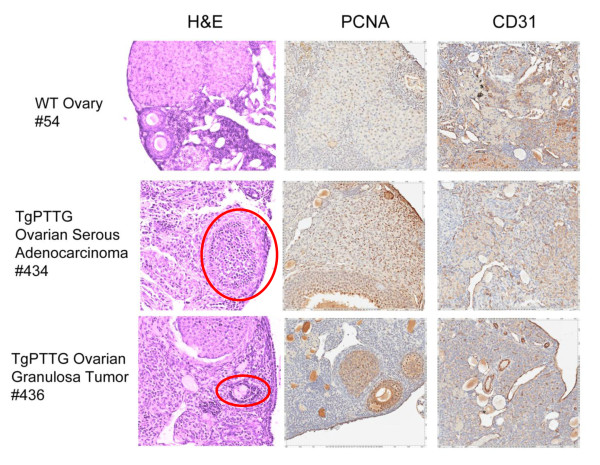
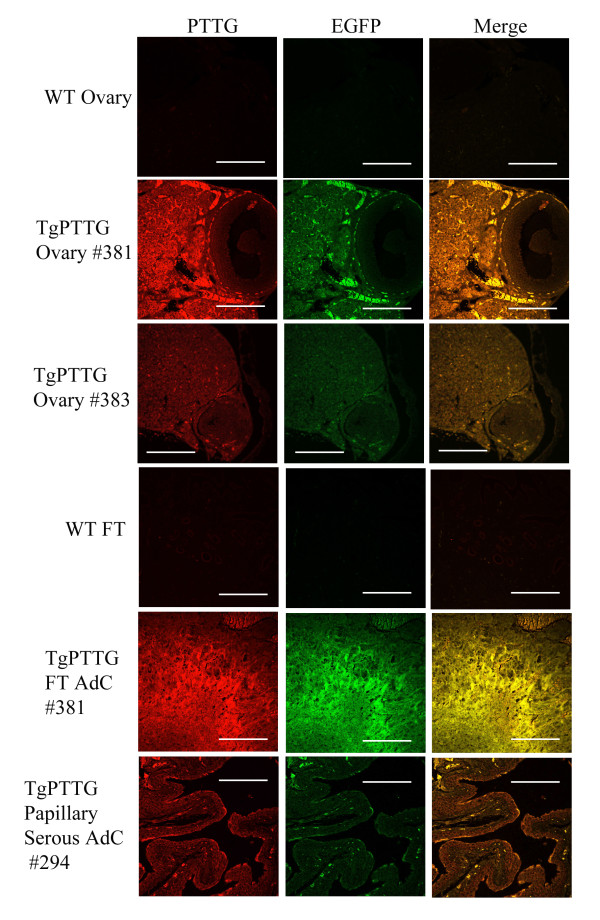
监测各种年龄的 PTTG 转基因后代(TgPTTG)的肿瘤发展情况。进行 H&E 分析以确定癌症的存在,并通过增殖标志物 PCNA 和微血管标志物 CD31 验证增生情况。进行免疫组织化学分析以确定转基因表达,显示定位于输卵管的上皮,在肝脏、肺、肾脏和脾脏中有更广泛的表达。在 8 个月大时,15 只 TgPTTG 中有 2 只发展为卵巢癌,2 只发展为良性肿瘤,2 只发展为宫颈发育不良,3 只发展为子宫腺肌病。在 10 个月大时,10 只 TgPTTG 中有 2 只发展为卵巢腺癌,1 只发展为乳头状浆液性腺癌,2 只发展为卵巢上皮细胞异型性。肿瘤发生是一个多步骤的过程,通常需要多个癌基因和/或肿瘤抑制基因失活。因此,为了了解 p53 对 PTTG 诱导的肿瘤发生的贡献,我们将 TgPTTG 与 p53+/- 小鼠杂交,并将这些小鼠维持 8 至 10 个月。与 p53+/- 单独相比,TgPTTG/p53+/- 动物的肉瘤发展更快,除了 17 只雌性中有 10 只患有原位宫颈癌外,还出现了不同类型的肿瘤。

结论

我们得出结论,虽然 PTTG 是一种功能性转化致癌基因,但它需要额外的合作伙伴,通过缺失 p53 或功能失活或调节,才能有效地促进肿瘤发生。
https://cdn.ncbi.nlm.nih.gov/pmc/blobs/eb64/3530432/0d35f788d24f/1471-2407-12-532-13.jpg
https://cdn.ncbi.nlm.nih.gov/pmc/blobs/eb64/3530432/944a629f0814/1471-2407-12-532-1.jpg
https://cdn.ncbi.nlm.nih.gov/pmc/blobs/eb64/3530432/ff8e30b7f512/1471-2407-12-532-2.jpg
https://cdn.ncbi.nlm.nih.gov/pmc/blobs/eb64/3530432/fea500b2b3e2/1471-2407-12-532-3.jpg
https://cdn.ncbi.nlm.nih.gov/pmc/blobs/eb64/3530432/4060d707dc2a/1471-2407-12-532-4.jpg
https://cdn.ncbi.nlm.nih.gov/pmc/blobs/eb64/3530432/bccf49d4e788/1471-2407-12-532-5.jpg
https://cdn.ncbi.nlm.nih.gov/pmc/blobs/eb64/3530432/1d02adb4d4d1/1471-2407-12-532-6.jpg
https://cdn.ncbi.nlm.nih.gov/pmc/blobs/eb64/3530432/7e129db9b279/1471-2407-12-532-7.jpg
https://cdn.ncbi.nlm.nih.gov/pmc/blobs/eb64/3530432/93e345232d8d/1471-2407-12-532-8.jpg
https://cdn.ncbi.nlm.nih.gov/pmc/blobs/eb64/3530432/ace7ab2cdc25/1471-2407-12-532-9.jpg
https://cdn.ncbi.nlm.nih.gov/pmc/blobs/eb64/3530432/f5b390ea3dad/1471-2407-12-532-10.jpg
https://cdn.ncbi.nlm.nih.gov/pmc/blobs/eb64/3530432/2d98e46f53b6/1471-2407-12-532-11.jpg
https://cdn.ncbi.nlm.nih.gov/pmc/blobs/eb64/3530432/2d840d2df9aa/1471-2407-12-532-12.jpg
https://cdn.ncbi.nlm.nih.gov/pmc/blobs/eb64/3530432/0d35f788d24f/1471-2407-12-532-13.jpg
https://cdn.ncbi.nlm.nih.gov/pmc/blobs/eb64/3530432/944a629f0814/1471-2407-12-532-1.jpg
https://cdn.ncbi.nlm.nih.gov/pmc/blobs/eb64/3530432/ff8e30b7f512/1471-2407-12-532-2.jpg
https://cdn.ncbi.nlm.nih.gov/pmc/blobs/eb64/3530432/fea500b2b3e2/1471-2407-12-532-3.jpg
https://cdn.ncbi.nlm.nih.gov/pmc/blobs/eb64/3530432/4060d707dc2a/1471-2407-12-532-4.jpg
https://cdn.ncbi.nlm.nih.gov/pmc/blobs/eb64/3530432/bccf49d4e788/1471-2407-12-532-5.jpg
https://cdn.ncbi.nlm.nih.gov/pmc/blobs/eb64/3530432/1d02adb4d4d1/1471-2407-12-532-6.jpg
https://cdn.ncbi.nlm.nih.gov/pmc/blobs/eb64/3530432/7e129db9b279/1471-2407-12-532-7.jpg
https://cdn.ncbi.nlm.nih.gov/pmc/blobs/eb64/3530432/93e345232d8d/1471-2407-12-532-8.jpg
https://cdn.ncbi.nlm.nih.gov/pmc/blobs/eb64/3530432/ace7ab2cdc25/1471-2407-12-532-9.jpg
https://cdn.ncbi.nlm.nih.gov/pmc/blobs/eb64/3530432/f5b390ea3dad/1471-2407-12-532-10.jpg
https://cdn.ncbi.nlm.nih.gov/pmc/blobs/eb64/3530432/2d98e46f53b6/1471-2407-12-532-11.jpg
https://cdn.ncbi.nlm.nih.gov/pmc/blobs/eb64/3530432/2d840d2df9aa/1471-2407-12-532-12.jpg
https://cdn.ncbi.nlm.nih.gov/pmc/blobs/eb64/3530432/0d35f788d24f/1471-2407-12-532-13.jpg

相似文献

1
Tumorigenic potential of pituitary tumor transforming gene (PTTG) in vivo investigated using a transgenic mouse model, and effects of cross breeding with p53 (+/-) transgenic mice.利用转基因小鼠模型研究垂体肿瘤转化基因 (PTTG) 的体内致瘤潜能,以及与 p53(+/-) 转基因小鼠杂交的影响。
BMC Cancer. 2012 Nov 20;12:532. doi: 10.1186/1471-2407-12-532.
2
Development of cystic glandular hyperplasia of the endometrium in Mullerian inhibitory substance type II receptor-pituitary tumor transforming gene transgenic mice.苗勒管抑制物质II型受体-垂体瘤转化基因转基因小鼠子宫内膜囊性腺性增生的发生
J Endocrinol. 2007 Jul;194(1):179-91. doi: 10.1677/JOE-06-0036.
3
PTTG and PBF Functionally Interact with p53 and Predict Overall Survival in Head and Neck Cancer.PTTG 和 PBF 与 p53 具有功能相互作用,并预测头颈部癌症的总生存期。
Cancer Res. 2018 Oct 15;78(20):5863-5876. doi: 10.1158/0008-5472.CAN-18-0855. Epub 2018 Aug 28.
4
Characterization of the murine pituitary tumor transforming gene (PTTG) and its promoter.小鼠垂体肿瘤转化基因(PTTG)及其启动子的特征分析。
Endocrinology. 2000 Feb;141(2):763-71. doi: 10.1210/endo.141.2.7294.
5
Phosphatase and tensin homologue and pituitary tumor-transforming gene in pituitary adenomas. Clinical-pathologic and immunohistochemical analysis.垂体腺瘤中的磷酸酶和张力蛋白同源物及垂体肿瘤转化基因。临床病理与免疫组化分析。
Ann Diagn Pathol. 2008 Aug;12(4):275-282. doi: 10.1016/j.anndiagpath.2008.02.001. Epub 2008 Jun 12.
6
PTTG/securin activates expression of p53 and modulates its function.垂体肿瘤转化基因/分离酶激活蛋白53的表达并调节其功能。
Mol Cancer. 2004 Jul 8;3:18. doi: 10.1186/1476-4598-3-18.
7
Pituitary tumor transforming gene: an important gene in normal cellular functions and tumorigenesis.垂体肿瘤转化基因:正常细胞功能和肿瘤发生中的一个重要基因。
Histol Histopathol. 2007 Feb;22(2):219-26. doi: 10.14670/HH-22.219.
8
Regulation of angiogenesis and invasion by human Pituitary tumor transforming gene (PTTG) through increased expression and secretion of matrix metalloproteinase-2 (MMP-2).人类垂体肿瘤转化基因(PTTG)通过增加基质金属蛋白酶-2(MMP-2)的表达和分泌来调控血管生成和侵袭。
Mol Cancer. 2006 Nov 10;5:61. doi: 10.1186/1476-4598-5-61.
9
Pituitary tumor transforming gene: an update.垂体肿瘤转化基因:最新进展
Front Horm Res. 2004;32:175-85. doi: 10.1159/000079044.
10
Pituitary tumor transforming gene overexpression facilitates pituitary tumor development.垂体肿瘤转化基因的过表达促进垂体肿瘤的发展。
Endocrinology. 2006 Oct;147(10):4781-91. doi: 10.1210/en.2006-0544. Epub 2006 Jun 29.

引用本文的文献

1
Transcriptomic Profiles of Normal Pituitary Cells and Pituitary Neuroendocrine Tumor Cells.正常垂体细胞和垂体神经内分泌肿瘤细胞的转录组图谱
Cancers (Basel). 2022 Dec 24;15(1):110. doi: 10.3390/cancers15010110.
2
Elevated PTTG and PBF predicts poor patient outcome and modulates DNA damage response genes in thyroid cancer.凝血酶原片段 1+2(PTTG)和血小板结合纤维蛋白(PBF)升高预示甲状腺癌患者预后不良,并调节甲状腺癌中的 DNA 损伤反应基因。
Oncogene. 2017 Sep 14;36(37):5296-5308. doi: 10.1038/onc.2017.154. Epub 2017 May 15.
3
High rates of chromosome missegregation suppress tumor progression but do not inhibit tumor initiation.

本文引用的文献

1
PTTG induces EMT through integrin αVβ3-focal adhesion kinase signaling in lung cancer cells.PTTG 通过整合素 αVβ3-粘着斑激酶信号通路诱导肺癌细胞 EMT。
Oncogene. 2012 Jun 28;31(26):3124-35. doi: 10.1038/onc.2011.488. Epub 2011 Nov 14.
2
Pituitary tumor transforming gene induces epithelial to mesenchymal transition by regulation of Twist, Snail, Slug, and E-cadherin.垂体肿瘤转化基因通过调节 Twist、Snail、Slug 和 E-钙黏蛋白诱导上皮间质转化。
Cancer Lett. 2011 Dec 1;311(1):66-76. doi: 10.1016/j.canlet.2011.06.033. Epub 2011 Jul 13.
3
[Expressions of bFGF and PTEN in cervical carcinoma and their clinical significance].
高频率的染色体错分离抑制肿瘤进展,但不抑制肿瘤起始。
Mol Biol Cell. 2016 Jul 1;27(13):1981-9. doi: 10.1091/mbc.E15-10-0747. Epub 2016 May 4.
4
PTTG regulates the metabolic switch of ovarian cancer cells via the c-myc pathway.垂体肿瘤转化基因(PTTG)通过c-myc途径调节卵巢癌细胞的代谢转换。
Oncotarget. 2015 Dec 1;6(38):40959-69. doi: 10.18632/oncotarget.5726.
[碱性成纤维细胞生长因子和抑癌基因PTEN在宫颈癌中的表达及其临床意义]
Zhonghua Zhong Liu Za Zhi. 2010 Jul;32(7):533-8.
4
Effect of bFGF on invasion of ovarian cancer cells through the regulation of Ets-1 and urokinase-type plasminogen activator.bFGF 通过调控 Ets-1 和尿激酶型纤溶酶原激活物对卵巢癌细胞侵袭的影响。
Pharm Biol. 2010 Feb;48(2):161-5. doi: 10.3109/13880200903062630.
5
On the stem cell origin of cancer.关于癌症的干细胞起源。
Am J Pathol. 2010 Jun;176(6):2584-494. doi: 10.2353/ajpath.2010.091064. Epub 2010 Apr 29.
6
Cell intrinsic & extrinsic factors in cervical carcinogenesis.细胞内在和外在因素与宫颈癌的发生。
Indian J Med Res. 2009 Sep;130(3):286-95.
7
PTTG: an important target gene for ovarian cancer therapy.PTTG:卵巢癌治疗的重要靶标基因。
J Ovarian Res. 2008 Oct 20;1(1):6. doi: 10.1186/1757-2215-1-6.
8
Real-time PCR to determine transgene copy number and to quantitate the biolocalization of adoptively transferred cells from EGFP-transgenic mice.采用实时聚合酶链反应(Real-time PCR)来确定转基因拷贝数,并对来自增强绿色荧光蛋白(EGFP)转基因小鼠的过继转移细胞进行生物定位定量分析。
Biotechniques. 2008 Sep;45(3):247-58. doi: 10.2144/000112913.
9
Immunohistochemical detection of insulin-like growth factor-I, transforming growth factor-beta2, basic fibroblast growth factor and epidermal growth factor-receptor expression in developing rat ovary.免疫组织化学检测发育中大鼠卵巢中胰岛素样生长因子-I、转化生长因子-β2、碱性成纤维细胞生长因子及表皮生长因子受体的表达
Cytokine. 2008 Aug;43(2):209-14. doi: 10.1016/j.cyto.2008.05.013. Epub 2008 Jun 30.
10
Development of cystic glandular hyperplasia of the endometrium in Mullerian inhibitory substance type II receptor-pituitary tumor transforming gene transgenic mice.苗勒管抑制物质II型受体-垂体瘤转化基因转基因小鼠子宫内膜囊性腺性增生的发生
J Endocrinol. 2007 Jul;194(1):179-91. doi: 10.1677/JOE-06-0036.