KEMRI-Wellcome Trust Research Programme, Kilifi District Hospital, Kilifi, Kenya.
J Infect Dis. 2012 Dec 15;206 Suppl 1(Suppl 1):S61-7. doi: 10.1093/infdis/jis536.
Influenza data gaps in sub-Saharan Africa include incidence, case fatality, seasonal patterns, and associations with prevalent disorders.
Nasopharyngeal samples from children aged <12 years who were admitted to Kilifi District Hospital during 2007-2010 with severe or very severe pneumonia and resided in the local demographic surveillance system were screened for influenza A, B, and C viruses by molecular methods. Outpatient children provided comparative data.
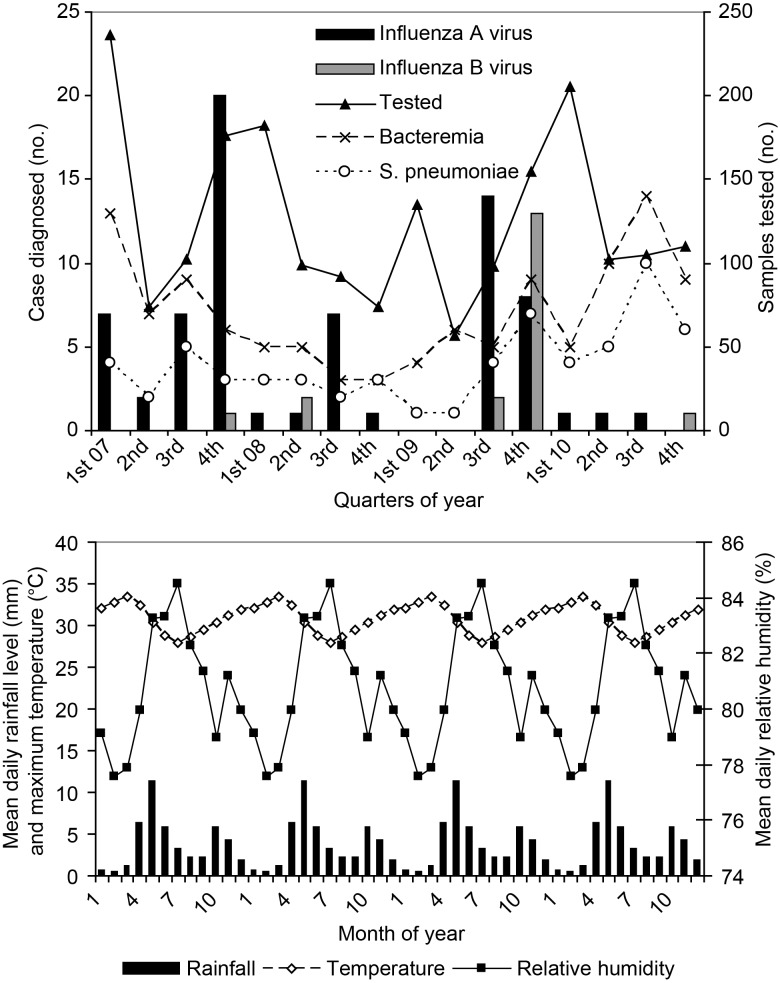
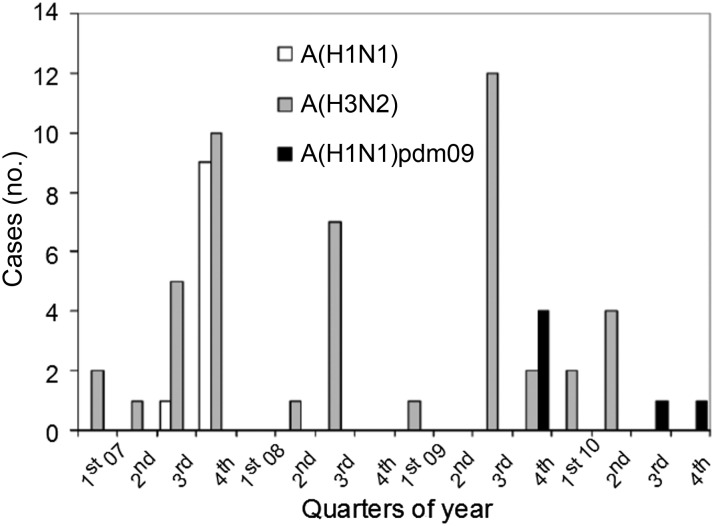
Of 2002 admissions, influenza A virus infection was diagnosed in 3.5% (71), influenza B virus infection, in 0.9% (19); and influenza C virus infection, in 0.8% (11 of 1404 tested). Four patients with influenza died. Among outpatients, 13 of 331 (3.9%) with acute respiratory infection and 1 of 196 without acute respiratory infection were influenza positive. The annual incidence of severe or very severe pneumonia, of influenza (any type), and of influenza A, was 1321, 60, and 43 cases per 100,000 <5 years of age, respectively. Peak occurrence was in quarters 3-4 each year, and approximately 50% of cases involved infants: temporal association with bacteremia was absent. Hypoxia was more frequent among pneumonia cases involving influenza (odds ratio, 1.78; 95% confidence interval, 1.04-1.96). Influenza A virus subtypes were seasonal H3N2 (57%), seasonal H1N1 (12%), and 2009 pandemic H1N1 (7%).
The burden of influenza was small during 2007-2010 in this pediatric hospital in Kenya. Influenza A virus subtype H3N2 predominated, and 2009 pandemic influenza A virus subtype H1N1 had little impact.
撒哈拉以南非洲的流感数据缺口包括发病率、病死率、季节性模式以及与常见疾病的关联。
通过分子方法,对在 2007-2010 年间因严重或极严重肺炎入住基利菲区医院且居住在当地人口监测系统中的<12 岁儿童的鼻咽样本进行了甲型、乙型和丙型流感病毒的筛查。门诊儿童提供了对照数据。
在 2002 例入院患者中,诊断出甲型流感病毒感染 3.5%(71 例)、乙型流感病毒感染 0.9%(19 例)、丙型流感病毒感染 0.8%(1404 例检测中 11 例)。有 4 例流感患者死亡。在门诊患者中,急性呼吸道感染的 331 例患者中有 13 例(3.9%)和无急性呼吸道感染的 196 例患者中有 1 例(0.5%)为流感阳性。严重或极严重肺炎、任何类型流感和甲型流感的年发病率分别为每 10 万名<5 岁儿童 1321、60 和 43 例。发病高峰出现在每年的第 3-4 季度,约 50%的病例涉及婴儿:与菌血症的时间关联不存在。流感相关肺炎病例更常出现缺氧(比值比,1.78;95%置信区间,1.04-1.96)。甲型流感病毒亚型为季节性 H3N2(57%)、季节性 H1N1(12%)和 2009 年大流行性 H1N1(7%)。
在 2007-2010 年期间,肯尼亚这家儿科医院的流感负担很小。甲型流感病毒 H3N2 亚型占主导地位,2009 年大流行性甲型流感病毒 H1N1 亚型影响较小。