Nyasimi Festus M, Owuor David Collins, Ngoi Joyce M, Mwihuri Alexander G, Otieno Grieven P, Otieno James R, Githinji George, Nyiro Joyce U, Nokes David James, Agoti Charles N
Epidemiology and Demography Department, Kenya Medical Research Institute (KEMRI) - Wellcome Trust Research Programme, P.O. Box 230, Kilifi-80108, Kenya.
Department of Public Health, School of Health and Human Sciences, Pwani University, P.O. Box 195, Kilifi-80108, Kenya.
Virus Evol. 2020 Aug 16;6(2):veaa045. doi: 10.1093/ve/veaa045. eCollection 2020 Jul.
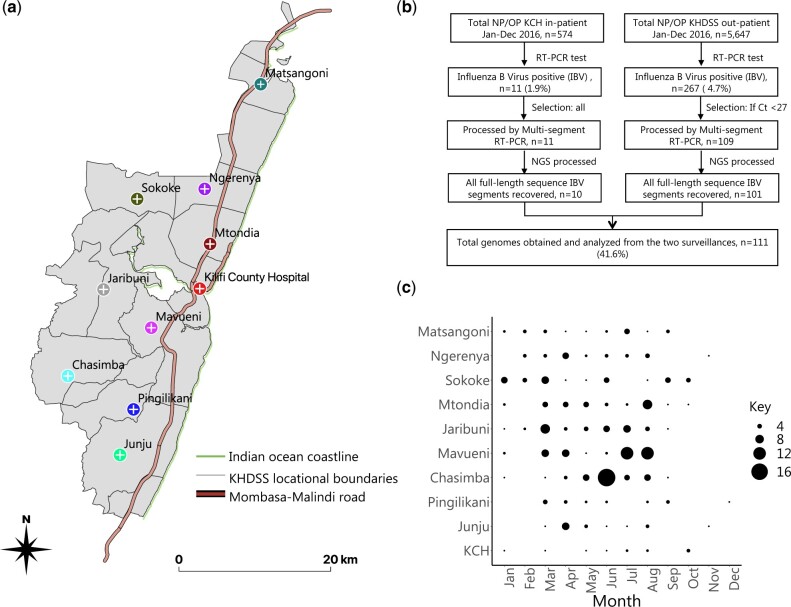
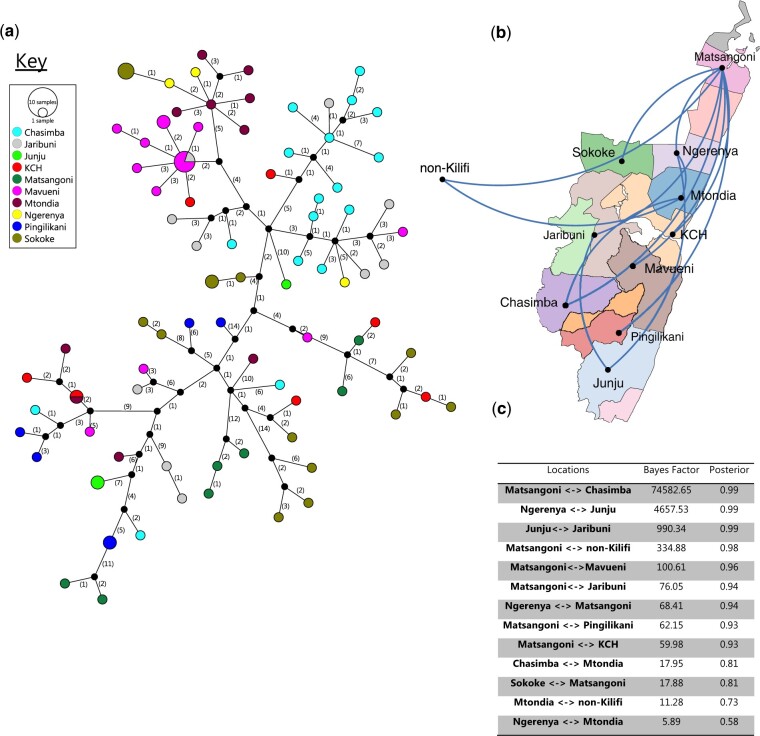
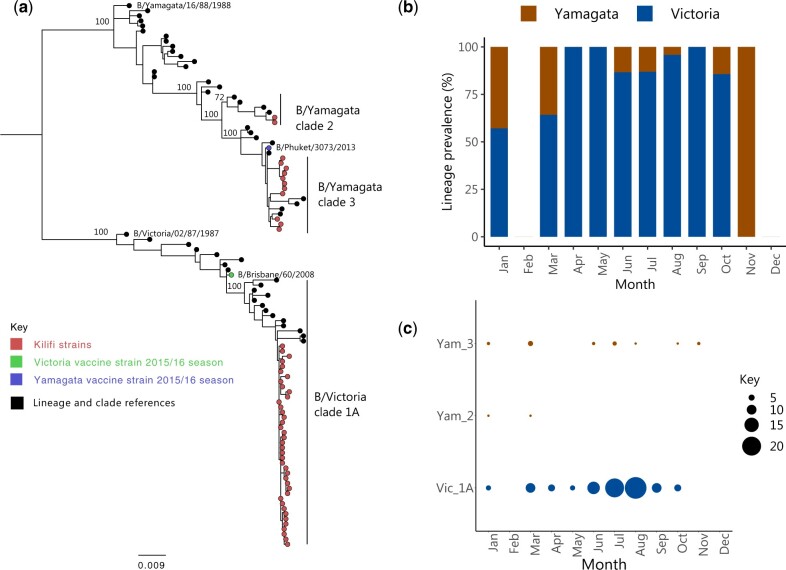
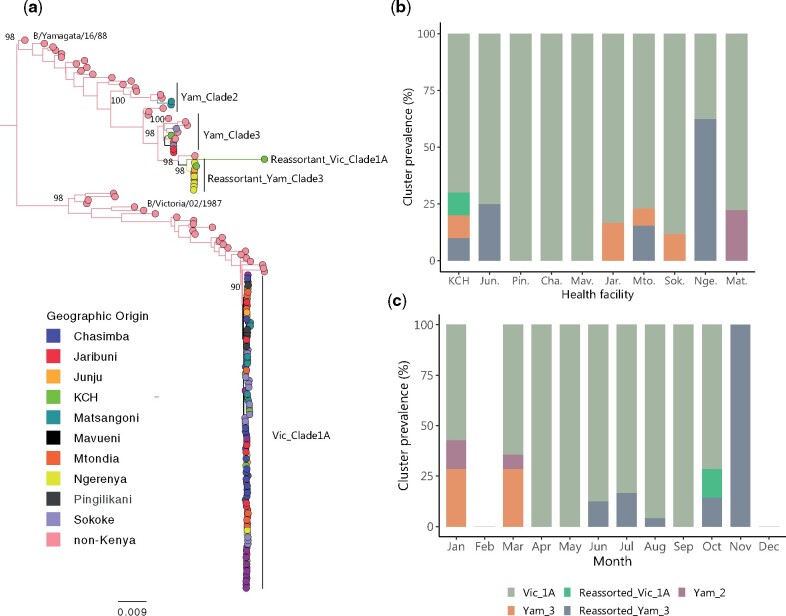
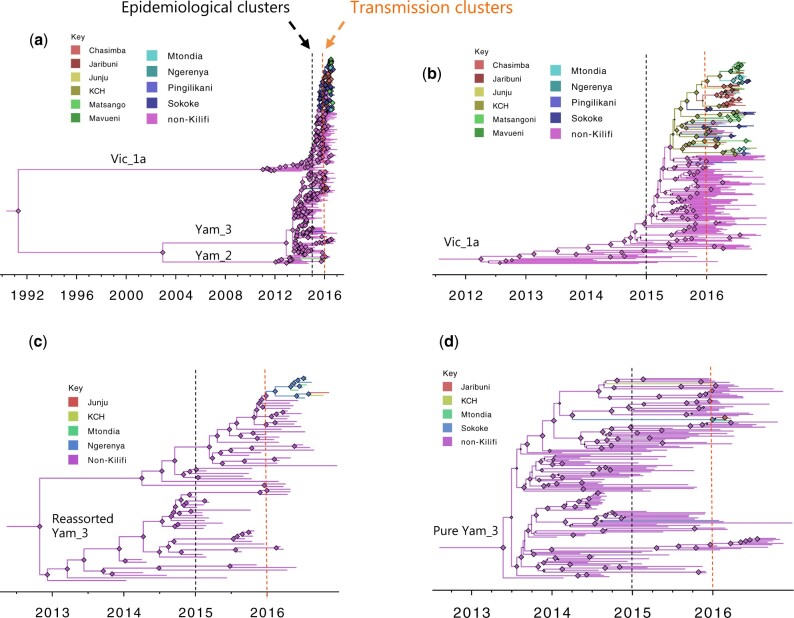
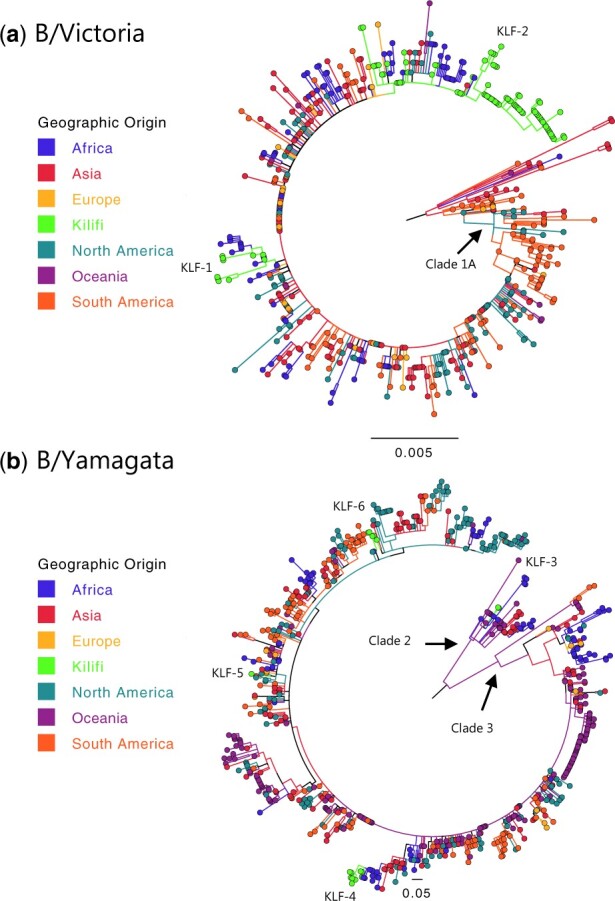
The genomic epidemiology of influenza B virus (IBV) remains understudied in Africa despite significance to design of effective local and global control strategies. We undertook surveillance throughout 2016 in coastal Kenya, recruiting individuals presenting with acute respiratory illness at nine outpatient health facilities (any age) or admitted to the Kilifi County Hospital (<5 years old). Whole genomes were sequenced for a selected 111 positives; 94 (84.7%) of B/Victoria lineage and 17 (15.3%) of B/Yamagata lineage. Inter-lineage reassortment was detected in ten viruses; nine with B/Yamagata backbone but B/Victoria NA and NP segments and one with a B/Victoria backbone but B/Yamagata PB2, PB1, PA, and MP segments. Five phylogenomic clusters were identified among the sequenced viruses; (i), pure B/Victoria clade 1A ( = 93, 83.8%), (ii), reassortant B/Victoria clade 1A ( = 1, 0.9%), (iii), pure B/Yamagata clade 2 ( = 2, 1.8%), (iv), pure B/Yamagata clade 3 ( = 6, 5.4%), and (v), reassortant B/Yamagata clade 3 ( = 9, 8.1%). Using divergence dates and clustering patterns in the presence of global background sequences, we counted up to twenty-nine independent IBV strain introductions into the study area (∼900 km) in 2016. Local viruses, including the reassortant B/Yamagata strains, clustered closely with viruses from neighbouring Tanzania and Uganda. Our study demonstrated that genomic analysis provides a clearer picture of locally circulating IBV diversity. The high number of IBV introductions highlights the challenge in controlling local influenza epidemics by targeted approaches, for example, sub-population vaccination or patient quarantine. The finding of divergent IBV strains co-circulating within a single season emphasises why broad immunity vaccines are the most ideal for influenza control in Kenya.
尽管乙型流感病毒(IBV)的基因组流行病学对制定有效的地方和全球控制策略具有重要意义,但在非洲仍未得到充分研究。2016年,我们在肯尼亚沿海地区进行了监测,在9个门诊医疗机构招募出现急性呼吸道疾病的个体(任何年龄),或在基利菲县医院招募入院患者(<5岁)。对选定的111份阳性样本进行了全基因组测序;其中94份(84.7%)属于B/维多利亚系,17份(15.3%)属于B/山形系。在10株病毒中检测到株间重配;9株具有B/山形主干,但NA和NP片段来自B/维多利亚系,1株具有B/维多利亚主干,但PB2、PB1、PA和MP片段来自B/山形系。在测序的病毒中鉴定出5个系统发育簇;(i),纯B/维多利亚1A分支(=93,83.8%),(ii),重配B/维多利亚1A分支(=1,0.9%),(iii),纯B/山形2分支(=2,1.8%),(iv),纯B/山形3分支(=6,5.4%),以及(v),重配B/山形3分支(=9,8.1%)。利用全球背景序列存在时的分歧日期和聚类模式,我们统计出2016年有多达29株独立的IBV毒株引入研究区域(约9百公里)。包括重配B/山形毒株在内的本地病毒与来自邻国坦桑尼亚和乌干达的病毒紧密聚类。我们的研究表明,基因组分析能更清晰地呈现本地传播的IBV多样性。大量IBV毒株的引入凸显了通过针对性方法(如亚人群疫苗接种或患者隔离)控制本地流感流行的挑战。在单个季节内同时存在不同IBV毒株的发现强调了为何广泛免疫疫苗是肯尼亚控制流感最理想的选择。