INRA, UMR1282 Infectiologie et Santé Publique F-37380, Nouzilly, France ; Université François Rabelais de Tours, UMR1282 Infectiologie et Santé Publique F-37000, Tours, France.
Microbiologyopen. 2012 Sep;1(3):243-58. doi: 10.1002/mbo3.28. Epub 2012 Jun 18.
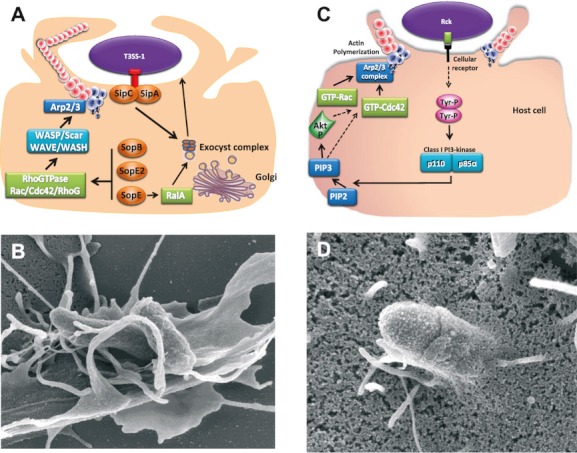
The Salmonella enterica species includes about 2600 diverse serotypes, most of which cause a wide range of food- and water-borne diseases ranging from self-limiting gastroenteritis to typhoid fever in both humans and animals. Moreover, some serotypes are restricted to a few animal species, whereas other serotypes are able to infect plants as well as cold- and warm-blooded animals. An essential feature of the pathogenicity of Salmonella is its capacity to cross a number of barriers requiring invasion of a large variety of phagocytic and nonphagocytic cells. The aim of this review is to describe the different entry pathways used by Salmonella serotypes to enter different nonphagocytic cell types. Until recently, it was accepted that Salmonella invasion of eukaryotic cells required only the type III secretion system (T3SS) encoded by the Salmonella pathogenicity island-1. However, recent evidence shows that Salmonella can cause infection in a T3SS-1-independent manner. Currently, two outer membrane proteins Rck and PagN have been clearly identified as Salmonella invasins. As Rck mediates a Zipper-like entry mechanism, Salmonella is therefore the first bacterium shown to be able to induce both Zipper and Trigger mechanisms to invade host cells. In addition to these known entry pathways, recent data have shown that unknown entry routes could be used according to the serotype, the host and the cell type considered, inducing either Zipper-like or Trigger-like entry processes. The new paradigm presented here should change our classic view of Salmonella pathogenicity. It could also modify our understanding of the mechanisms leading to the different Salmonella-induced diseases and to Salmonella-host specificity.
肠沙门氏菌属包括约 2600 种不同的血清型,其中大多数可引起广泛的食源性和水源性疾病,从人类和动物的自限性肠胃炎到伤寒热不等。此外,一些血清型仅限于少数动物物种,而其他血清型能够感染植物以及冷血和温血动物。沙门氏菌致病性的一个重要特征是其能够跨越多种需要入侵多种吞噬细胞和非吞噬细胞的屏障的能力。本综述的目的是描述肠沙门氏菌血清型用于进入不同非吞噬细胞类型的不同进入途径。直到最近,人们还认为沙门氏菌入侵真核细胞只需要沙门氏菌致病性岛-1 编码的 III 型分泌系统(T3SS)。然而,最近的证据表明,沙门氏菌可以以 T3SS-1 非依赖性方式引起感染。目前,两种外膜蛋白 Rck 和 PagN 已被明确鉴定为沙门氏菌入侵蛋白。由于 Rck 介导 Zipper 样进入机制,沙门氏菌因此是第一个被证明能够诱导 Zipper 和 Trigger 两种机制进入宿主细胞的细菌。除了这些已知的进入途径外,最近的数据表明,根据血清型、宿主和所考虑的细胞类型,未知的进入途径可能被用于诱导 Zipper 样或 Trigger 样进入过程。这里提出的新范式应该改变我们对沙门氏菌致病性的经典观点。它还可能改变我们对导致不同沙门氏菌诱导疾病和沙门氏菌宿主特异性的机制的理解。