Department of Neurology, Wake Forest School of Medicine Winston-Salem, North Carolina.
Brain Behav. 2012 Nov;2(6):814-24. doi: 10.1002/brb3.101. Epub 2012 Oct 28.
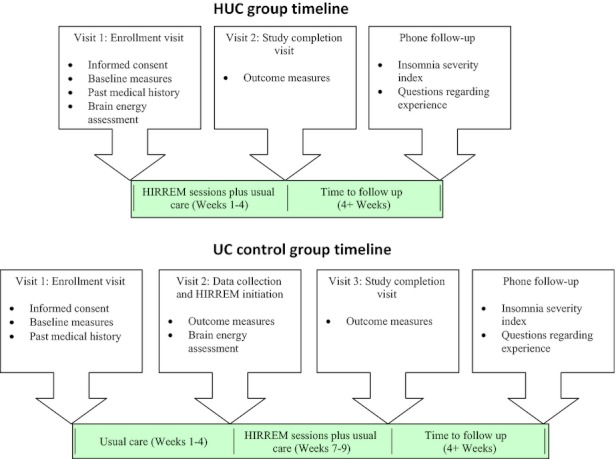
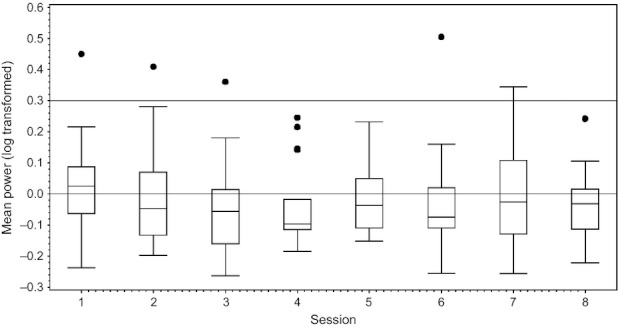
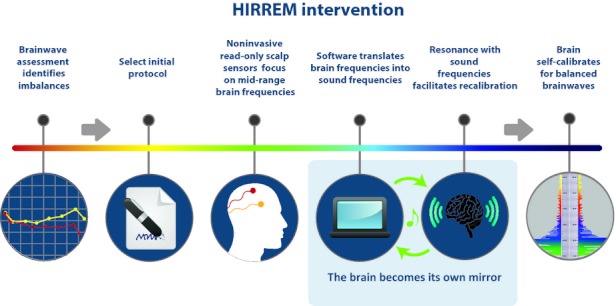
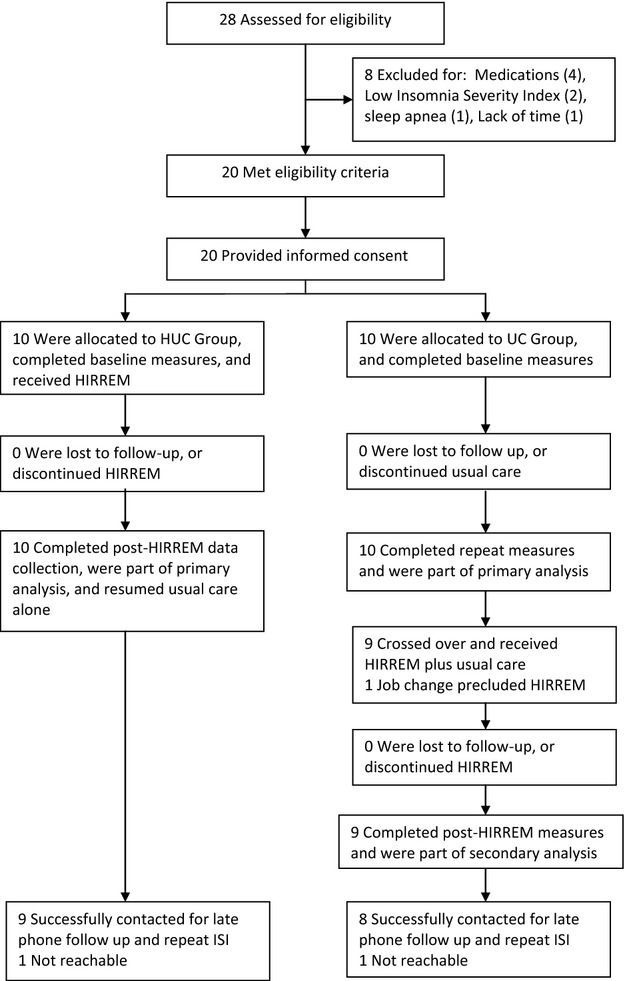
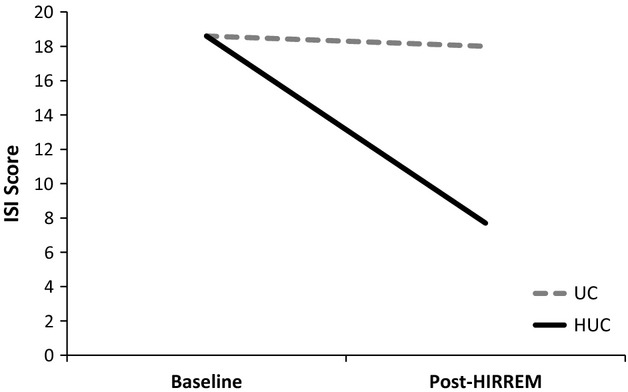
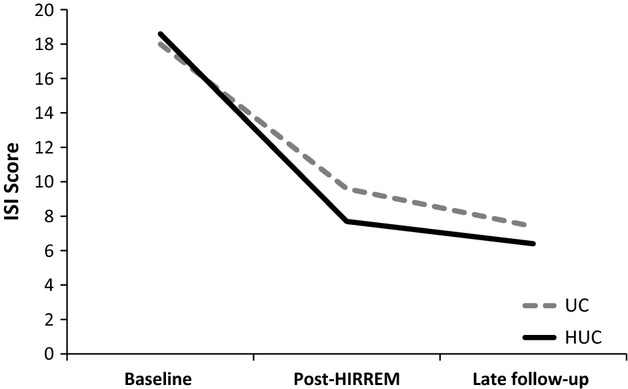
Effective noninvasive interventions for insomnia are needed. High-resolution, relational, resonance-based, electroencephalic mirroring (HIRREM™) is a noninvasive, electroencephalography (EEG)-based method to facilitate greater client-unique, autocalibrated improvements of balance and harmony in cortical neural oscillations. This study explores using HIRREM for insomnia. Twenty subjects, with an Insomnia Severity Index (ISI) score of ≥15 (14 women, mean age 45.4, mean ISI 18.6), were enrolled in this randomized, unblinded, wait-list control, crossover, superiority study. Subjects were randomized to receive 8-12 HIRREM sessions over 3 weeks, plus usual care (HUC), or usual care alone (UC). Pre- and post-HIRREM data collection included ISI (primary outcome), and many secondary, exploratory measures (CES-D, SF-36, HR, BP, neurocognitive testing, and VAS scales). The UC group later crossed over to receive HIRREM. ISI was also repeated 4-6 weeks post-HIRREM. All subjects completed the primary intervention period. Analysis for differential change of ISI in the initial intervention period for HUC versus UC showed a drop of 10.3 points (95% CI: -13.7 to -6.9, P < 0.0001, standardized effect size of 2.68). Key secondary outcomes included statistically identical differential change for the crossed-over UC group, and persistence of the effect on the ISI up to > 4 weeks post-HIRREM. Differential change in the HUC group was also statistically significant for CES-D (-8.8, 95% CI: -17.5 to -0.1, P = 0.047), but other exploratory outcomes were not statistically significant. For all receiving HIRREM (n = 19), decreased high-frequency total power was seen in the bilateral temporal lobes. No adverse events were seen. This pilot clinical trial, the first using HIRREM as an intervention, suggests that HIRREM is feasible and effective for individuals having moderate-to-severe insomnia, with clinically relevant, statistically significant benefits based on differential change in the ISI. Effects persisted for 4 weeks after completion of HIRREM. Larger controlled clinical trials are warranted.
需要有效的非侵入性失眠干预措施。高分辨率、关系型、共振、脑电镜像(HIRREM)是一种非侵入性的、基于脑电图(EEG)的方法,可促进更大的、独特的、自动校准的皮质神经振荡平衡和和谐的改善。本研究探讨了使用 HIRREM 治疗失眠。20 名被试者的失眠严重程度指数(ISI)评分≥15(14 名女性,平均年龄 45.4 岁,平均 ISI 为 18.6),被纳入这项随机、非盲、等待对照、交叉、优势研究。被随机分为三组:在 3 周内接受 8-12 次 HIRREM 治疗加常规护理(HUC),或仅接受常规护理(UC)。HIRREM 前后的数据收集包括 ISI(主要结果)和许多次要的、探索性的测量指标(CES-D、SF-36、HR、BP、神经认知测试和 VAS 量表)。UC 组随后交叉接受 HIRREM。HIRREM 后 4-6 周也重复了 ISI。所有患者均完成了主要干预期。对 HUC 与 UC 初始干预期间 ISI 的差异变化进行分析显示,ISI 下降了 10.3 分(95%CI:-13.7 至-6.9,P<0.0001,标准化效应大小为 2.68)。关键的次要结局包括交叉 UC 组的差异变化统计学上相同,以及 HIRREM 后 4 周以上对 ISI 的影响持续存在。HUC 组在 CES-D 上的差异变化也具有统计学意义(-8.8,95%CI:-17.5 至-0.1,P=0.047),但其他探索性结局无统计学意义。所有接受 HIRREM(n=19)的患者双侧颞叶高频总功率均下降。未观察到不良反应。这项初步临床试验是首次将 HIRREM 作为干预措施进行的研究,表明 HIRREM 对中重度失眠患者是可行且有效的,具有基于 ISI 差异变化的临床相关、统计学显著的益处。HIRREM 完成后 4 周仍能持续产生效果。需要更大规模的对照临床试验。