Centre of Excellence in Computational Systems Biology, The University of Western Australia, Perth, WA 6009, Australia.
Nucleic Acids Res. 2013 Jan;41(Database issue):D1185-91. doi: 10.1093/nar/gks1151. Epub 2012 Nov 24.
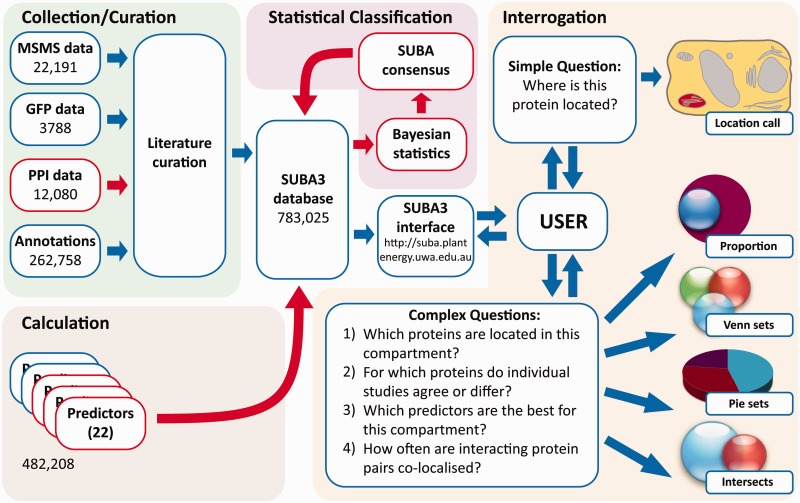
The subcellular location database for Arabidopsis proteins (SUBA3, http://suba.plantenergy.uwa.edu.au) combines manual literature curation of large-scale subcellular proteomics, fluorescent protein visualization and protein-protein interaction (PPI) datasets with subcellular targeting calls from 22 prediction programs. More than 14 500 new experimental locations have been added since its first release in 2007. Overall, nearly 650 000 new calls of subcellular location for 35 388 non-redundant Arabidopsis proteins are included (almost six times the information in the previous SUBA version). A re-designed interface makes the SUBA3 site more intuitive and easier to use than earlier versions and provides powerful options to search for PPIs within the context of cell compartmentation. SUBA3 also includes detailed localization information for reference organelle datasets and incorporates green fluorescent protein (GFP) images for many proteins. To determine as objectively as possible where a particular protein is located, we have developed SUBAcon, a Bayesian approach that incorporates experimental localization and targeting prediction data to best estimate a protein's location in the cell. The probabilities of subcellular location for each protein are provided and displayed as a pictographic heat map of a plant cell in SUBA3.
拟南芥蛋白亚细胞定位数据库 (SUBA3,http://suba.plantenergy.uwa.edu.au) 将大规模亚细胞蛋白质组学的文献手动整理、荧光蛋白可视化和蛋白质-蛋白质相互作用 (PPI) 数据集与 22 个预测程序的亚细胞靶向调用相结合。自 2007 年首次发布以来,已经增加了超过 14500 个新的实验地点。总体而言,近 35388 个非冗余拟南芥蛋白的亚细胞定位有 650000 多个新的调用(几乎是以前 SUBA 版本信息的六倍)。重新设计的界面使 SUBA3 网站比以前的版本更直观、更易于使用,并提供了在细胞区室化背景下搜索 PPI 的强大选项。SUBA3 还包括参考细胞器数据集的详细定位信息,并整合了许多蛋白质的绿色荧光蛋白 (GFP) 图像。为了尽可能客观地确定特定蛋白质的位置,我们开发了 SUBAcon,这是一种贝叶斯方法,它结合了实验定位和靶向预测数据,以最佳估计蛋白质在细胞中的位置。为每个蛋白质提供亚细胞定位的概率,并在 SUBA3 中以植物细胞的象形热图形式显示。