Jiang Weihong, Guo Yunzhong, Tan Lihua, Tang Xiaohong, Yang Qiong, Yang Kan
Department of Cardiology, Third Xiangya Hospital, Central South University, Changsha, Hunan 410013, P.R. China.
Exp Ther Med. 2012 Sep;4(3):493-496. doi: 10.3892/etm.2012.616. Epub 2012 Jun 20.
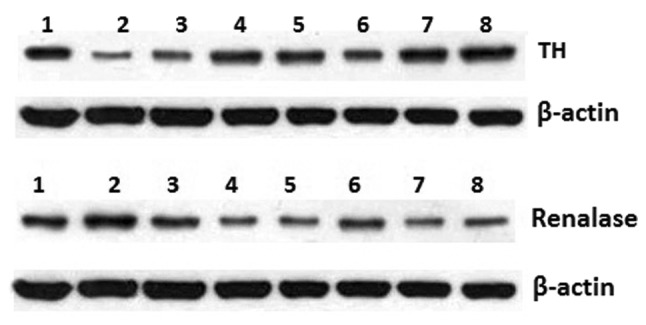
The aim of this study was to investigate the impact of renal denervation on the blood pressure, plasma renalase content and expression of renalase and tyrosine hydroxylase (TH) in the kidney of spontaneous hypertensive (SH) rats and to explore the mechanism of renal denervation involved in lowering blood pressure. SH rats (n=48) were randomly assigned to baseline, surgery (renal denervation), sham and control groups. WKY rats matched in age (n=12) served as the baseline control group. All rats were housed until they were 12 weeks old. The rats in the baseline group and the WKY group rats were sacrificed, and blood and kidney were collected for examination. In the renal denervation, sham and control groups, the blood pressure was continuously monitored. One and six weeks after renal denervation, 6 rats in each group were sacrificed, and blood and kidney were collected for examination. ELISA was employed to measure the plasma renalase, and western blot analysis was performed to detect the expression of TH and renalase in the kidney. Compared with the WKY rats, SH rats in the baseline group had significantly increased blood pressure and markedly elevated TH protein expression (P<0.05), but dramatically reduced plasma renalase content and protein expression of renalase in the kidney (P<0.05). One week after surgery, the mean arterial pressure and TH protein expression in the surgery group was lowered compared with the baseline group and dramatically reduced when compared with the sham and control groups (P<0.05). In the surgery group, renalase levels were markedly increased compared with the baseline, sham and control groups (P<0.05). Six weeks after renal denervation, the mean arterial pressure and TH levels in the surgery group were significantly increased while the renalase content and expression were markedly reduced compared with those at week 1, however, there were no marked differences among the surgery, sham and control groups (P>0.05). Moreover, no pronounced differences in the above variables were found between the sham and control groups at any timepoint (P>0.05). Renal denervation can lower blood pressure, which may be attributed to the suppression of sympathetic nerves, increase in plasma renalase content and renalase expression in the kidney.
本研究旨在探讨肾去神经支配对自发性高血压(SH)大鼠血压、血浆肾酶含量以及肾脏中肾酶和酪氨酸羟化酶(TH)表达的影响,并探究肾去神经支配参与降压的机制。将48只SH大鼠随机分为基线组、手术(肾去神经支配)组、假手术组和对照组。选取12只年龄匹配的WKY大鼠作为基线对照组。所有大鼠饲养至12周龄。处死基线组大鼠和WKY组大鼠,采集血液和肾脏进行检测。对肾去神经支配组、假手术组和对照组大鼠的血压进行持续监测。肾去神经支配术后1周和6周,每组处死6只大鼠,采集血液和肾脏进行检测。采用酶联免疫吸附测定法(ELISA)检测血浆肾酶,运用蛋白质免疫印迹分析检测肾脏中TH和肾酶的表达。与WKY大鼠相比,基线组SH大鼠血压显著升高,TH蛋白表达明显上调(P<0.05),但血浆肾酶含量及肾脏中肾酶蛋白表达显著降低(P<0.05)。术后1周,手术组平均动脉压和TH蛋白表达较基线组降低,与假手术组和对照组相比显著降低(P<0.05)。手术组肾酶水平较基线组、假手术组和对照组显著升高(P<0.05)。肾去神经支配术后6周,手术组平均动脉压和TH水平显著升高,而肾酶含量和表达较第1周显著降低,然而手术组、假手术组和对照组之间无显著差异(P>0.05)。此外,在任何时间点,假手术组和对照组上述变量均无明显差异(P>0.05)。肾去神经支配可降低血压,这可能归因于交感神经的抑制、血浆肾酶含量增加以及肾脏中肾酶表达增加。