School of Public Health and Health Services, the George Washington University, Washington, DC 20037, USA.
BMC Public Health. 2012 Nov 26;12:1031. doi: 10.1186/1471-2458-12-1031.
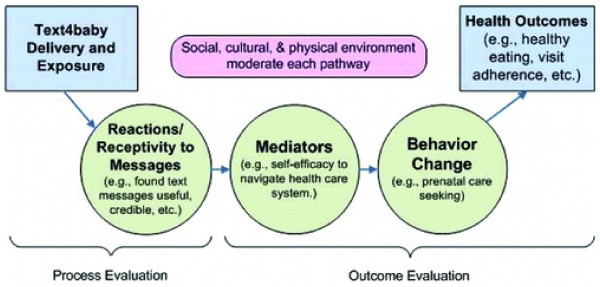
Mobile phone technologies for health promotion and disease prevention have evolved rapidly, but few studies have tested the efficacy of mobile health in full-fledged programs. Text4baby is an example of mobile health based on behavioral theory, and it delivers text messages to traditionally underserved pregnant women and new mothers to change their health, health care beliefs, practices, and behaviors in order to improve clinical outcomes. The purpose of this pilot evaluation study is to assess the efficacy of this text messaging campaign.
We conducted a randomized pilot evaluation study. All participants were pregnant women first presenting for care at the Fairfax County, Virginia Health Department. We randomized participants to enroll in text4baby and receive usual health care (intervention), or continue simply to receive usual care (control). We then conducted a 24-item survey by telephone of attitudes and behaviors related to text4baby. We surveyed participants at baseline, before text4baby was delivered to the intervention group, and at follow-up at approximately 28 weeks of baby's gestational age.
We completed 123 baseline interviews in English and in Spanish. Overall, the sample was predominantly of Hispanic origin (79.7%) with an average age of 27.6 years. We completed 90 follow-up interviews, and achieved a 73% retention rate. We used a logistic generalized estimating equation model to evaluate intervention effects on measured outcomes. We found a significant effect of text4baby intervention exposure on increased agreement with the attitude statement "I am prepared to be a new mother" (OR = 2.73, CI = 1.04, 7.18, p = 0.042) between baseline and follow-up. For those who had attained a high school education or greater, we observed a significantly higher overall agreement to attitudes against alcohol consumption during pregnancy (OR = 2.80, CI = 1.13, 6.90, p = 0.026). We also observed a significant improvement of attitudes toward alcohol consumption from baseline to follow-up (OR = 3.57, CI = 1.13 - 11.24, p = 0.029).
This pilot study is the first randomized evaluation of text4baby. It is a promising program in that exposure to the text messages was associated with changes in specific beliefs targeted by the messages.
移动电话技术在促进健康和预防疾病方面发展迅速,但很少有研究测试过完整的移动健康计划的疗效。Text4baby 就是一个基于行为理论的移动健康的例子,它向传统上服务不足的孕妇和新妈妈发送短信,改变她们的健康、健康信念、实践和行为,以改善临床结果。本试点评估研究的目的是评估该短信活动的疗效。
我们进行了一项随机试点评估研究。所有参与者均为首次在弗吉尼亚州费尔法克斯县卫生署就诊的孕妇。我们将参与者随机分配到 Text4baby 组并接受常规护理(干预组),或继续仅接受常规护理(对照组)。然后,我们通过电话对与 Text4baby 相关的态度和行为进行了 24 项调查。我们在基线时、向干预组发送 Text4baby 之前以及大约 28 周妊娠时进行了随访调查。
我们用英语和西班牙语完成了 123 次基线访谈。总体而言,样本主要来自西班牙裔(79.7%),平均年龄为 27.6 岁。我们完成了 90 次随访访谈,保留率为 73%。我们使用逻辑广义估计方程模型评估干预措施对测量结果的影响。我们发现 Text4baby 干预接触对增加对态度陈述“我准备成为新妈妈”的认同有显著影响(OR=2.73,CI=1.04,7.18,p=0.042),在基线和随访之间。对于那些受过高中或以上教育的人,我们观察到对怀孕期间反对饮酒的态度有显著更高的总体认同(OR=2.80,CI=1.13,6.90,p=0.026)。我们还观察到从基线到随访对饮酒态度的显著改善(OR=3.57,CI=1.13-11.24,p=0.029)。
本试点研究是对 Text4baby 的首次随机评估。这是一个有前途的项目,因为接触短信与信息所针对的特定信念的变化有关。