Kawaguchi Takumi, Torimura Takuji, Takata Akio, Satomi Susumu, Sata Michio
Division of Gastroenterology, Department of Medicine, Kurume University School of Medicine, Kurume, Japan ; Department of Digestive Disease Information and Research, Kurume University School of Medicine, Kurume, Japan ; Liver Cancer Research Division, Research Center for Innovative Cancer Therapy, Kurume University, Kurume, Japan.
Case Rep Gastroenterol. 2012 Sep;6(3):660-7. doi: 10.1159/000343094. Epub 2012 Oct 24.
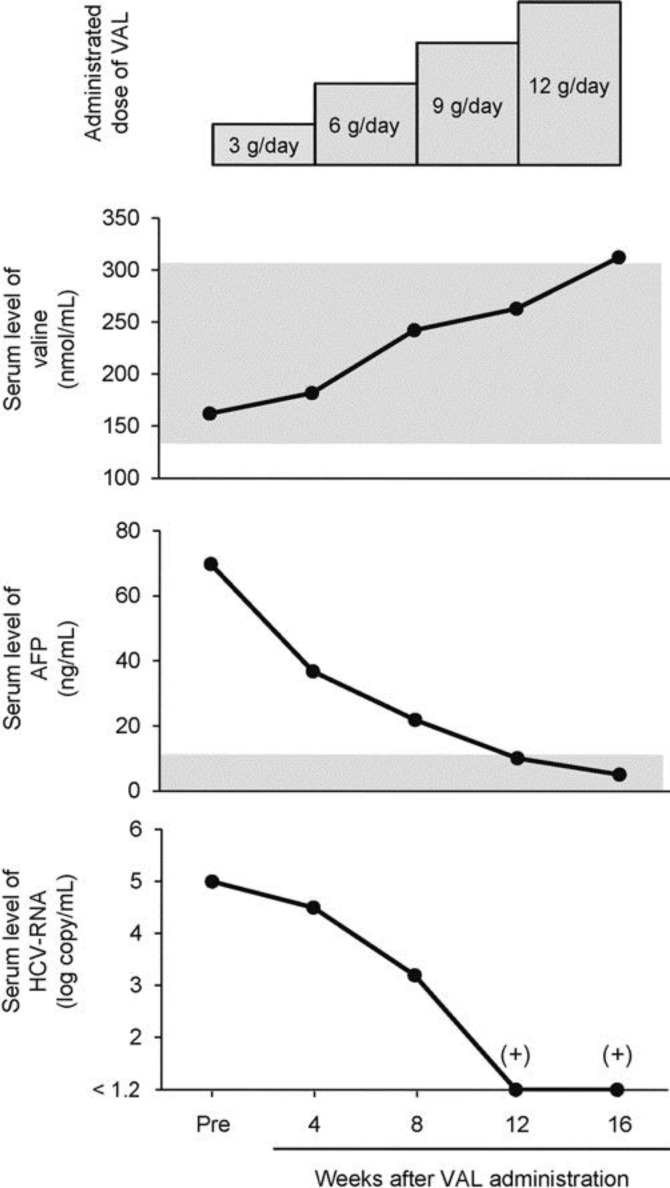
A decreased serum level of branched-chain amino acid (BCAA) is a distinctive metabolic disorder in patients with liver cirrhosis. Recently, BCAA has been reported to exert various pharmacological activities, and valine, which is a BCAA, has been shown to affect lipid metabolism and the immune system in in vivo experiments. However, the clinical impact of valine supplementation on viral hepatitis C virus (HCV) load has never been reported. Here, we first describe a case of HCV-related advanced liver cirrhosis that was treated by an oral valine agent. The administration of valine resulted in an improvement of fatigue and a reduction in hepatic fibrosis indexes as well as serum α-fetoprotein level. Furthermore, a marked reduction in HCV RNA levels was seen after valine treatment. The patient was then treated by interferon β, resulting in the successful eradication of chronic HCV infection. Thus, valine may be involved in the reduction of HCV viral load and could support a sustained virologic response to interferon therapy.
血清支链氨基酸(BCAA)水平降低是肝硬化患者一种独特的代谢紊乱。最近,有报道称BCAA具有多种药理活性,作为BCAA之一的缬氨酸在体内实验中已显示出会影响脂质代谢和免疫系统。然而,补充缬氨酸对丙型肝炎病毒(HCV)载量的临床影响尚未见报道。在此,我们首次描述了一例口服缬氨酸制剂治疗的HCV相关晚期肝硬化病例。缬氨酸的给药使疲劳症状得到改善,肝纤维化指标以及血清甲胎蛋白水平降低。此外,缬氨酸治疗后HCV RNA水平显著降低。该患者随后接受干扰素β治疗,成功根除了慢性HCV感染。因此,缬氨酸可能参与了HCV病毒载量的降低,并可能支持对干扰素治疗的持续病毒学应答。