Centro Cardiologico Monzino, I.R.C.C.S, Milan, Italy.
PLoS One. 2012;7(11):e48499. doi: 10.1371/journal.pone.0048499. Epub 2012 Nov 19.
Mechanisms linking chronic kidney disease (CKD) and adverse outcomes in acute coronary syndromes (ACS) are not fully understood. Among potential key players, reduced nitric oxide (NO) synthesis due to its endogenous inhibitors, asymmetric (ADMA) and symmetric (SDMA) dimethylarginine could be involved. We measured plasma concentration of arginine, ADMA and SDMA and investigated their relationship with CKD and long-term outcome in non-ST-elevation myocardial infarction (NSTEMI).
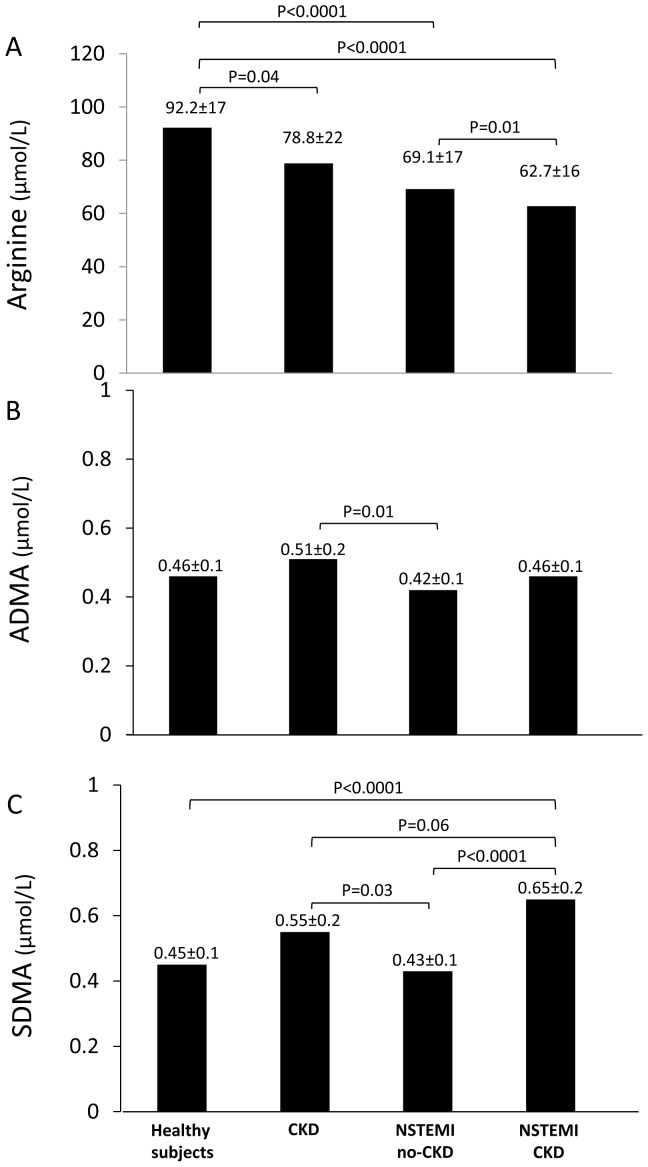
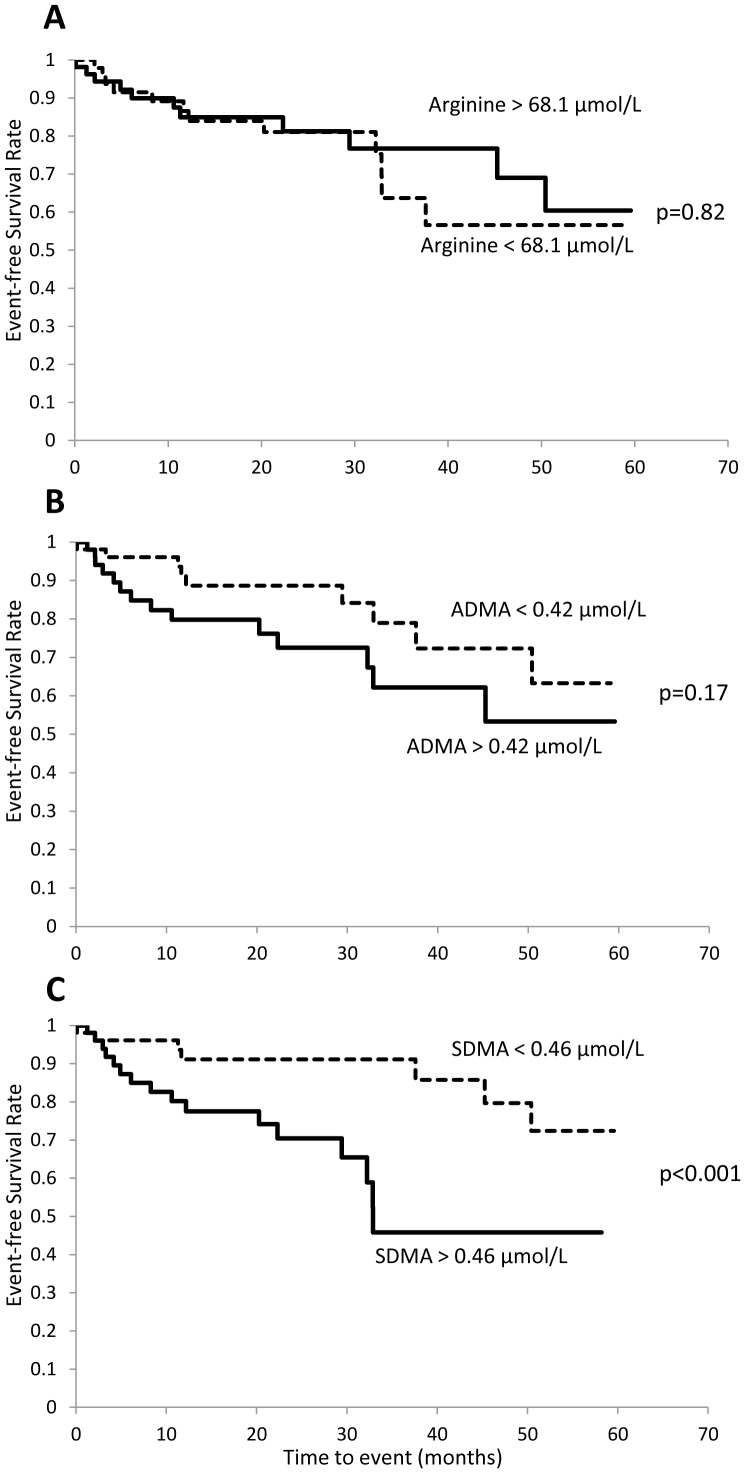
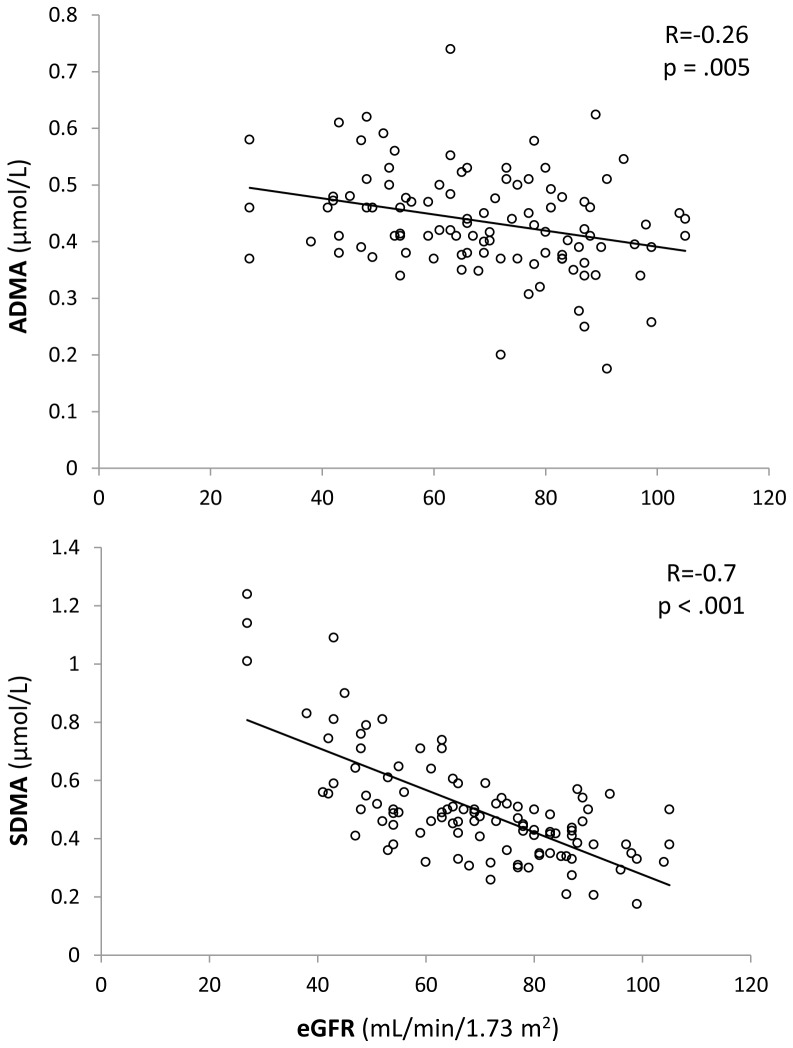
METHODOLOGY/PRINCIPAL FINDINGS: We prospectively measured arginine, ADMA, and SDMA at hospital admission in 104 NSTEMI patients. CKD was defined as an estimated glomerular filtration rate (eGFR) <60 ml/min/1.73 m(2). We considered a primary end point of combined cardiac death and re-infarction at a median follow-up of 21 months. In CKD (n = 33) and no-CKD (n = 71) patients, arginine and ADMA were similar, whereas SDMA was significantly higher in CKD patients (0.65±0.23 vs. 0.42±0.12 µmol/L; P<0.0001). Twenty-four (23%) patients had an adverse cardiac event during follow-up: 12 (36%) were CKD and 12 (17%) no-CKD patients (P = 0.02). When study population was stratified according to arginine, ADMA and SDMA median values, only SDMA (median 0.46 µmol/L) was associated with the primary end-point (P = 0.0016). In models adjusted for age, hemoglobin and left ventricular ejection fraction, the hazard ratio (HR) for CKD and SDMA were high (HR 2.93, interquartile range [IQR] 1.15-7.53; P = 0.02 and HR 6.80, IQR 2.09-22.2; P = 0.001, respectively) but, after mutual adjustment, only SDMA remained significantly associated with the primary end point (HR 5.73, IQR 1.55-21.2; P = 0.009).
CONCLUSIONS/SIGNIFICANCE: In NSTEMI patients, elevated SDMA plasma levels are associated with CKD and worse long-term prognosis.
慢性肾脏病(CKD)和急性冠状动脉综合征(ACS)不良结局之间的机制尚不完全清楚。在潜在的关键因素中,由于其内源性抑制剂不对称(ADMA)和对称二甲基精氨酸(SDMA),导致一氧化氮(NO)合成减少可能会涉及其中。我们检测了入院时的血浆精氨酸、ADMA 和 SDMA 浓度,并研究了它们与非 ST 段抬高型心肌梗死(NSTEMI)中的 CKD 及长期预后的关系。
方法/主要发现:我们前瞻性地检测了 104 例 NSTEMI 患者入院时的精氨酸、ADMA 和 SDMA。CKD 的定义为估算肾小球滤过率(eGFR)<60 ml/min/1.73 m2。我们以中位数随访 21 个月时的联合心脏死亡和再梗死为主要终点。在 CKD(n=33)和非 CKD(n=71)患者中,精氨酸和 ADMA 相似,而 SDMA 在 CKD 患者中明显更高(0.65±0.23 对 0.42±0.12 μmol/L;P<0.0001)。24 例(23%)患者在随访期间发生不良心脏事件:12 例(36%)为 CKD,12 例(17%)为非 CKD 患者(P=0.02)。根据精氨酸、ADMA 和 SDMA 的中位数将研究人群分层后,只有 SDMA(中位数 0.46 μmol/L)与主要终点相关(P=0.0016)。在校正年龄、血红蛋白和左心室射血分数后,CKD 和 SDMA 的风险比(HR)较高(HR 2.93,四分位距 [IQR] 1.15-7.53;P=0.02 和 HR 6.80,IQR 2.09-22.2;P=0.001,分别),但在相互调整后,只有 SDMA 与主要终点显著相关(HR 5.73,IQR 1.55-21.2;P=0.009)。
结论/意义:在 NSTEMI 患者中,升高的 SDMA 血浆水平与 CKD 和更差的长期预后相关。