Hall Jean A, Yerramilli Maha, Obare Edward, Yerramilli Murthy, Melendez Lynda D, Jewell Dennis E
Department of Biomedical Sciences, College of Veterinary Medicine, Oregon State University, Corvallis, OR, 97331-4802.
IDEXX Biotechnology Group, IDEXX Laboratories, Inc., Westbrook, ME, 04092.
J Vet Intern Med. 2015 May-Jun;29(3):808-14. doi: 10.1111/jvim.12607. Epub 2015 Apr 24.
Symmetric dimethylarginine (SDMA) is an accurate and precise biomarker for estimating glomerular filtration rate (GFR) in humans and cats. Serum creatinine (sCr) also correlates with GFR, but has limitations as a biomarker of renal function because nonrenal factors can influence its concentration.
Differences in lean body mass (LBM) influence sCr, but not serum SDMA concentrations.
Forty-one healthy Beagles, mean age 9.9 years (range: 3.1-14.8 years), were studied over a 6 month period.
Serum biomarkers of renal function were measured prospectively at baseline, and 1, 3, and 6 months. SDMA concentrations were measured by liquid chromatography-mass spectroscopy and sCr concentrations by enzymatic colorimetry. Body composition was determined by dual energy x-ray absorptiometry.
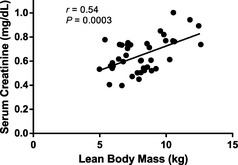
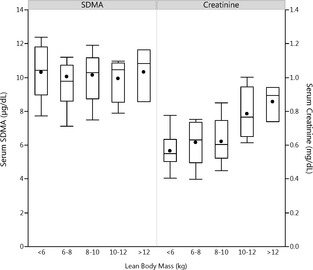
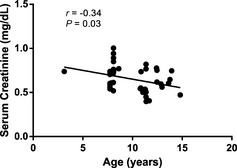
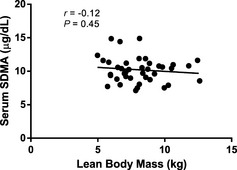
LBM (P < .001) and age (P = .006) were significant explanatory variables for sCr concentration (R(2) = 0.38), but not SDMA concentration. Time on food was the only significant explanatory variable for SDMA concentration (R(2) = 0.49). SDMA concentrations decreased across time (P < .001). LBM was affected by sex (males > females; P = .02). Mature adult dogs (<8 years) had greater LBM compared with geriatric dogs (≥8 years; P < .001).
sCr concentrations, but not SDMA concentrations, are influenced by LBM, which limits sCr utility as a biomarker for monitoring renal function in dogs with decreased LBM. Reductions in LBM can lower sCr concentration and overestimate GFR. SDMA concentrations, but not sCr concentrations were influenced by time on food. SDMA could have clinical advantages over sCr in monitoring response to nutritional interventions.
对称二甲基精氨酸(SDMA)是一种准确且精确的生物标志物,可用于评估人类和猫的肾小球滤过率(GFR)。血清肌酐(sCr)也与GFR相关,但作为肾功能的生物标志物存在局限性,因为非肾脏因素会影响其浓度。
瘦体重(LBM)的差异会影响sCr,但不会影响血清SDMA浓度。
对41只健康的比格犬进行了为期6个月的研究,平均年龄9.9岁(范围:3.1 - 14.8岁)。
在基线、1个月、3个月和6个月时前瞻性地测量肾功能的血清生物标志物。通过液相色谱 - 质谱法测量SDMA浓度,通过酶比色法测量sCr浓度。通过双能X线吸收法测定身体成分。
LBM(P <.001)和年龄(P =.006)是sCr浓度的显著解释变量(R² = 0.38),但不是SDMA浓度的解释变量。禁食时间是SDMA浓度的唯一显著解释变量(R² = 0.49)。SDMA浓度随时间下降(P <.001)。LBM受性别影响(雄性>雌性;P =.02)。成年犬(<8岁)的LBM比老年犬(≥8岁)更大(P <.001)。
LBM会影响sCr浓度,但不会影响SDMA浓度,这限制了sCr作为监测LBM降低的犬只肾功能生物标志物的效用。LBM降低会降低sCr浓度并高估GFR。SDMA浓度受禁食时间影响,而sCr浓度不受影响。在监测营养干预反应方面,SDMA可能比sCr具有临床优势。