Programa de Pós-Graduação em Ecologia, Instituto Nacional de Pesquisas da Amazônia (INPA), Manaus, Amazonas, Brasil.
PLoS One. 2012;7(11):e48559. doi: 10.1371/journal.pone.0048559. Epub 2012 Nov 20.
Native Amazonian populations managed forest resources in numerous ways, often creating oligarchic forests dominated by useful trees. The scale and spatial distribution of forest modification beyond pre-Columbian settlements is still unknown, although recent studies propose that human impact away from rivers was minimal. We tested the hypothesis that past human management of the useful tree community decreases with distance from rivers.
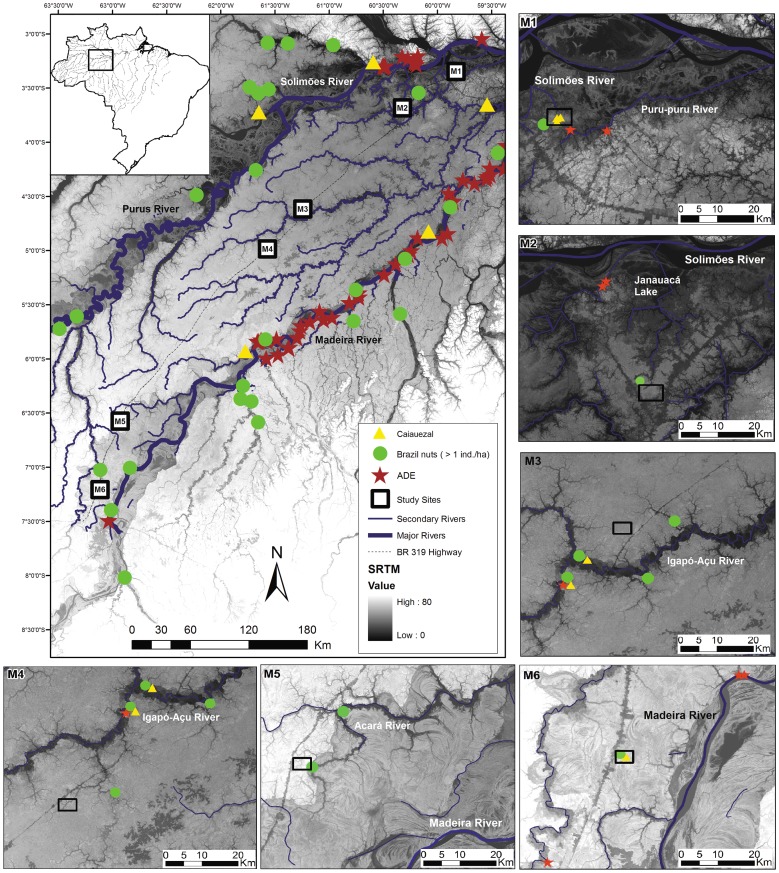
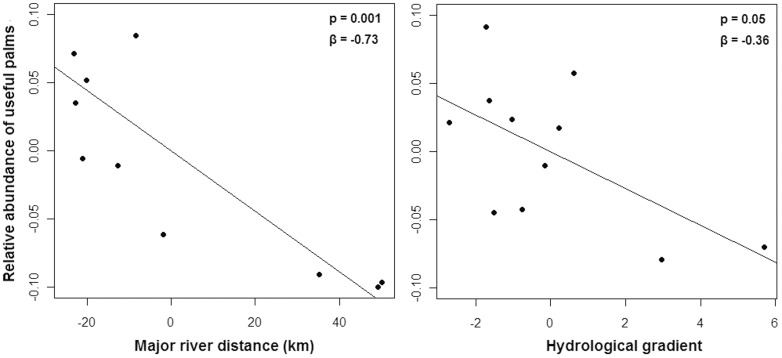
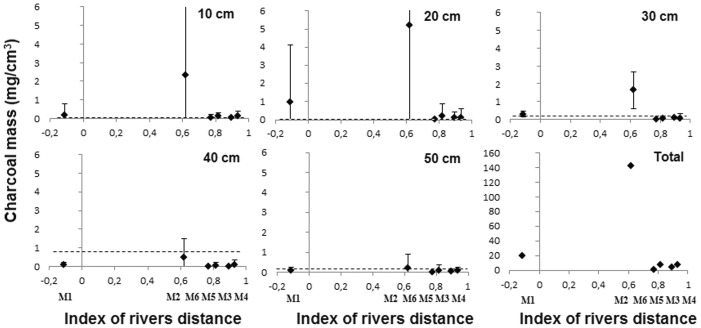
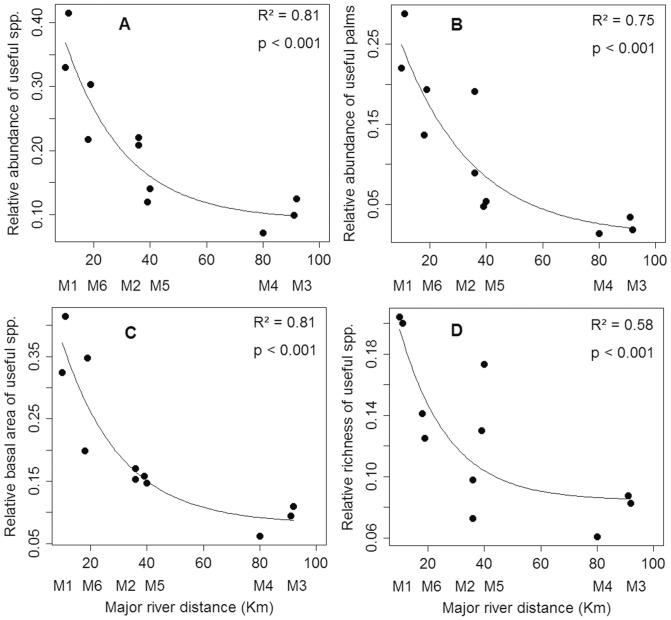
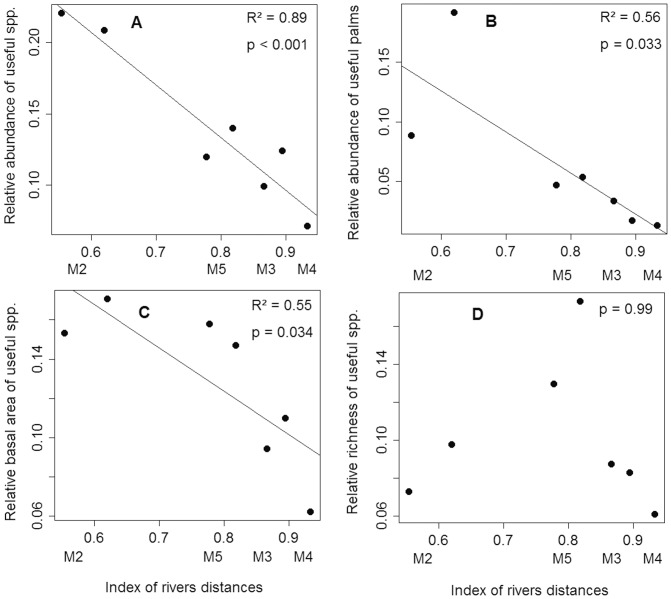
METHODOLOGY/PRINCIPAL FINDINGS: In six sites, we inventoried trees and palms with DBH≥10 cm and collected soil for charcoal analysis; we also mapped archaeological evidence around the sites. To quantify forest manipulation, we measured the relative abundance, richness and basal area of useful trees and palms. We found a strong negative exponential relationship between forest manipulation and distance to large rivers. Plots located from 10 to 20 km from a main river had 20-40% useful arboreal species, plots between 20 and 40 km had 12-23%, plots more than 40 km had less than 15%. Soil charcoal abundance was high in the two sites closest to secondary rivers, suggesting past agricultural practices. The shortest distance between archaeological evidence and plots was found in sites near rivers.
CONCLUSIONS/SIGNIFICANCE: These results strongly suggest that past forest manipulation was not limited to the pre-Columbian settlements along major rivers, but extended over interfluvial areas considered to be primary forest today. The sustainable use of Amazonian forests will be most effective if it considers the degree of past landscape domestication, as human-modified landscapes concentrate useful plants for human sustainable use and management today.
原生亚马逊地区的人们以多种方式管理森林资源,经常营造出由有用树木主导的寡头森林。在哥伦布前的定居点之外,森林改造的规模和空间分布仍不清楚,尽管最近的研究表明,远离河流的人类影响是最小的。我们检验了这样一个假设,即过去人类对有用树种社区的管理随着与河流的距离的增加而减少。
方法/主要发现:在六个地点,我们对胸径≥10 厘米的树木和棕榈进行了清查,并收集了土壤进行木炭分析;我们还在这些地点周围绘制了考古证据图。为了量化森林管理,我们测量了有用树木和棕榈的相对丰度、丰富度和基面积。我们发现,森林管理与到大河的距离之间存在强烈的负指数关系。距离主要河流 10-20 公里的地段有 20-40%的有用树木物种,20-40 公里的地段有 12-23%,40 公里以上的地段有少于 15%。距离次要河流最近的两个地点的土壤木炭丰度较高,这表明过去存在农业活动。在靠近河流的地点,考古证据与地段之间的最短距离。
结论/意义:这些结果强烈表明,过去的森林管理不仅限于主要河流沿岸的哥伦布前定居点,还扩展到了今天被认为是原始森林的河间地区。如果考虑到过去景观驯化的程度,亚马逊森林的可持续利用将是最有效的,因为人类改造的景观集中了对人类可持续利用和管理有用的植物。