• 文献检索
  • 文档翻译
  • 深度研究
  • 学术资讯
  • Suppr Zotero 插件Zotero 插件
  • 邀请有礼
  • 套餐&价格
  • 历史记录
应用&插件
Suppr Zotero 插件Zotero 插件浏览器插件Mac 客户端Windows 客户端微信小程序
定价
高级版会员购买积分包购买API积分包
服务
文献检索文档翻译深度研究API 文档MCP 服务
关于我们
关于 Suppr公司介绍联系我们用户协议隐私条款
关注我们

Suppr 超能文献

核心技术专利:CN118964589B侵权必究
粤ICP备2023148730 号-1Suppr @ 2026

文献检索

告别复杂PubMed语法,用中文像聊天一样搜索,搜遍4000万医学文献。AI智能推荐,让科研检索更轻松。

立即免费搜索

文件翻译

保留排版,准确专业,支持PDF/Word/PPT等文件格式,支持 12+语言互译。

免费翻译文档

深度研究

AI帮你快速写综述,25分钟生成高质量综述,智能提取关键信息,辅助科研写作。

立即免费体验

治疗皮肤基底细胞癌和鳞状细胞癌 5 年后肿瘤复发。

Tumor recurrence 5 years after treatment of cutaneous basal cell carcinoma and squamous cell carcinoma.

机构信息

Department of Dermatology, University of California at San Francisco, San Francisco, California 94143-0808, USA.

出版信息

J Invest Dermatol. 2013 May;133(5):1188-96. doi: 10.1038/jid.2012.403. Epub 2012 Nov 29.

DOI:10.1038/jid.2012.403
PMID:23190903
原文链接:https://pmc.ncbi.nlm.nih.gov/articles/PMC3711403/
Abstract

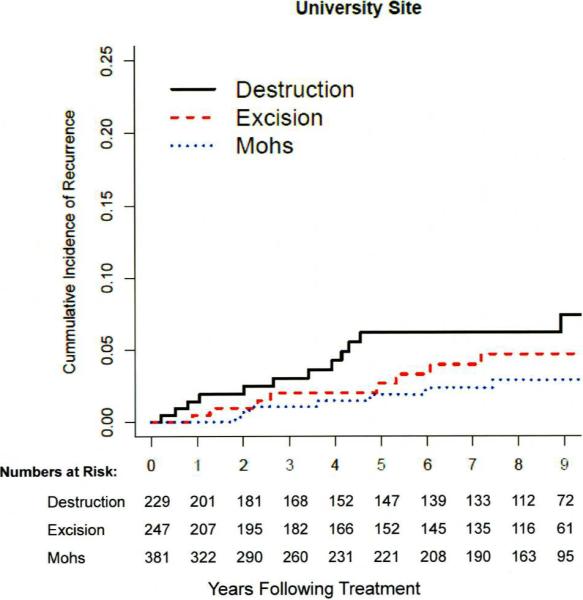
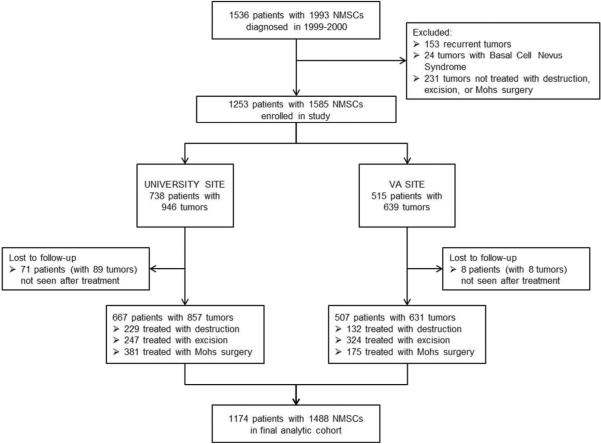
For most cutaneous basal cell and squamous cell carcinomas (nonmelanoma skin cancers (NMSCs)), data are insufficient to permit evidence-based choices among treatments. To compare tumor recurrence after treatments, we conducted a prospective cohort study of consecutive patients with primary NMSCs treated with the most common treatments, in two practices in 1999-2000. Recurrence was determined from medical records by observers blinded to treatment type. Follow-up was available for 1,174 patients with 1,488 tumors (93.8%) at median 7.4 years; of these tumors, 24.3% (N=361) were treated with destruction with electrodessication/curettage, 38.3% (N=571) with excision, and 37.4% (N=556) with histologically guided serial excision (Mohs surgery). The overall 5-year tumor recurrence rate (95% confidence interval) was 3.3% (2.3, 4.4). Unadjusted recurrence rates did not differ after treatments: 4.9% (2.3, 7.4) after destruction, 3.5% (1.8, 5.2) after excision, and 2.1% (0.6, 3.5) after Mohs surgery (P=0.26), and no difference was seen after adjustment for risk factors. In tumors treated only with excision or Mohs surgery, the hazard of recurrence was not significantly different, even after adjustment for propensity for treatment with Mohs surgery. These data indicate that common treatments for NMSCs were at least 95% effective, and further studies are needed to guide therapeutic choices for different clinical subgroups.

摘要

对于大多数皮肤基底细胞癌和鳞状细胞癌(非黑色素瘤皮肤癌(NMSC)),数据不足以在治疗方案之间做出基于证据的选择。为了比较治疗后的肿瘤复发情况,我们对 1999 年至 2000 年期间在两个实践中接受最常见治疗的原发性 NMSC 连续患者进行了前瞻性队列研究。通过观察者从病历中确定治疗后肿瘤的复发情况,观察者对治疗类型不知情。中位随访时间为 7.4 年,共 1174 例患者(1488 个肿瘤)可获得随访结果;这些肿瘤中,24.3%(N=361)采用电干燥/刮除术破坏治疗,38.3%(N=571)采用切除术治疗,37.4%(N=556)采用组织学引导的连续切除(Mohs 手术)治疗。总的 5 年肿瘤复发率(95%置信区间)为 3.3%(2.3, 4.4)。治疗后未调整的复发率无差异:破坏治疗后为 4.9%(2.3, 7.4),切除治疗后为 3.5%(1.8, 5.2),Mohs 手术后为 2.1%(0.6, 3.5)(P=0.26),治疗倾向性调整后也无差异。在仅接受切除术或 Mohs 手术治疗的肿瘤中,即使在调整了 Mohs 手术治疗倾向后,复发的风险也没有显著差异。这些数据表明,NMSC 的常见治疗方法至少有效 95%,需要进一步研究来指导不同临床亚组的治疗选择。
https://cdn.ncbi.nlm.nih.gov/pmc/blobs/3602/3711403/6a20ced12a96/nihms-410938-f0002.jpg
https://cdn.ncbi.nlm.nih.gov/pmc/blobs/3602/3711403/f85cd1800080/nihms-410938-f0001.jpg
https://cdn.ncbi.nlm.nih.gov/pmc/blobs/3602/3711403/6a20ced12a96/nihms-410938-f0002.jpg
https://cdn.ncbi.nlm.nih.gov/pmc/blobs/3602/3711403/f85cd1800080/nihms-410938-f0001.jpg
https://cdn.ncbi.nlm.nih.gov/pmc/blobs/3602/3711403/6a20ced12a96/nihms-410938-f0002.jpg

相似文献

1
Tumor recurrence 5 years after treatment of cutaneous basal cell carcinoma and squamous cell carcinoma.治疗皮肤基底细胞癌和鳞状细胞癌 5 年后肿瘤复发。
J Invest Dermatol. 2013 May;133(5):1188-96. doi: 10.1038/jid.2012.403. Epub 2012 Nov 29.
2
Recurrence after treatment of nonmelanoma skin cancer: a prospective cohort study.非黑色素瘤皮肤癌治疗后的复发:一项前瞻性队列研究。
Arch Dermatol. 2011 May;147(5):540-6. doi: 10.1001/archdermatol.2011.109.
3
Tumor recurrence of keratinocyte carcinomas judged appropriate for Mohs micrographic surgery using Appropriate Use Criteria.根据合理使用标准判断适合莫氏显微外科手术的角质形成细胞癌的肿瘤复发情况。
J Am Acad Dermatol. 2017 Jun;76(6):1131-1138.e1. doi: 10.1016/j.jaad.2016.12.045. Epub 2017 Mar 29.
4
Recurrence of basosquamous carcinoma after Mohs micrographic surgery.Mohs 显微外科手术后基底细胞鳞癌复发。
Dermatology. 2010;221(4):352-5. doi: 10.1159/000320127. Epub 2010 Oct 2.
5
Outcomes in intermediate-risk squamous cell carcinomas treated with Mohs micrographic surgery compared with wide local excision.Mohs 显微外科手术与广泛局部切除治疗中危鳞状细胞癌的结果比较。
J Am Acad Dermatol. 2020 May;82(5):1195-1204. doi: 10.1016/j.jaad.2019.12.049. Epub 2019 Dec 27.
6
Risk Factors and Rate of Recurrence after Mohs Surgery in Basal Cell and Squamous Cell Carcinomas: A Nationwide Prospective Cohort (REGESMOHS, Spanish Registry of Mohs Surgery).Mohs 手术治疗基底细胞癌和鳞状细胞癌的复发风险因素和复发率:一项全国性前瞻性队列研究(REGESMOHS,西班牙 Mohs 手术登记处)。
Acta Derm Venereol. 2021 Nov 24;101(11):adv00602. doi: 10.2340/actadv.v101.544.
7
Melanomas of the head and neck have high-local recurrence risk features and require tissue-rearranging reconstruction more commonly than basal cell carcinoma and squamous cell carcinoma: A comparison of indications for microscopic margin control prior to reconstruction in 13,664 tumors.头颈部黑素瘤具有高局部复发风险特征,比基底细胞癌和鳞状细胞癌更需要组织重建:对 13664 个肿瘤重建前进行微观边缘控制适应证的比较。
J Am Acad Dermatol. 2021 Aug;85(2):409-418. doi: 10.1016/j.jaad.2018.11.020. Epub 2018 Nov 17.
8
Characteristics of non-melanoma skin cancers of the cutaneous perioral and vermilion lip treated by Mohs micrographic surgery.经Mohs 显微外科手术治疗的皮肤口腔周围和唇红部非黑素瘤皮肤癌的特征。
J Eur Acad Dermatol Venereol. 2019 Feb;33(2):305-311. doi: 10.1111/jdv.15263. Epub 2018 Nov 6.
9
Recurrence of periocular basal cell carcinoma and squamous cell carcinoma after Mohs micrographic surgery: a retrospective cohort study.眼周基底细胞癌和鳞状细胞癌经 Mohs 显微手术切除后复发:一项回顾性队列研究。
Br J Dermatol. 2019 May;180(5):1176-1182. doi: 10.1111/bjd.17516. Epub 2019 Feb 10.
10
Recurrence rates of cutaneous squamous cell carcinoma of the head and neck after Mohs micrographic surgery vs. standard excision: a retrospective cohort study.Mohs 显微描记手术与标准切除术治疗头颈部皮肤鳞状细胞癌的复发率:一项回顾性队列研究。
Br J Dermatol. 2019 Aug;181(2):338-343. doi: 10.1111/bjd.17188. Epub 2018 Oct 28.

引用本文的文献

1
The Role of Cetuximab in Non-Melanoma Skin Cancer: A Review of Clinical Evidence and Emerging Strategies.西妥昔单抗在非黑色素瘤皮肤癌中的作用:临床证据与新兴策略综述
Curr Treat Options Oncol. 2025 Jul 9. doi: 10.1007/s11864-025-01335-3.
2
A Review of Neoadjuvant PD-1 Inhibitors in the Setting of Cutaneous Malignancies.皮肤恶性肿瘤背景下新辅助PD-1抑制剂的综述
J Clin Aesthet Dermatol. 2025 May 1;18(5):30-35.
3
Is a 3 mm Surgical Margin Safe for Basal Cell Carcinoma in the Head and Neck that is Less than 2 cm, Considering Different Risk Factors?

本文引用的文献

1
Mohs micrographic surgery and surgical excision for nonmelanoma skin cancer treatment in the Medicare population.医疗保险人群中莫氏显微外科手术和手术切除治疗非黑色素瘤皮肤癌的情况
Arch Dermatol. 2012 Apr;148(4):473-7. doi: 10.1001/archdermatol.2011.2456.
2
Fee comparisons of treatments for nonmelanoma skin cancer in a private practice academic setting.私人执业学术环境中非黑色素瘤皮肤癌治疗费用比较。
Dermatol Surg. 2012 Apr;38(4):570-84. doi: 10.1111/j.1524-4725.2011.02231.x. Epub 2011 Dec 6.
3
Comparative effectiveness research and patients with multiple chronic conditions.
考虑不同风险因素时,3毫米的手术切缘对于头颈部小于2厘米的基底细胞癌是否安全?
Arch Plast Surg. 2024 Aug 6;51(5):487-494. doi: 10.1055/a-2338-9192. eCollection 2024 Sep.
4
Squamous Cell Carcinoma of the Nail Bed.甲床鳞状细胞癌
Perm J. 2024 Dec 16;28(4):103-106. doi: 10.7812/TPP/23.138. Epub 2024 Sep 20.
5
Clinical Characteristics of Local Recurrent Basal Cell Carcinoma After Surgical Excision: A Retrospective Study of the Patients From a Tertiary Clinical Center.手术切除后局部复发性基底细胞癌的临床特征:来自三级临床中心患者的回顾性研究
Cureus. 2024 Aug 12;16(8):e66668. doi: 10.7759/cureus.66668. eCollection 2024 Aug.
6
Mohs Micrographic Surgery for Cutaneous Squamous Cell Carcinoma.皮肤鳞状细胞癌的莫氏显微外科手术
Cancers (Basel). 2024 Jun 28;16(13):2394. doi: 10.3390/cancers16132394.
7
Global burden and prediction study of cutaneous squamous cell carcinoma from 1990 to 2030: A systematic analysis and comparison with China.全球 1990 年至 2030 年皮肤鳞状细胞癌的负担和预测研究:与中国的系统分析和比较。
J Glob Health. 2024 May 3;14:04093. doi: 10.7189/jogh.14.04093.
8
Treatment of Basal Cell Carcinoma of the Lower Eyelid With High-Dose-Rate Brachytherapy.高剂量率近距离放射治疗下睑基底细胞癌
Cureus. 2024 Jan 27;16(1):e53067. doi: 10.7759/cureus.53067. eCollection 2024 Jan.
9
Multicenter Retrospective Andalusian Study of the Use of Sonidegib for the Treatment of Local Advanced Basal Cell Carcinoma in Real Clinical Practice.多中心回顾性安达卢西亚研究:在实际临床实践中使用索尼德吉治疗局部晚期基底细胞癌
J Clin Med. 2023 Aug 29;12(17):5631. doi: 10.3390/jcm12175631.
10
Adequacy of surgical margins, re-excision, and evaluation of factors associated with recurrence: a retrospective study of 769 basal cell carcinomas.切缘充分性、再次切除以及与复发相关因素的评估:769 例基底细胞癌的回顾性研究。
An Bras Dermatol. 2023 Jul-Aug;98(4):449-459. doi: 10.1016/j.abd.2022.07.005. Epub 2023 Mar 16.
比较效果研究与患有多种慢性病的患者
N Engl J Med. 2011 Jun 30;364(26):2478-81. doi: 10.1056/NEJMp1100535. Epub 2011 Jun 22.
4
Recurrence after treatment of nonmelanoma skin cancer: a prospective cohort study.非黑色素瘤皮肤癌治疗后的复发:一项前瞻性队列研究。
Arch Dermatol. 2011 May;147(5):540-6. doi: 10.1001/archdermatol.2011.109.
5
Incidence estimate of nonmelanoma skin cancer in the United States, 2006.2006年美国非黑色素瘤皮肤癌的发病率估计
Arch Dermatol. 2010 Mar;146(3):283-7. doi: 10.1001/archdermatol.2010.19.
6
Mohs micrographic surgery for Basal cell carcinoma of the face.面部基底细胞癌的莫氏显微外科手术。
Arch Dermatol. 2009 Dec;145(12):1428-30. doi: 10.1001/archdermatol.2009.315.
7
Surgical decision making for basal-cell carcinoma of the face.面部基底细胞癌的手术决策
Lancet Oncol. 2008 Dec;9(12):1119-20. doi: 10.1016/S1470-2045(08)70292-4.
8
Surgical excision versus Mohs' micrographic surgery for primary and recurrent basal-cell carcinoma of the face: a prospective randomised controlled trial with 5-years' follow-up.手术切除与莫氏显微描记手术治疗面部原发性和复发性基底细胞癌的比较:一项为期5年随访的前瞻性随机对照试验。
Lancet Oncol. 2008 Dec;9(12):1149-56. doi: 10.1016/S1470-2045(08)70260-2. Epub 2008 Nov 17.
9
Quality-of-life outcomes of treatments for cutaneous basal cell carcinoma and squamous cell carcinoma.皮肤基底细胞癌和鳞状细胞癌治疗的生活质量结果
J Invest Dermatol. 2007 Jun;127(6):1351-7. doi: 10.1038/sj.jid.5700740. Epub 2007 Feb 15.
10
Cost-effectiveness of Mohs micrographic surgery vs surgical excision for basal cell carcinoma of the face.莫氏显微外科手术与手术切除治疗面部基底细胞癌的成本效益分析
Arch Dermatol. 2006 Sep;142(9):1235; author reply 1235-6. doi: 10.1001/archderm.142.9.1235-a.