Paúl Constança, Ribeiro Oscar, Teixeira Laetitia
Research and Education Unit on Ageing, UnIFai, ICBAS, Institute of Biomedical Sciences Abel Salazar, Universidade do Porto, 4050-313 Porto, Portugal.
Curr Gerontol Geriatr Res. 2012;2012:382972. doi: 10.1155/2012/382972. Epub 2012 Oct 31.
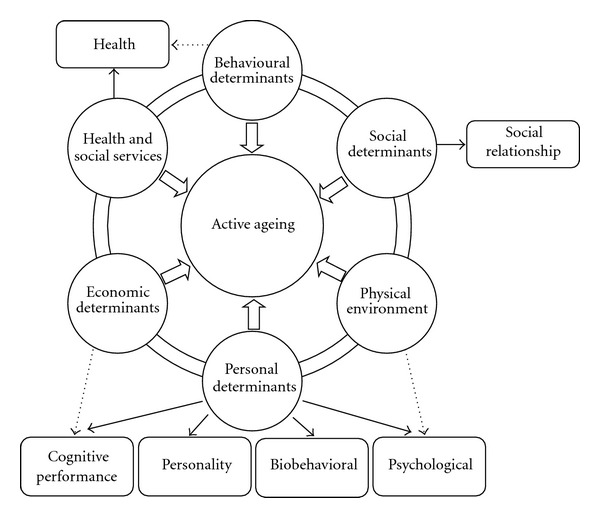
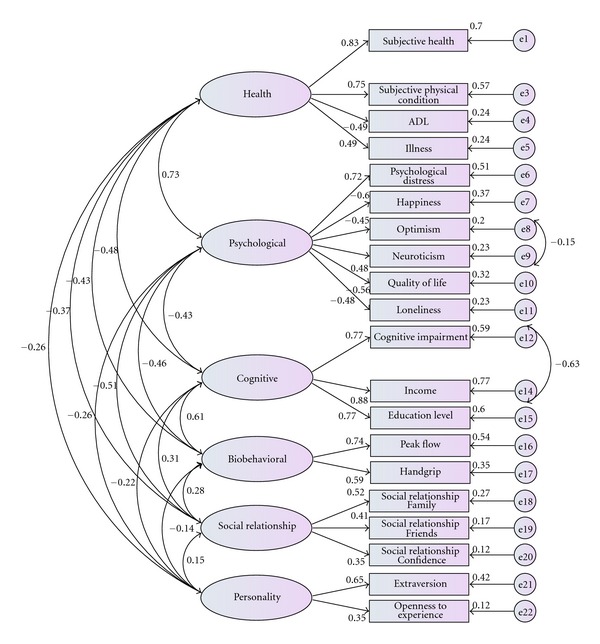
Background. In the beginning of the 21st century, the world summit on population taking place in Madrid approved active ageing, WHO (2002) as the main objective of health and social policies for old people. Few studies have been done on the scientific validity of the construct. This study aims to validate the construct of active ageing and test empirically the WHO (2002) model of Active Ageing in a sample of community-dwelling seniors. Methods. 1322 old people living in the community were interviewed using an extensive assessment protocol to measure WHO's determinants of active ageing and performed an exploratory factor analysis followed by a confirmatory factor analyses. Results. We did not confirm the active ageing model, as most of the groups of determinants are either not independent or not significant. We got to a six-factor model (health, psychological component, cognitive performance, social relationships, biobehavioural component, and personality) explaining 54.6% of total variance. Conclusion. The present paper shows that there are objective as well as subjective variables contributing to active ageing and that psychological variables seem to give a very important contribute to the construct. The profile of active ageing is expected to vary between contexts and cultures and can be used to guide specific community and individually based interventions.
背景。21世纪初,在马德里召开的世界人口峰会批准了积极老龄化这一世界卫生组织(2002年)提出的老年人健康和社会政策的主要目标。关于这一概念的科学有效性的研究较少。本研究旨在验证积极老龄化的概念,并在社区居住的老年人样本中对世界卫生组织(2002年)的积极老龄化模型进行实证检验。方法。采用广泛的评估方案对1322名社区居住的老年人进行访谈,以测量世界卫生组织确定的积极老龄化的决定因素,并进行探索性因素分析,随后进行验证性因素分析。结果。我们没有证实积极老龄化模型,因为大多数决定因素组要么不独立,要么不显著。我们得出了一个六因素模型(健康、心理成分、认知表现、社会关系、生物行为成分和个性),该模型解释了总方差的54.6%。结论。本文表明,有客观和主观变量促成了积极老龄化,并且心理变量似乎对这一概念有非常重要的贡献。积极老龄化的特征预计会因背景和文化而异,可用于指导具体的社区干预和基于个体的干预。