Genes to Cognition Programme, Centre for Clinical Brain Sciences and Centre for Neuroregeneration, The University of Edinburgh, Edinburgh, UK.
Nat Neurosci. 2013 Jan;16(1):16-24. doi: 10.1038/nn.3276. Epub 2012 Dec 2.
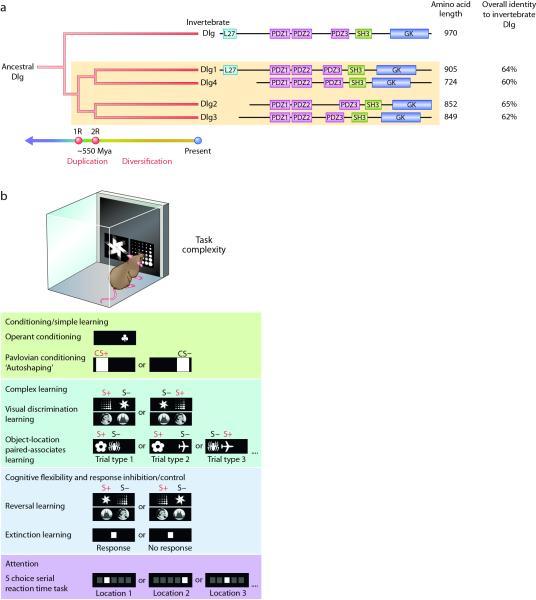
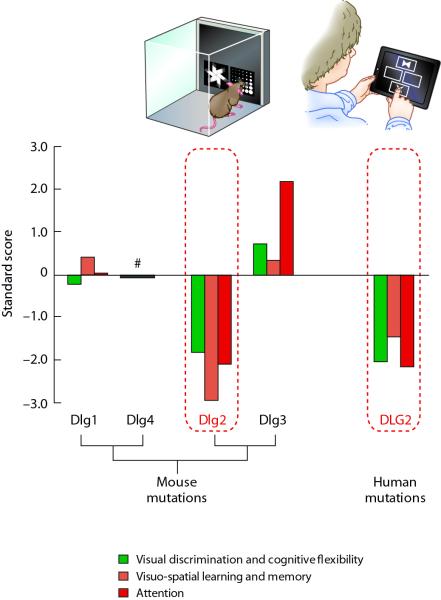
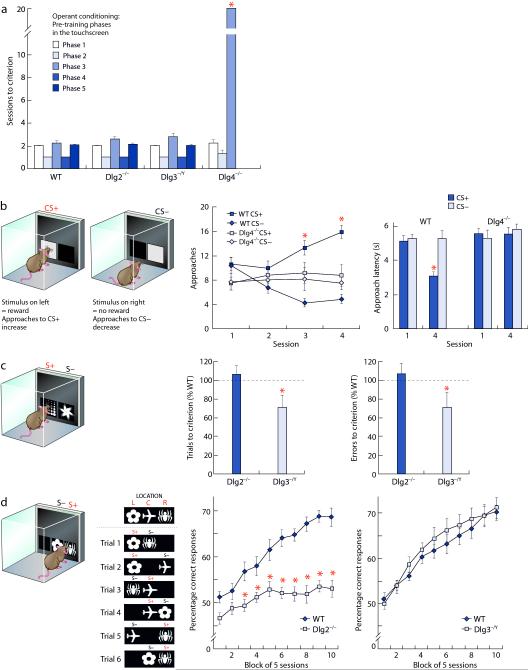
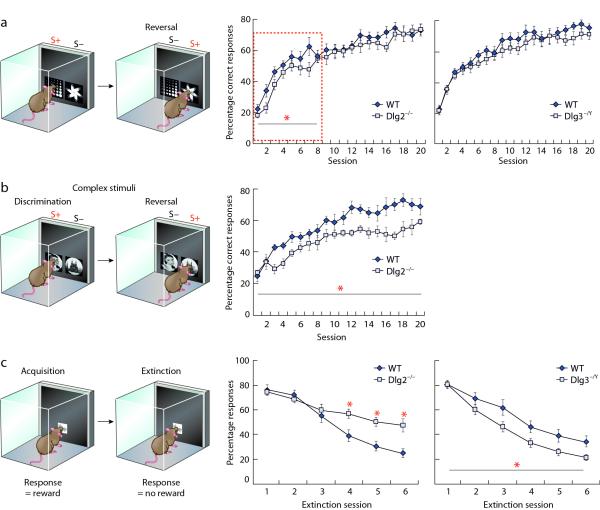
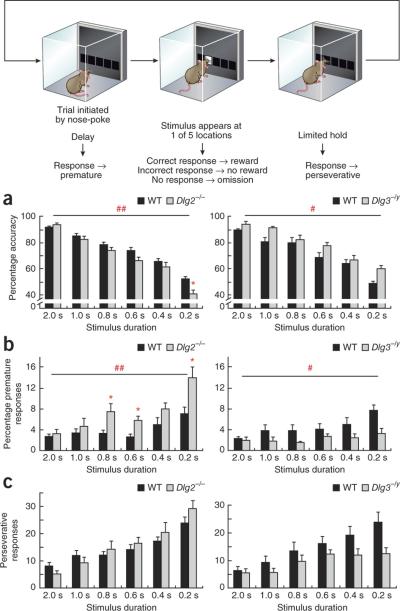
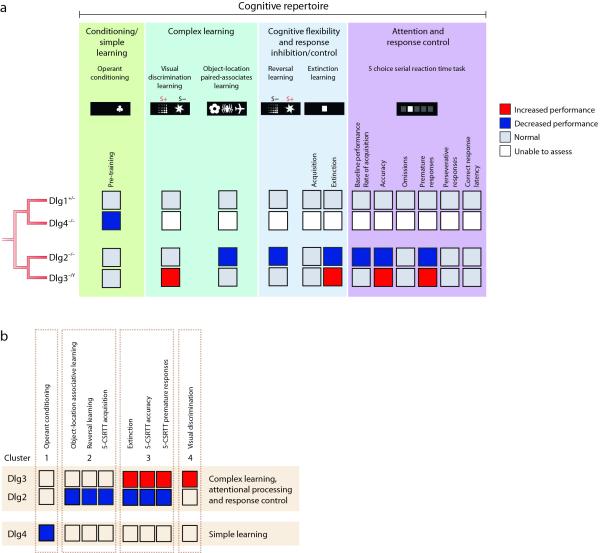
The origins and evolution of higher cognitive functions, including complex forms of learning, attention and executive functions, are unknown. A potential mechanism driving the evolution of vertebrate cognition early in the vertebrate lineage (550 million years ago) was genome duplication and subsequent diversification of postsynaptic genes. Here we report, to our knowledge, the first genetic analysis of a vertebrate gene family in cognitive functions measured using computerized touchscreens. Comparison of mice carrying mutations in each of the four Dlg paralogs showed that simple associative learning required Dlg4, whereas Dlg2 and Dlg3 diversified to have opposing functions in complex cognitive processes. Exploiting the translational utility of touchscreens in humans and mice, testing Dlg2 mutations in both species showed that Dlg2's role in complex learning, cognitive flexibility and attention has been highly conserved over 100 million years. Dlg-family mutations underlie psychiatric disorders, suggesting that genome evolution expanded the complexity of vertebrate cognition at the cost of susceptibility to mental illness.
高级认知功能(包括复杂形式的学习、注意力和执行功能)的起源和进化尚不清楚。一种潜在的机制可能推动了脊椎动物认知的进化,这种机制发生在脊椎动物谱系的早期(5.5 亿年前),即通过基因组复制和随后的突触后基因多样化。在这里,我们报告了我们所知的第一个使用计算机化触摸屏测量认知功能的脊椎动物基因家族的遗传分析。比较携带四个 Dlg 基因家族的突变的小鼠,发现简单的联想学习需要Dlg4,而 Dlg2 和 Dlg3 多样化,在复杂的认知过程中具有相反的功能。利用触摸屏在人类和小鼠中的翻译效用,在这两个物种中测试 Dlg2 的突变,表明 Dlg2 在复杂学习、认知灵活性和注意力方面的作用在 1 亿多年的时间里得到了高度的保守。Dlg 基因突变是精神疾病的基础,这表明基因组进化以易患精神疾病为代价,扩大了脊椎动物认知的复杂性。