Department of Orthopaedics and Rehabilitation, University of Florida, 3450 Hull Road, Gainesville, FL 32607, USA.
Knee Surg Sports Traumatol Arthrosc. 2013 Sep;21(9):2107-12. doi: 10.1007/s00167-012-2309-7. Epub 2012 Dec 1.
To compare the clinical outcomes of bone-patellar tendon-bone (BTB) allografts processed via a novel sterilization system with the traditional aseptically processed BTB allografts for anterior cruciate ligament (ACL) reconstruction.
A total of 67 patients undergoing ACL reconstruction at 6 independent investigation sites were randomized into one of two intervention groups, BioCleanse-sterilized or aseptic BTB allografts. Inclusion criteria included an acute, isolated, unilateral ACL tear, and exclusion criteria included prior ACL injury, multi-ligament reconstruction, and signs of degenerative joint disease. Post-op examiners and patients were blinded to graft type. Patients were evaluated at 6, 12, and 24 months. Clinical outcomes were compared using the IKDC, a KT-1000 knee arthrometer, level of effusion, and ranges of motion (ROM).
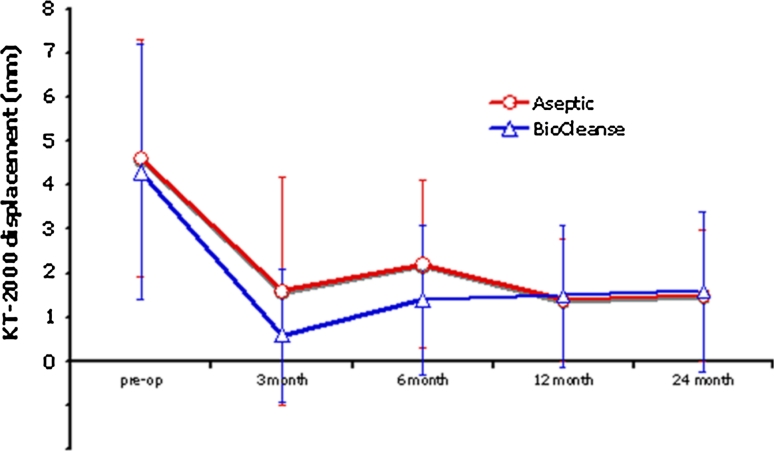
After randomization, 24 patients received aseptic BTB allografts and 43 patients received BioCleanse-sterilized allografts. Significant improvement in IKDC scores (P < 0.0001) as well as KT-1000 results (P < 0.0001) was noted over the 24-month period for both groups. IKDC or KT-1000 results were not significantly different between groups at any time point. Active flexion ROM significantly improved from pre-op to 24-month follow-up (P < 0.0001) with no difference between groups at any time point. Active extension ROM did not differ significantly between the two groups.
These results indicate that the sterilization process, BioCleanse, did not demonstrate a statistical difference in clinical outcomes for the BTB allograft at 2 years. The BioCleanse process may provide surgeons with allografts clinically similar to aseptically processed allograft tissue with the benefit of addressing donor-to-recipient disease.
II.
比较新型消毒系统处理的骨-髌腱-骨(BTB)同种异体移植物与传统无菌处理的 BTB 同种异体移植物在前交叉韧带(ACL)重建中的临床效果。
共有 67 名在 6 个独立研究地点接受 ACL 重建的患者随机分为两组,分别接受 BioCleanse 消毒或无菌 BTB 同种异体移植物。纳入标准包括急性、孤立性、单侧 ACL 撕裂,排除标准包括既往 ACL 损伤、多韧带重建和退行性关节病迹象。术后检查者和患者对移植物类型均不知情。患者在术后 6、12 和 24 个月进行评估。使用 IKDC 比较临床结果,包括 KT-1000 膝关节关节测量仪、积液水平和活动范围(ROM)。
随机分组后,24 名患者接受无菌 BTB 同种异体移植物,43 名患者接受 BioCleanse 消毒同种异体移植物。两组在 24 个月的随访期间,IKDC 评分(P < 0.0001)和 KT-1000 结果(P < 0.0001)均有显著改善。在任何时间点,两组的 IKDC 或 KT-1000 结果均无显著差异。主动屈曲 ROM 从术前到 24 个月的随访显著改善(P < 0.0001),两组在任何时间点均无差异。主动伸展 ROM 两组间无显著差异。
这些结果表明,在 2 年时,消毒过程 BioCleanse 对 BTB 同种异体移植物的临床效果没有统计学差异。BioCleanse 过程可能为外科医生提供与无菌处理同种异体组织在临床上相似的同种异体移植物,同时还能解决供体与受体疾病的问题。
II 级。