Department of Preventive Medicine, Nagoya University Graduate School of Medicine, Nagoya, Japan.
Clin Interv Aging. 2012;7:481-7. doi: 10.2147/CIA.S36289. Epub 2012 Nov 12.
The purpose of this study is to determine whether elderly subjects with severe brain atrophy, which is associated with neurodegeneration and difficulty swallowing (dysphagia), are more susceptible to lower respiratory tract infections (LRTI), including pneumonia.
The severity of brain atrophy was assessed by computed tomography in 51 nursing home residents aged 60-96 years. The incidence of LRTI, defined by body temperature ≥ 38.0°C, presence of two or more respiratory symptoms, and use of antibiotics, was determined over 4 years. The incidence of LRTI was compared according to the severity and type of brain atrophy.
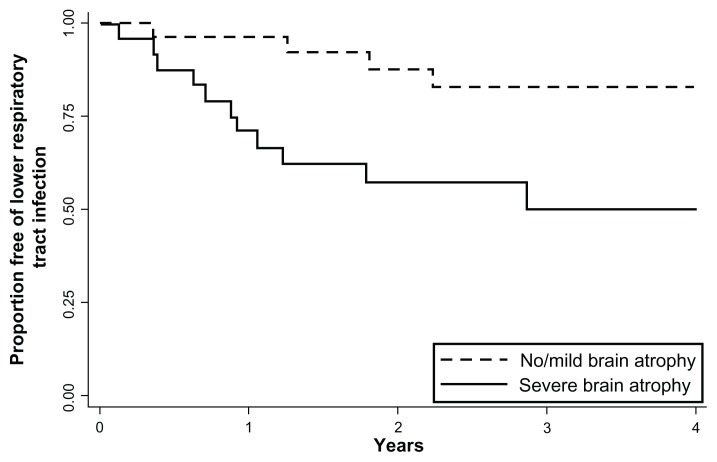
The incidence rate ratio of LRTI was significantly higher (odds ratio 4.60, 95% confidence interval 1.18-17.93, fully adjusted P = 0.028) and the time to the first episode of LRTI was significantly shorter (log-rank test, P = 0.019) in subjects with severe brain atrophy in any lobe. Frontal and parietal lobe atrophy was associated with a significantly increased risk of LRTI, while temporal lobe atrophy, ventricular dilatation, and diffuse white matter lesions did not influence the risk of LRTI.
Elderly subjects with severe brain atrophy are more susceptible to LRTI, possibly as a result of neurodegeneration causing dysphagia and silent aspiration. Assessing the severity of brain atrophy might be useful to identify subjects at increased risk of respiratory infections in a prospective manner.
本研究旨在确定伴有神经退行性变和吞咽困难(吞咽障碍)的严重脑萎缩的老年患者是否更容易发生下呼吸道感染(LRTI),包括肺炎。
通过计算机断层扫描评估 51 名年龄在 60-96 岁的养老院居民的脑萎缩严重程度。通过体温≥38.0°C、存在两种或多种呼吸症状以及使用抗生素来确定 4 年内的 LRTI 发生率。根据脑萎缩的严重程度和类型比较 LRTI 的发生率。
严重脑萎缩(任何脑叶)患者的 LRTI 发生率明显更高(比值比 4.60,95%置信区间 1.18-17.93,完全调整后 P = 0.028),且首次发生 LRTI 的时间也明显缩短(对数秩检验,P = 0.019)。额叶和顶叶萎缩与 LRTI 的风险显著增加相关,而颞叶萎缩、脑室扩张和弥漫性白质病变并不影响 LRTI 的风险。
严重脑萎缩的老年患者更容易发生 LRTI,可能是由于神经退行性变导致吞咽障碍和无症状性误吸。评估脑萎缩的严重程度可能有助于前瞻性地识别具有较高呼吸道感染风险的患者。