Centre for Cognitive and Neural Systems (CCNS), University of Edinburgh, 1 George Square, Edinburgh, EH8 9JZ, UK.
Nat Commun. 2012;3:1246. doi: 10.1038/ncomms2250.
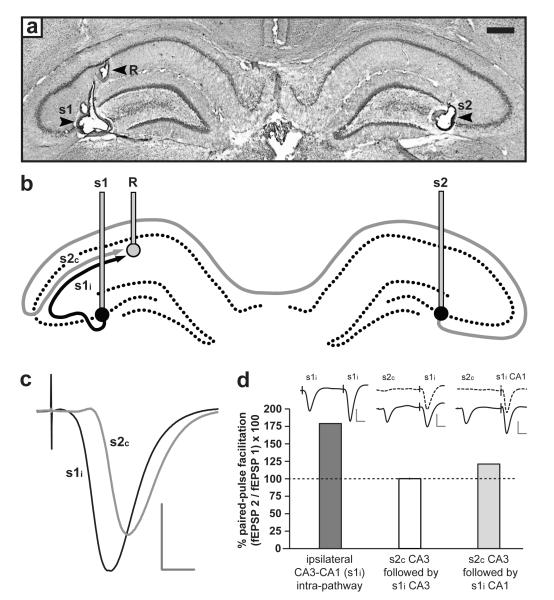
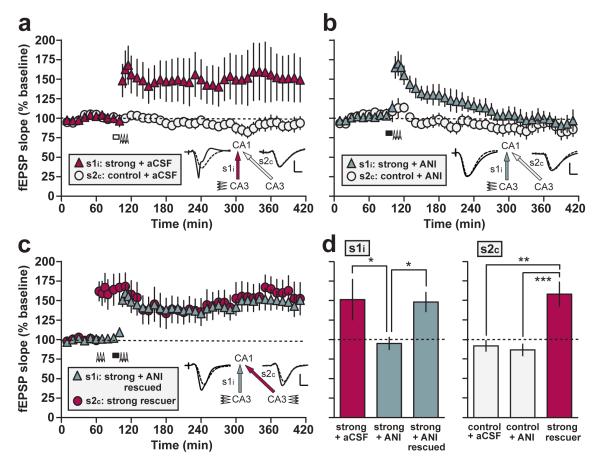
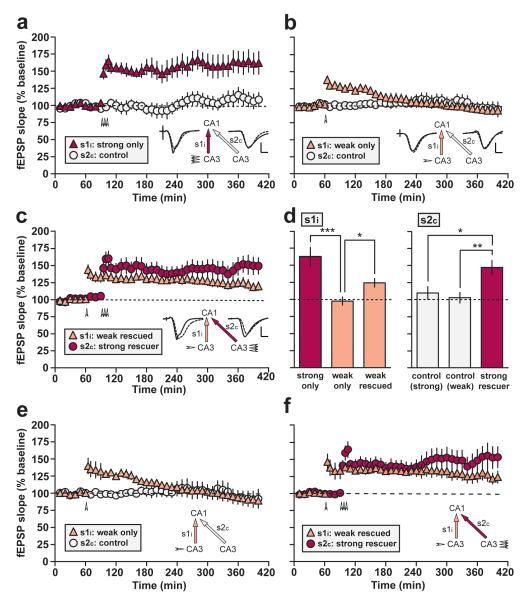
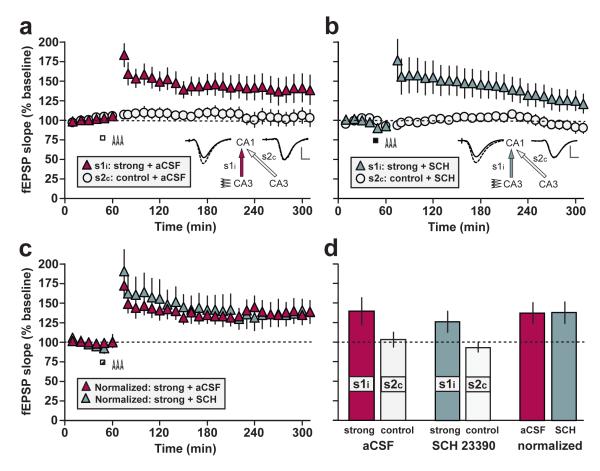
In isolated hippocampal slices, decaying long-term potentiation can be stabilized and converted to late long-term potentiation lasting many hours, by prior or subsequent strong high-frequency tetanization of an independent input to a common population of neurons-a phenomenon known as 'synaptic tagging and capture'. Here we show that the same phenomenon occurs in the intact rat. Late long-term potentiation can be induced in CA1 during the inhibition of protein synthesis if an independent input is strongly tetanized beforehand. Conversely, declining early long-term potentiation induced by weak tetanization can be converted into lasting late long-term potentiation by subsequent strong tetanization of a separate input. These findings indicate that synaptic tagging and capture is not limited to in vitro preparations; the past and future activity of neurons has a critical role in determining the persistence of synaptic changes in the living animal, thus providing a bridge between cellular studies of protein synthesis-dependent synaptic potentiation and behavioural studies of memory persistence.
在离体海马切片中,通过对独立输入到共同神经元群体的先前或随后的强烈高频强直刺激,可以稳定并将衰减的长时程增强转化为持续数小时的晚期长时程增强,这一现象被称为“突触标记和捕获”。在这里,我们表明,在完整的大鼠中也存在同样的现象。如果在之前强烈强直刺激独立输入,则可以在 CA1 中诱导晚期长时程增强。相反,通过随后对单独输入进行强烈强直刺激,可以将由弱强直刺激诱导的衰减早期长时程增强转换为持久的晚期长时程增强。这些发现表明,突触标记和捕获不仅限于体外制剂;神经元的过去和未来活动在决定活体内突触变化的持久性方面起着关键作用,从而为依赖蛋白质合成的突触增强的细胞研究与记忆持久性的行为研究之间架起了桥梁。