Department of Biology, University of Florida , Gainesville, FL 32611 , USA.
Biol Open. 2012 Oct 15;1(10):937-48. doi: 10.1242/bio.20121594. Epub 2012 Jul 27.
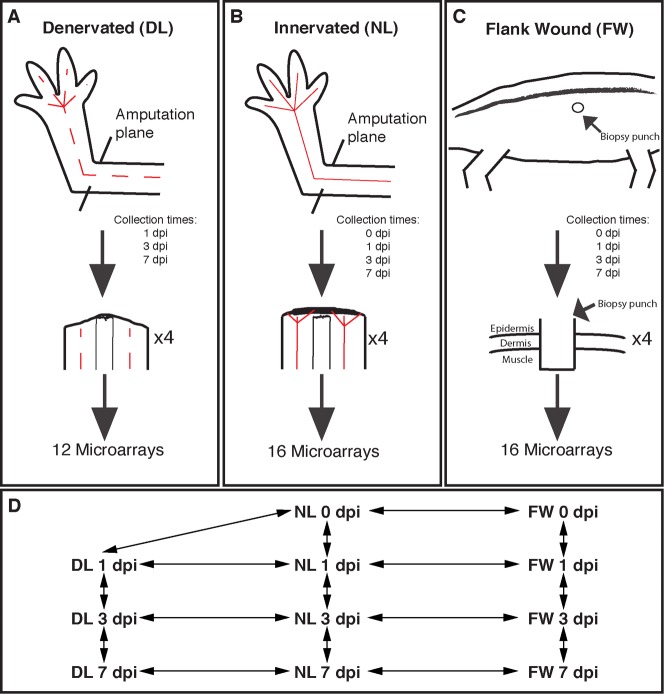
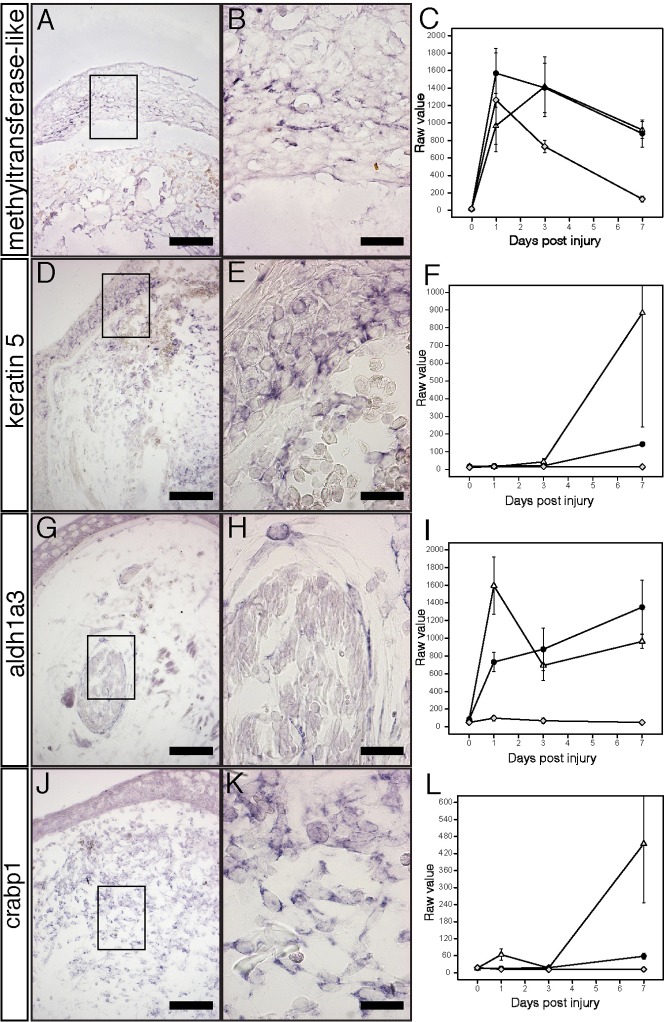
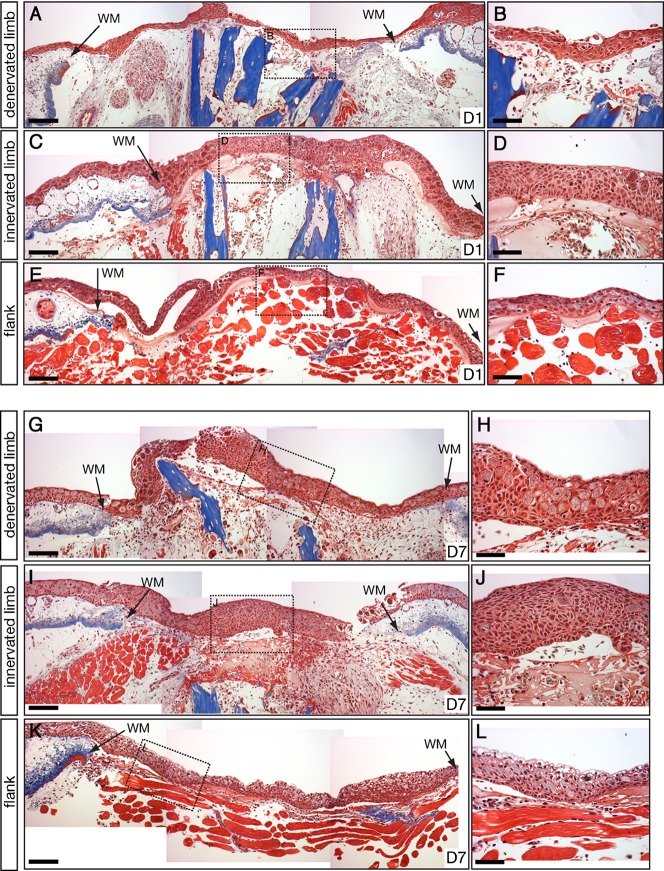
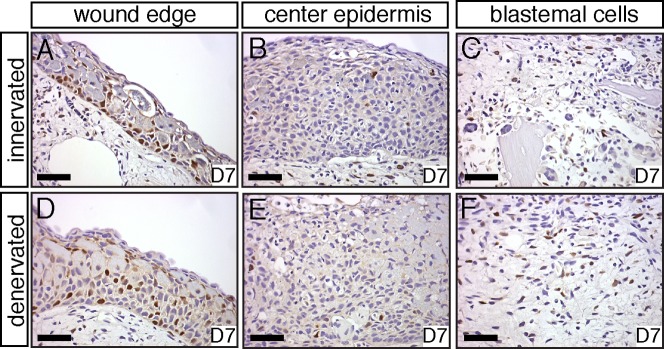
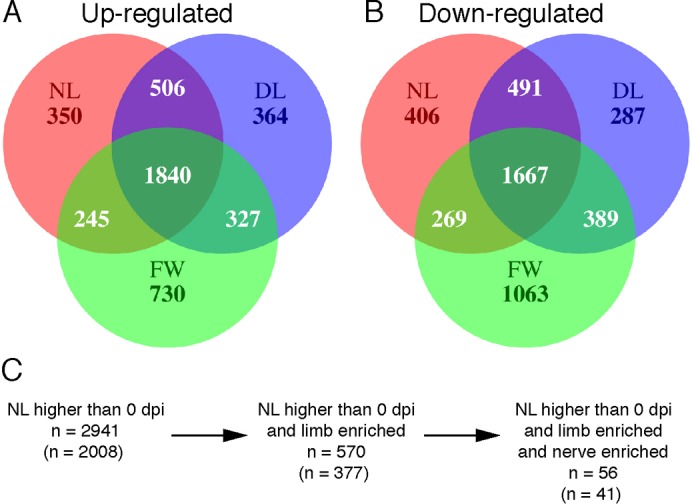
Salamander limb regeneration is dependent upon tissue interactions that are local to the amputation site. Communication among limb epidermis, peripheral nerves, and mesenchyme coordinate cell migration, cell proliferation, and tissue patterning to generate a blastema, which will form missing limb structures. An outstanding question is how cross-talk between these tissues gives rise to the regeneration blastema. To identify genes associated with epidermis-nerve-mesenchymal interactions during limb regeneration, we examined histological and transcriptional changes during the first week following injury in the wound epidermis and subjacent cells between three injury types; 1) a flank wound on the side of the animal that will not regenerate a limb, 2) a denervated limb that will not regenerate a limb, and 3) an innervated limb that will regenerate a limb. Early, histological and transcriptional changes were similar between the injury types, presumably because a common wound-healing program is employed across anatomical locations. However, some transcripts were enriched in limbs compared to the flank and are associated with vertebrate limb development. Many of these genes were activated before blastema outgrowth and expressed in specific tissue types including the epidermis, peripheral nerve, and mesenchyme. We also identified a relatively small group of transcripts that were more highly expressed in innervated limbs versus denervated limbs. These transcripts encode for proteins involved in myelination of peripheral nerves, epidermal cell function, and proliferation of mesenchymal cells. Overall, our study identifies limb-specific and nerve-dependent genes that are upstream of regenerative growth, and thus promising candidates for the regulation of blastema formation.
蝾螈肢体再生依赖于局部于截肢部位的组织相互作用。肢体表皮、周围神经和间充质之间的通讯协调细胞迁移、细胞增殖和组织模式形成芽基,芽基将形成缺失的肢体结构。一个悬而未决的问题是这些组织之间的交流如何产生再生芽基。为了鉴定在肢体再生过程中与表皮-神经-间充质相互作用相关的基因,我们检查了三种损伤类型(1)动物不会再生肢体的侧方创伤、2)不会再生肢体的去神经化肢体和 3)会再生肢体的神经化肢体)在损伤后第一周内伤口表皮和下方细胞的组织学和转录变化。早期,损伤类型之间的组织学和转录变化相似,可能是因为在解剖位置上采用了共同的伤口愈合程序。然而,与侧方和与脊椎动物肢体发育相关的一些转录物在肢体中富集。这些基因中的许多在芽基外生之前被激活,并在特定组织类型中表达,包括表皮、周围神经和间充质。我们还鉴定了一小部分在神经化肢体中比去神经化肢体中表达更高的转录物。这些转录物编码参与周围神经髓鞘形成、表皮细胞功能和间充质细胞增殖的蛋白质。总体而言,我们的研究确定了肢体特异性和神经依赖性基因,这些基因是再生性生长的上游基因,因此是芽基形成的有希望的调节候选基因。