Stickland Michael K, Butcher Scott J, Marciniuk Darcy D, Bhutani Mohit
Pulmonary Division, Department of Medicine, 8334B Aberhart Centre, University of Alberta, Edmonton, AB, Canada T6G 2B7 ; Centre for Lung Health, Covenant Health, Edmonton, AB, Canada.
Pulm Med. 2012;2012:824091. doi: 10.1155/2012/824091. Epub 2012 Nov 19.
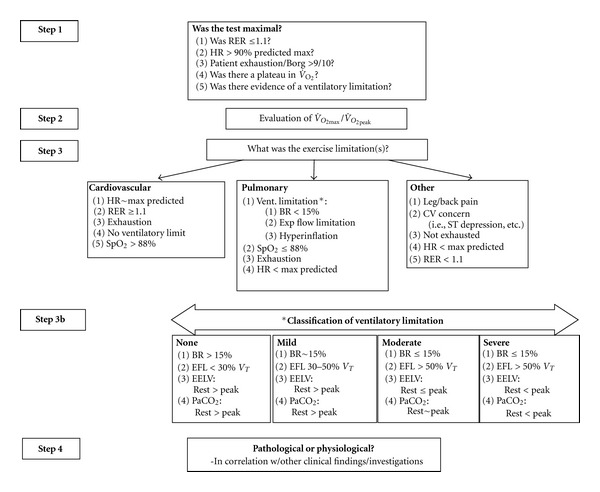
The cardiopulmonary exercise test (CPET) is an important physiological investigation that can aid clinicians in their evaluation of exercise intolerance and dyspnea. Maximal oxygen consumption ([Formula: see text]) is the gold-standard measure of aerobic fitness and is determined by the variables that define oxygen delivery in the Fick equation ([Formula: see text] = cardiac output × arterial-venous O(2) content difference). In healthy subjects, of the variables involved in oxygen delivery, it is the limitations of the cardiovascular system that are most responsible for limiting exercise, as ventilation and gas exchange are sufficient to maintain arterial O(2) content up to peak exercise. Patients with lung disease can develop a pulmonary limitation to exercise which can contribute to exercise intolerance and dyspnea. In these patients, ventilation may be insufficient for metabolic demand, as demonstrated by an inadequate breathing reserve, expiratory flow limitation, dynamic hyperinflation, and/or retention of arterial CO(2). Lung disease patients can also develop gas exchange impairments with exercise as demonstrated by an increased alveolar-to-arterial O(2) pressure difference. CPET testing data, when combined with other clinical/investigation studies, can provide the clinician with an objective method to evaluate cardiopulmonary physiology and determination of exercise intolerance.
心肺运动试验(CPET)是一项重要的生理学检查,可帮助临床医生评估运动不耐受和呼吸困难。最大摄氧量([公式:见原文])是有氧适能的金标准指标,由菲克方程([公式:见原文]=心输出量×动静脉氧含量差)中定义氧输送的变量决定。在健康受试者中,在参与氧输送的变量中,运动受限最主要是由心血管系统的限制导致的,因为通气和气体交换足以在运动峰值时维持动脉氧含量。肺部疾病患者可能会出现运动的肺部限制,这可能导致运动不耐受和呼吸困难。在这些患者中,通气可能不足以满足代谢需求,表现为呼吸储备不足、呼气流量受限、动态肺过度充气和/或动脉二氧化碳潴留。肺部疾病患者运动时也可能出现气体交换受损,表现为肺泡-动脉氧压差增加。当CPET测试数据与其他临床/检查研究相结合时,可为临床医生提供一种评估心肺生理学和确定运动不耐受的客观方法。