Poulton Alison, Briody Julie, McCorquodale Thomas, Melzer Elaine, Herrmann Markus, Baur Louise A, Duque Gustavo
Department of Paediatrics, Sydney Medical School Nepean, The University of Sydney, Penrith, NSW, Australia.
Int J Pediatr Endocrinol. 2012 Dec 5;2012(1):30. doi: 10.1186/1687-9856-2012-30.
Children treated with stimulant medication for attention deficit hyperactivity disorder (ADHD) often lose weight. It is important to understand the implications of this during growth. This prospective study was designed to quantify the changes in body composition and markers of bone metabolism on starting treatment.
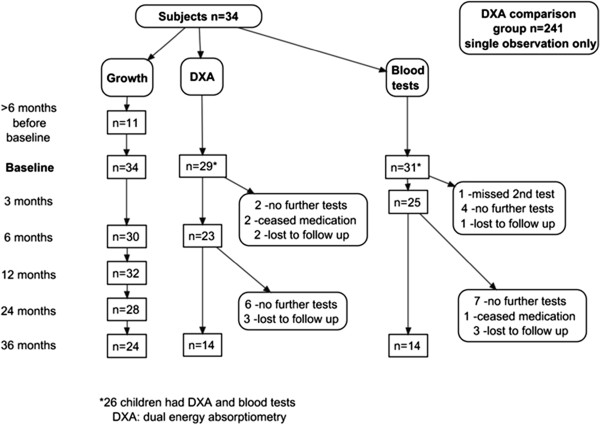
34 children (29 boys) aged 4.7 to 9.1 years newly diagnosed with ADHD were treated with dexamphetamine or methylphenidate, titrating the dose to optimise the therapeutic response. Medication was continued for as long as clinically indicated. Body composition and bone density (dual-energy X-ray absorptiometry) were measured at baseline, 6 months and 3 years; changes were analysed in Z-scores based on data from 241 healthy, local children. Markers of bone turnover were measured at baseline, 3 months and 3 years.
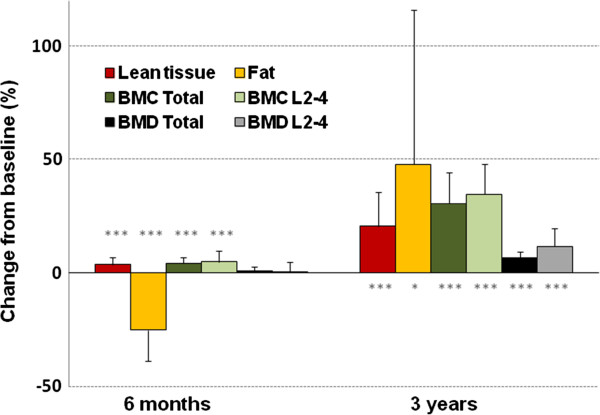
Fat loss of 1.4±0.96kg (total fat 5.7±3.6 to 4.3±3.1kg, p<0.001) occurred in the first 6 months. There were significant reductions over 3 years in the sex and height corrected Z-scores for lean tissue, bone mineral content, bone mineral density and ratio of central to total fat (-0.84±0.86, p=0.003; -0.55±0.31, p<0.0001; -0.41±0.28, p<0.0001 and -0.55±0.62, p=0.006 respectively). Propeptide of type I collagen indicated a significant reduction in bone turnover after 3 months (564±202 to 458±96ng/ml, p=0.019), which was fully recovered after 3 years (619±276ng/ml).
Stimulant medication was associated with early fat loss and reduced bone turnover. Lean tissue including bone increased more slowly over 3 years of continuous treatment than would be expected for growth in height. There was long-term improvement in the proportion of central fat for height. This study shows that relatively minor reductions in weight on stimulant medication can be associated with long-term changes in body composition. Further study is required to determine the effects of these changes on adult health.
使用兴奋剂药物治疗注意力缺陷多动障碍(ADHD)的儿童常常会体重减轻。了解这一情况在生长过程中的影响很重要。这项前瞻性研究旨在量化开始治疗时身体成分和骨代谢标志物的变化。
34名新诊断为ADHD的4.7至9.1岁儿童(29名男孩)接受右旋苯丙胺或哌甲酯治疗,调整剂量以优化治疗反应。只要临床有指征,药物就持续使用。在基线、6个月和3年时测量身体成分和骨密度(双能X线吸收法);根据241名当地健康儿童的数据,以Z评分分析变化情况。在基线、3个月和3年时测量骨转换标志物。
在最初6个月内脂肪减少了1.4±0.96kg(总脂肪从5.7±3.6kg降至4.3±3.1kg,p<0.001)。3年内,瘦组织、骨矿物质含量、骨矿物质密度以及中心脂肪与总脂肪之比的性别和身高校正Z评分显著降低(分别为-0.84±0.86,p=0.003;-0.55±0.31,p<0.0001;-0.41±0.28,p<0.0001和-0.55±0.62,p=0.006)。I型胶原前肽表明3个月后骨转换显著降低(从564±202ng/ml降至458±96ng/ml,p=0.019),3年后完全恢复(619±276ng/ml)。
兴奋剂药物与早期脂肪减少和骨转换降低有关。在连续3年的治疗中,包括骨骼在内的瘦组织增长速度比预期的身高增长速度更慢。身高对应的中心脂肪比例有长期改善。这项研究表明,兴奋剂药物导致的相对轻微体重减轻可能与身体成分的长期变化有关。需要进一步研究以确定这些变化对成人健康的影响。