Institute of Radiation Biology, Helmholtz Zentrum Muenchen, German Research Center for Environmental Health, Muenchen, Germany.
Radiat Oncol. 2012 Dec 5;7:206. doi: 10.1186/1748-717X-7-206.
There is evidence that the extent of the G2/M arrest following irradiation is correlated with tumour cell survival and hence therapeutic success. We studied the regulation of cellular response to radiation treatment by miR-21-mediated modulation of cell cycle progression in breast cancer cells and analysed miR-21 expression in breast cancer tissue samples with long-term follow up.
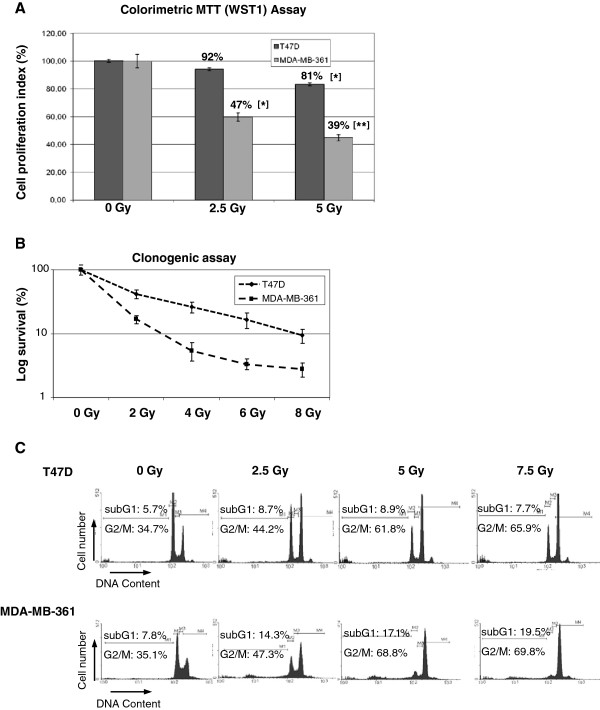
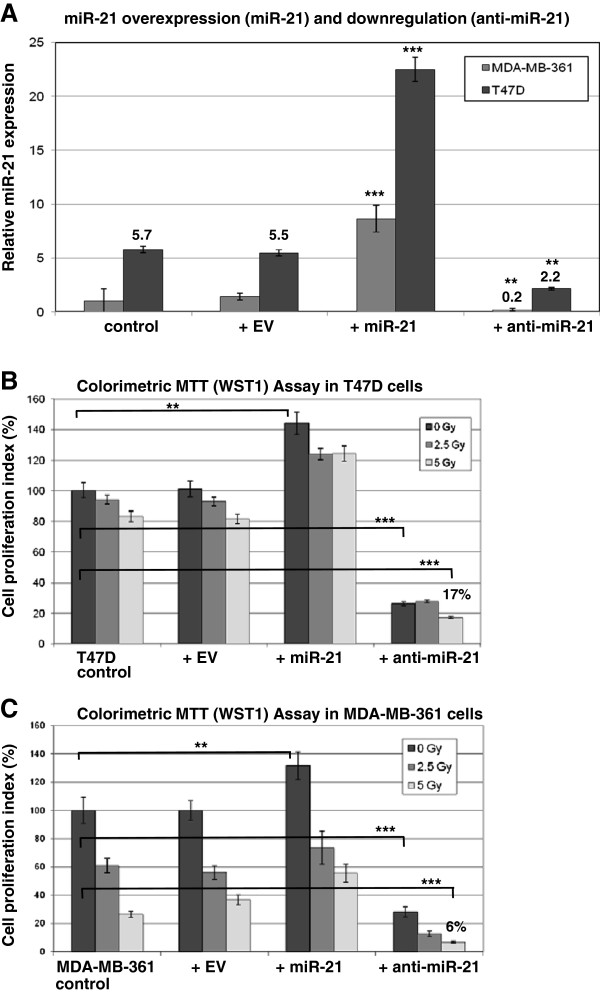
The miR-21 expression levels were quantified (qRT-PCR) in a panel of 86 cases of invasive breast carcinomas in relation to metastasis free survival. The cellular radiosensitivity of human breast cancer cells after irradiation was determined comparing two cell lines (T47D and MDA-MB-361) by cell proliferation and colony forming assays. The influence of miR-21 overexpression or downregulation on cell cycle progression and G2/M checkpoint arrest after irradiation was assessed by flow cytometric analysis.
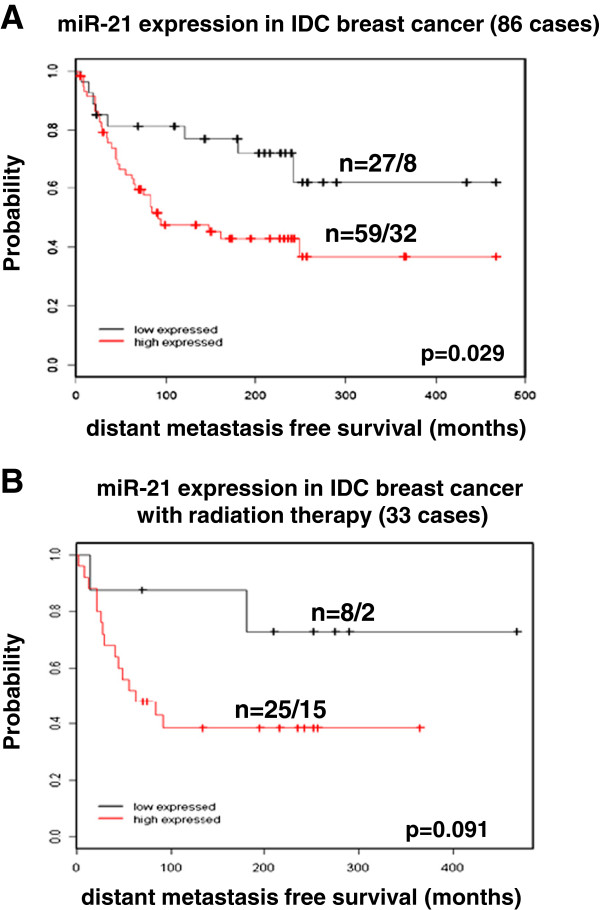
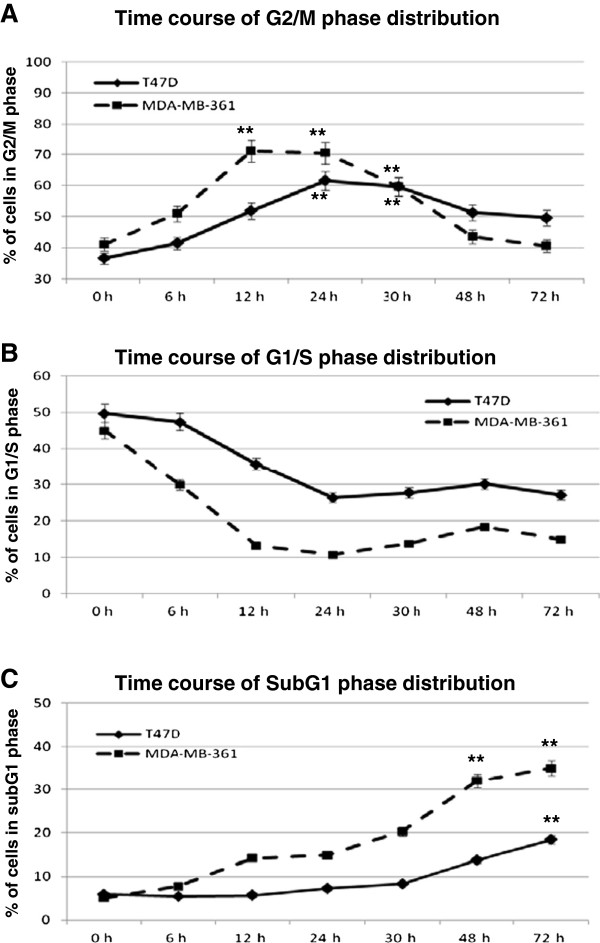
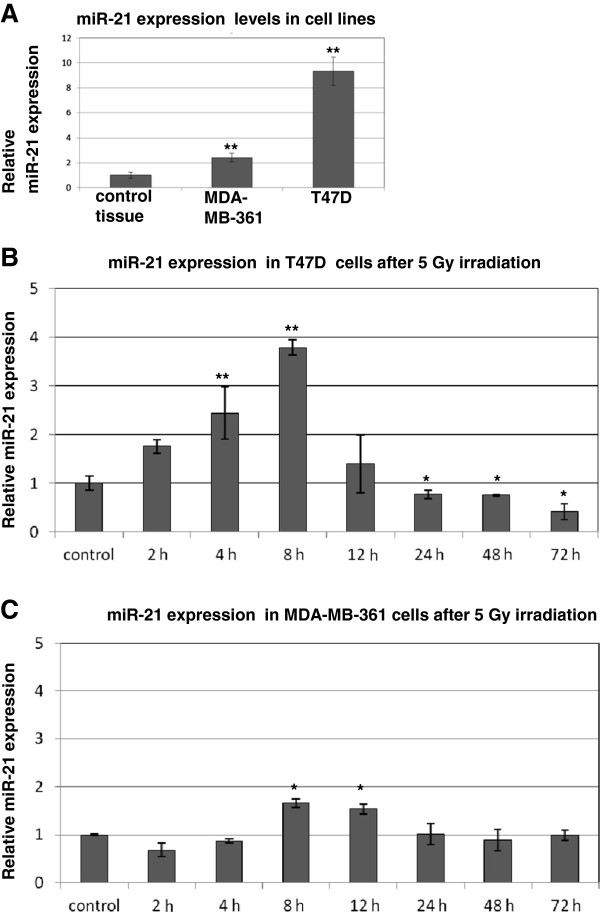
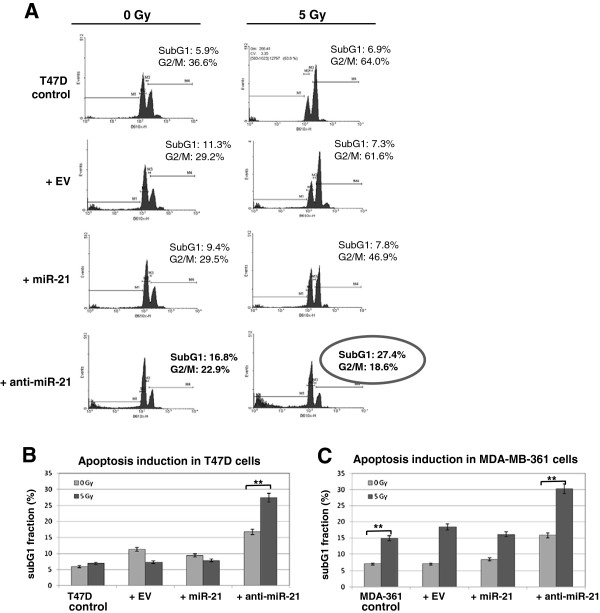
The expression of miR-21 was transiently increased 8 hours after irradiation in the radioresistant T47D cells and significantly changed with lower extent in radiosensitive MDA-MB-361 cells. Anti-miR-21 treated breast cancer cells failed to exhibit the DNA damage-G2 checkpoint increase after irradiation. Apoptotic activity was significantly enhanced from 7% to 27% in T47D cells and from 18% to 30% in MDA-MB-361 cells 24 hours after 5 Gy irradiation. Additionally, we characterized expression of miR-21 in invasive breast carcinomas. In comparison to non-cancerous adjacent breast tissue, tumours samples had increased miR-21 expression that inversely correlated with the distant metastases-free survival of patients (p = 0.029).
Our data indicate that miR-21 expression in breast cancer cells contributes to radiation resistance by compromising cell cycle progression. These data point to the potential of combining radiotherapy with an anti-miR-21 as a potent G2/M check point inhibitor in overcoming radiation resistance of tumours.
有证据表明,照射后 G2/M 期阻滞的程度与肿瘤细胞的存活有关,从而影响治疗效果。我们通过 miR-21 调节乳腺癌细胞周期进程来研究细胞对放射治疗的反应调节,并对具有长期随访的乳腺癌组织样本进行 miR-21 表达分析。
我们在 86 例浸润性乳腺癌病例的面板中定量检测了 miR-21 的表达水平,并将其与无转移生存率进行了比较。通过细胞增殖和集落形成测定,比较了两种细胞系(T47D 和 MDA-MB-361)的细胞放射敏感性。通过流式细胞术分析评估 miR-21 过表达或下调对照射后细胞周期进程和 G2/M 检查点阻滞的影响。
在耐辐射的 T47D 细胞中,miR-21 的表达在照射后 8 小时内短暂增加,而在放射敏感的 MDA-MB-361 细胞中则显著降低。经抗 miR-21 处理的乳腺癌细胞在照射后未能表现出 DNA 损伤-G2 检查点增加。T47D 细胞中凋亡活性从 7%显著增加到 27%,MDA-MB-361 细胞中凋亡活性从 18%增加到 30%,在 5 Gy 照射后 24 小时。此外,我们还对浸润性乳腺癌中 miR-21 的表达进行了特征描述。与非癌性相邻乳腺组织相比,肿瘤样本的 miR-21 表达增加,与患者无远处转移生存率呈负相关(p = 0.029)。
我们的数据表明,乳腺癌细胞中的 miR-21 表达通过损害细胞周期进程来促进放射抵抗。这些数据表明,联合放疗和抗 miR-21 作为一种有效的 G2/M 检查点抑制剂,有可能克服肿瘤的放射抵抗。