Medars GmbH, Berlin, Germany.
BMC Pulm Med. 2012 Dec 8;12:74. doi: 10.1186/1471-2466-12-74.
Glycopyrronium bromide (NVA237) is an inhaled long-acting muscarinic antagonist in development for treatment of COPD. This study compared the efficacy and safety of once-daily (OD) and twice-daily (BID) glycopyrronium bromide regimens, using a novel model-based approach, in patients with moderate-to-severe COPD.
Double-blind, randomized, dose-finding trial with an eight-treatment, two-period, balanced incomplete block design. Patients (smoking history ≥10 pack-years, post-bronchodilator FEV1 ≥30% and <80% predicted, FEV1/FVC <0.7) were randomized to one of 16 independent sequences for 28 days. Primary endpoint: mean trough FEV1 at Day 28.
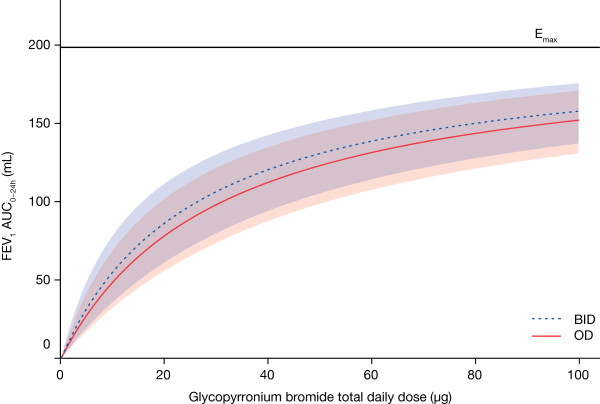
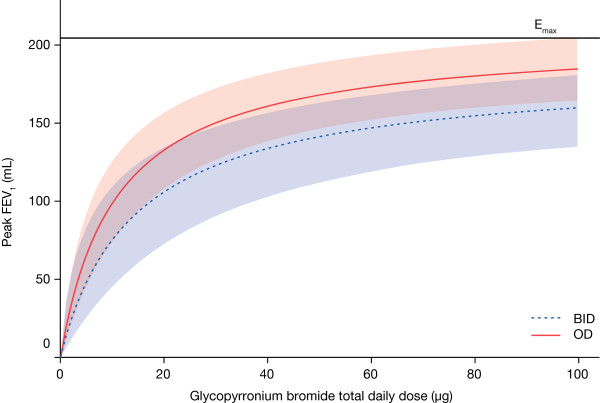
385 patients (mean age 61.2 years; mean post-bronchodilator FEV1 53% predicted) were randomized; 88.6% completed. All OD and BID dosing regimens produced dose-dependent bronchodilation; at Day 28, increases in mean trough FEV1 versus placebo were statistically significant for all regimens, ranging from 51 mL (glycopyrronium bromide 12.5 μg OD) to 160 mL (glycopyrronium bromide 50 μg BID). Pharmacodynamic steady-state was reached by Day 7. There was a small separation (≤37 mL) between BID and OD dose-response curves for mean trough FEV1 at steady-state in favour of BID dosing. Over 24 hours, separation between OD and BID regimens was even smaller (FEV1 AUC0-24h maximum difference for equivalent daily dose regimens: 8 mL). Dose-response results for FEV1 at 12 hours, FEV1 AUC0-12h and FEV1 AUC0-4h at steady-state showed OD regimens provided greater improvement over placebo than BID regimens for total daily doses of 25 μg, 50 μg and 100 μg, while the reverse was true for OD versus BID regimens from 12-24 hours. The 12.5 μg BID dose produced a marginally higher improvement in trough FEV1 versus placebo than 50 μg OD, however, the response at 12 hours over placebo was suboptimal (74 mL). Glycopyrronium bromide was safe and well tolerated at all doses.
Glycopyrronium bromide 50 μg OD provides significant bronchodilation over a 24 hour period, and in terms of FEV1 AUC0-24h is not significantly different than the same total daily dose administered BID. Importantly, OD dosing may confer better patient adherence. The results are consistent with previous glycopyrronium bromide studies and support once-daily dosing of glycopyrronium bromide 50 μg in patients with moderate-to-severe COPD.
ClinicalTrials.gov: NCT01119950.
溴化吡丙醇铵(NVA237)是一种正在开发的用于治疗 COPD 的吸入长效毒蕈碱拮抗剂。本研究采用一种新的基于模型的方法,比较了溴化吡丙醇铵每日一次(OD)和每日两次(BID)给药方案在中重度 COPD 患者中的疗效和安全性。
这是一项双盲、随机、剂量发现试验,采用 16 种治疗方案、两期、平衡不完全区组设计。患者(吸烟史≥10 包年,支气管扩张剂后 FEV1≥30%且<80%预计值,FEV1/FVC<0.7)随机分为 16 个独立序列中的一个,进行 28 天治疗。主要终点:第 28 天的平均谷值 FEV1。
385 例患者(平均年龄 61.2 岁;平均支气管扩张剂后 FEV1 为预计值的 53%)被随机分组;88.6%完成了研究。所有 OD 和 BID 给药方案均产生剂量依赖性支气管扩张作用;与安慰剂相比,所有方案在第 28 天的平均谷值 FEV1均有统计学意义的增加,范围从 51ml(溴化吡丙醇铵 12.5μg OD)到 160ml(溴化吡丙醇铵 50μg BID)。第 7 天达到药效学稳态。在稳态时,BID 和 OD 剂量反应曲线之间的平均谷值 FEV1 有较小的分离(≤37ml),有利于 BID 给药。24 小时内,OD 和 BID 方案之间的分离更小(等效日剂量方案的 FEV1 AUC0-24h 最大差异:8ml)。FEV1 在 12 小时、FEV1 AUC0-12h 和 FEV1 AUC0-4h 的 12 小时时,OD 方案的总日剂量为 25μg、50μg 和 100μg 时,与安慰剂相比,OD 方案的改善程度优于 BID 方案,而从 12 小时到 24 小时,OD 方案与 BID 方案的结果则相反。与 50μg OD 相比,12.5μg BID 剂量对谷值 FEV1 的改善程度略高,但对安慰剂的 12 小时反应并不理想(74ml)。溴化吡丙醇铵在所有剂量下均安全且耐受良好。
溴化吡丙醇铵 50μg OD 在 24 小时内提供显著的支气管扩张作用,并且在 FEV1 AUC0-24h 方面与每日两次给予相同的总日剂量没有显著差异。重要的是,OD 给药可能会提高患者的依从性。结果与先前的溴化吡丙醇铵研究一致,支持在中重度 COPD 患者中每日一次给予溴化吡丙醇铵 50μg。
ClinicalTrials.gov:NCT01119950。