Respiratory Division, University Hospital, UZ Brussel, Free University of Brussels, Brussels, Belgium.
Longartsenpraktijk, Prins Bisschopssingel, Hasselt, Belgium.
Int J Chron Obstruct Pulmon Dis. 2014 Feb 24;9:215-28. doi: 10.2147/COPD.S51592. eCollection 2014.
Addition of a second bronchodilator from a different pharmacological class may benefit patients with moderate-to-severe chronic obstructive pulmonary disease (COPD) whose symptoms are insufficiently controlled by bronchodilator monotherapy. GLOW6 evaluated the efficacy and safety of once-daily coadministration of the long-acting β2-agonist indacaterol (IND) and the long-acting muscarinic antagonist glycopyrronium (GLY) versus IND alone in patients with moderate-to-severe COPD.
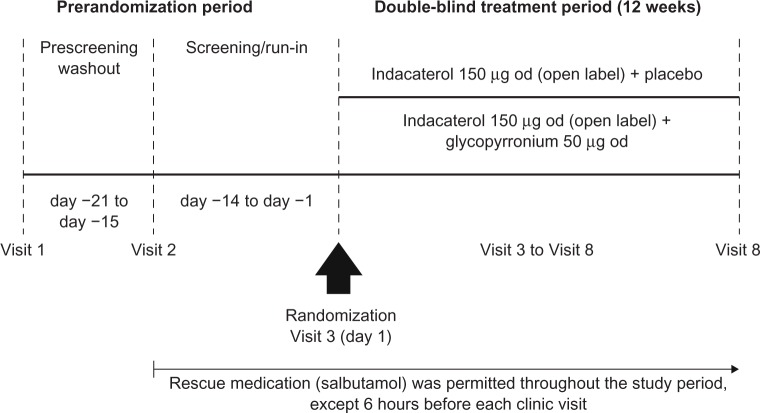
In this randomized, double-blind, parallel group, placebo-controlled, 12-week study, patients were randomized 1:1 to IND 150 μg and GLY 50 μg daily (IND + GLY) or IND 150 μg daily and placebo (IND + PBO) (all delivered via separate Breezhaler® devices). The primary objective was to demonstrate the superiority of IND + GLY versus IND + PBO for trough forced expiratory volume in 1 second (FEV1) at week 12. Other end points included trough FEV1 at day 1, FEV1 area under the curve from 30 minutes to 4 hours (AUC30min-4h), peak FEV1, inspiratory capacity and trough forced vital capacity (FVC) at day 1 and week 12, and transition dyspnea index (TDI) focal score, COPD symptoms, and rescue medication use over 12 weeks.
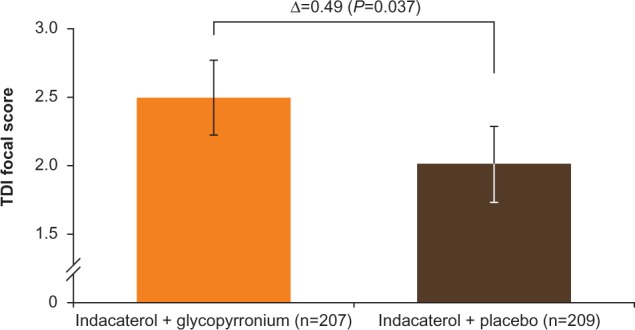
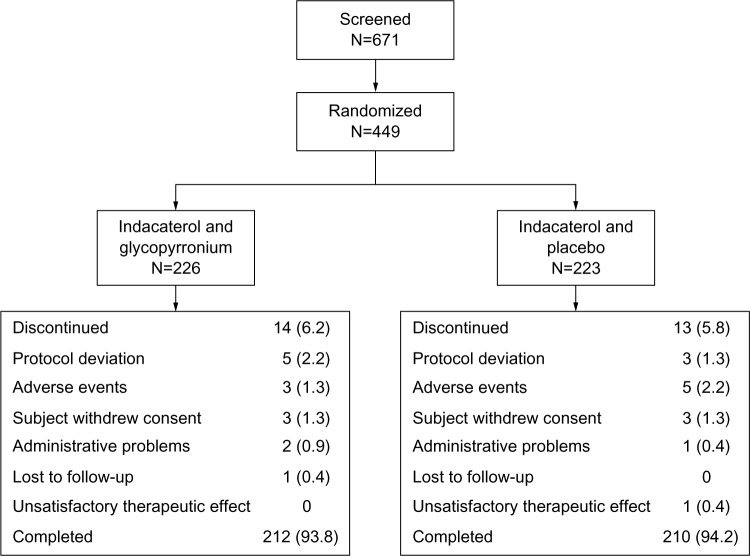
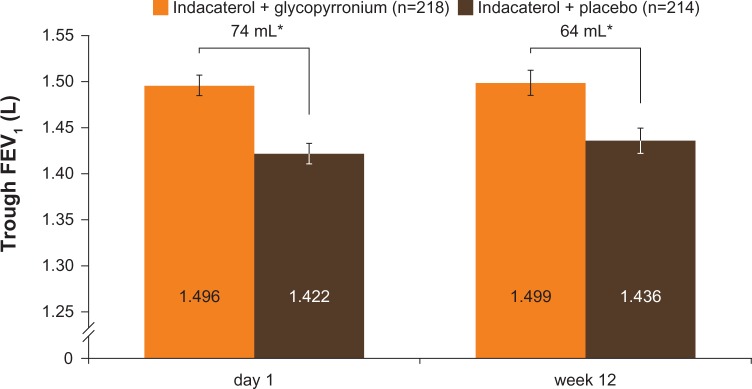
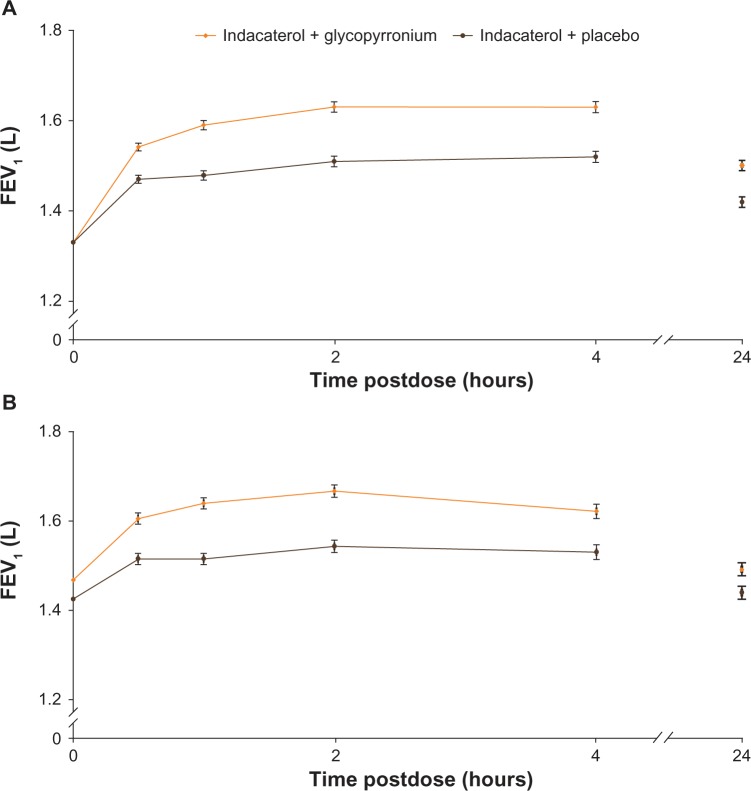
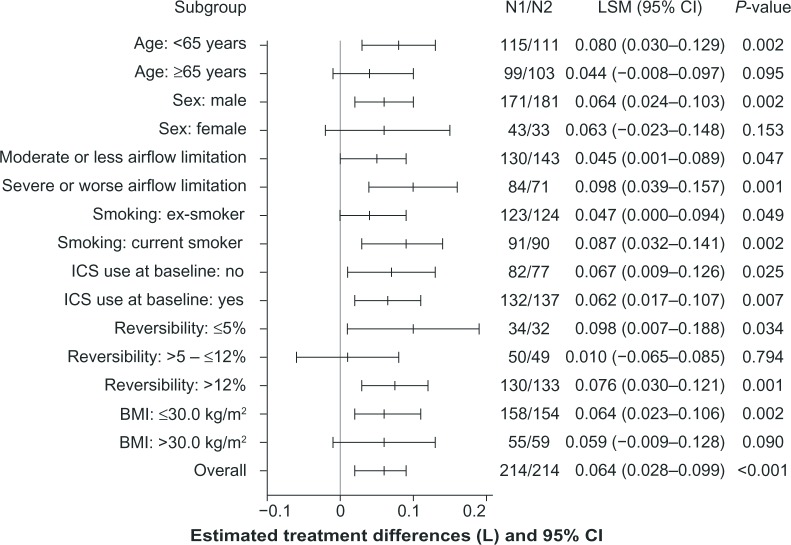
A total of 449 patients were randomized (IND + GLY, 226; IND + PBO, 223); 94% completed the study. On day 1 and at week 12, IND + GLY significantly improved trough FEV1 versus IND + PBO, with treatment differences of 74 mL (95% CI 46-101 mL) and 64 mL (95% CI 28-99 mL), respectively (both P<0.001). IND + GLY significantly improved postdose peak FEV1, FEV1 AUC30min-4h, and trough FVC at day 1 and week 12 versus IND + PBO (all P<0.01). TDI focal score and COPD symptoms (percentage of days able to perform usual daily activities and change from baseline in mean daytime respiratory score) were significantly improved with IND + GLY versus IND + PBO (P<0.05). The incidence of adverse events was similar for the two treatment groups.
In patients with moderate-to-severe COPD, once-daily coadministration of IND and GLY provides significant and sustained improvement in bronchodilation versus IND alone from day 1, with significant improvements in patient-centered outcomes.
对于因支气管扩张剂单药治疗未能充分控制症状而导致病情处于中重度的慢性阻塞性肺疾病(COPD)患者,添加一种来自不同药理学类别的第二种支气管扩张剂可能有益。GLOW6 评估了长效β2-激动剂茚达特罗(IND)和长效毒蕈碱拮抗剂格隆溴铵(GLY)联合用药与 IND 单药治疗对中重度 COPD 患者的疗效和安全性。
在这项随机、双盲、平行分组、安慰剂对照、为期 12 周的研究中,患者以 1:1 的比例随机分配至 IND150μg 和 GLY50μg 每日一次(IND+GLY)或 IND150μg 每日一次和安慰剂(IND+PBO)(均通过单独的 Breezhaler®装置给药)。主要终点是证明 IND+GLY 相对于 IND+PBO 在第 12 周时谷值用力呼气量(FEV1)的优越性。其他终点包括第 1 天的谷值 FEV1、30 分钟至 4 小时(AUC30min-4h)的 FEV1 曲线下面积、第 1 天和第 12 周的峰值 FEV1、吸气量和谷值用力肺活量(FVC)、转移呼吸困难指数(TDI)焦点评分、COPD 症状和 12 周内的急救药物使用情况。
共有 449 名患者被随机分配(IND+GLY,226 名;IND+PBO,223 名);94%的患者完成了研究。在第 1 天和第 12 周,与 IND+PBO 相比,IND+GLY 显著改善了谷值 FEV1,治疗差异分别为 74ml(95%CI46-101ml)和 64ml(95%CI28-99ml)(均 P<0.001)。与 IND+PBO 相比,IND+GLY 还显著改善了第 1 天和第 12 周时的餐后峰值 FEV1、FEV1 AUC30min-4h 和谷值 FVC(均 P<0.01)。与 IND+PBO 相比,TDI 焦点评分和 COPD 症状(能够进行日常活动的天数百分比和白天平均呼吸评分的基线变化)也有显著改善(均 P<0.05)。两组治疗的不良事件发生率相似。
对于中重度 COPD 患者,IND 和 GLY 的每日联合给药与 IND 单药治疗相比,从第 1 天开始即可显著持续改善支气管扩张作用,并显著改善患者的中心结局。