Department of Pediatrics, Georgia Prevention Institute, Georgia Health Sciences University, Augusta, GA 30912, USA.
J Pediatr. 2013 May;162(5):1004-9.e1. doi: 10.1016/j.jpeds.2012.10.059. Epub 2012 Dec 7.
To test the hypothesis that changes in DNA methylation are involved in vitamin D deficiency-related immune cell regulation using an unbiased genome-wide approach combined with a genomic and epigenomic integrative approach.
We performed a genome-wide methylation scan using the Illumina HumanMethylation 27 BeadChip on leukocyte DNA of 11 cases of vitamin D deficiency (serum 25-hydroxyvitamin D [25(OH)D] ≤ 25 nmol/L) and 11 age-matched controls ([25(OH)D] > 75 nmol/L); the subjects were African American normal-weight (body mass index <85th percentile) males aged 14-19 years. The Limma package was used to analyze each CpG site for differential methylation between cases and controls. To correct for multiple testing, the set of raw P values were converted to false discovery rates (FDRs). We also compared our findings with the recent data from Genome-Wide Association Studies of circulating 25(OH)D levels and then performed a permutation test to examine whether the "double hit" genes were randomly enriched.
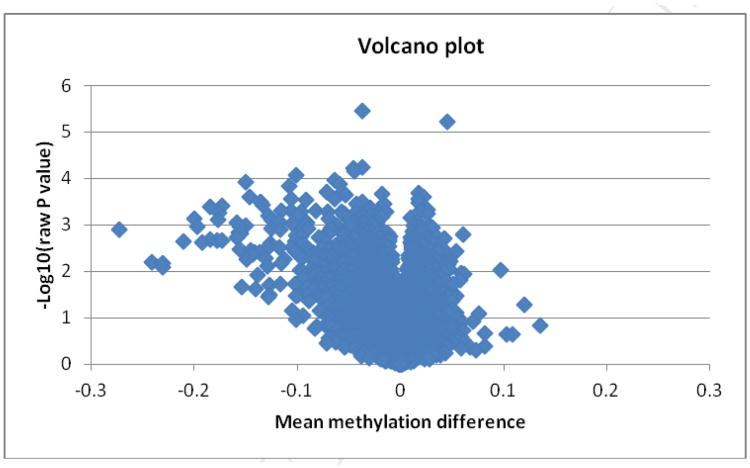
A total of 79 CpG sites achieved raw P < .001. Of the 79 CpG sites, 2 CpG sites survived multiple testing: cg16317961 (raw P = 3.5 × 10(-6), FDR = 0.078, in MAPRE2) and cg04623955 (raw P = 5.9 × 10(-6), FDR = 0.078, in DIO3). Furthermore, 3 out of the 4 genes previously identified in the 2 Genome-Wide Association Studies were also significant at the methylation level (DHCR7: cg07487535, P = .015 and cg10763288, P = .017; CYP2R1: cg25454890, P = .040; CYP24A1: cg18956481, P = .022), reflecting significant enrichment (P = .0098).
Severe vitamin D deficiency is associated with methylation changes in leukocyte DNA. The genomic and epigenomic approach reinforce the crucial roles played by the DHCR7, CYP2R1, and CYP24A1 genes in vitamin D metabolism.
采用无偏基因组方法结合基因组和表观基因组综合方法,检验维生素 D 缺乏相关免疫细胞调节中 DNA 甲基化变化的假说。
我们对 11 例维生素 D 缺乏症患者(血清 25-羟维生素 D [25(OH)D]≤25 nmol/L)和 11 名年龄匹配的对照者([25(OH)D]>75 nmol/L)的白细胞 DNA 进行了全基因组甲基化扫描,采用 Illumina HumanMethylation 27 BeadChip;研究对象为年龄在 14-19 岁的非裔美国正常体重(体重指数<85 百分位)男性。采用 Limma 包对病例组和对照组之间每个 CpG 位点的差异甲基化进行分析。为了校正多重检验,将原始 P 值集转换为错误发现率(FDR)。我们还将我们的发现与最近关于循环 25(OH)D 水平的全基因组关联研究数据进行了比较,然后进行了置换检验,以检查“双重打击”基因是否随机富集。
共有 79 个 CpG 位点达到了原始 P<0.001。在 79 个 CpG 位点中,有 2 个 CpG 位点通过了多重检验:cg16317961(原始 P=3.5×10(-6),FDR=0.078,位于 MAPRE2 中)和 cg04623955(原始 P=5.9×10(-6),FDR=0.078,位于 DIO3 中)。此外,在之前的 2 项全基因组关联研究中发现的 4 个基因中的 3 个在甲基化水平上也具有显著性(DHCR7:cg07487535,P=0.015 和 cg10763288,P=0.017;CYP2R1:cg25454890,P=0.040;CYP24A1:cg18956481,P=0.022),反映出显著的富集(P=0.0098)。
严重维生素 D 缺乏与白细胞 DNA 中的甲基化变化有关。基因组和表观基因组方法加强了 DHCR7、CYP2R1 和 CYP24A1 基因在维生素 D 代谢中的关键作用。