German Cancer Research Center, DKFZ-ZMBH Alliance, Heidelberg, Germany.
Adv Exp Med Biol. 2013;768:197-211. doi: 10.1007/978-1-4614-5107-5_12.
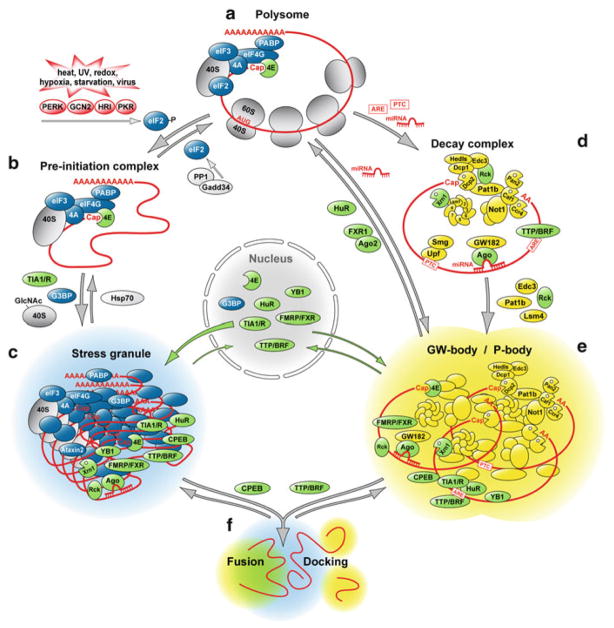
Whereas P-bodies are intimately linked to the cytoplasmic RNA decay machinery, stress granules harbor stalled translation initiation complexes that accumulate upon stress-induced translation arrest. In this Chapter, we reflect on the relationship between P-bodies and stress granules. In mammalian cells, the two structures can be clearly distinguished from each other using specific protein or RNA markers, but they also share many proteins and mRNAs. While the formation of P-bodies and stress granules is coordinately triggered by stress, their assembly appears to be regulated independently by different pathways. Under certain types of stress, P-bodies frequently dock with stress granules, and overexpressing certain proteins that localize to both structures can cause P-body/stress granule fusion. Currently available data suggest that these self-assembling compartments are controlled by flux of mRNAs within the cytoplasm, and that their assembly mirrors the translation and degradation rates of their component mRNAs.
虽然 P 体与细胞质 RNA 降解机制密切相关,但应激颗粒中含有停滞的翻译起始复合物,这些复合物在应激诱导的翻译抑制时积累。在这一章中,我们反思了 P 体和应激颗粒之间的关系。在哺乳动物细胞中,这两种结构可以使用特定的蛋白质或 RNA 标记物清楚地区分开来,但它们也共享许多蛋白质和 mRNA。虽然 P 体和应激颗粒的形成是由应激协调触发的,但它们的组装似乎是由不同的途径独立调节的。在某些类型的应激下,P 体经常与应激颗粒结合,而过表达定位于这两种结构的某些蛋白质会导致 P 体/应激颗粒融合。目前可用的数据表明,这些自组装的隔室受细胞质内 mRNA 流的控制,它们的组装反映了其组成 mRNA 的翻译和降解速率。