Institut für Sport-und Bewegungswissenschaft, Universität Stuttgart, Allmandring 28, 70569 Stuttgart, Germany.
Comput Math Methods Med. 2012;2012:848630. doi: 10.1155/2012/848630. Epub 2012 Nov 22.
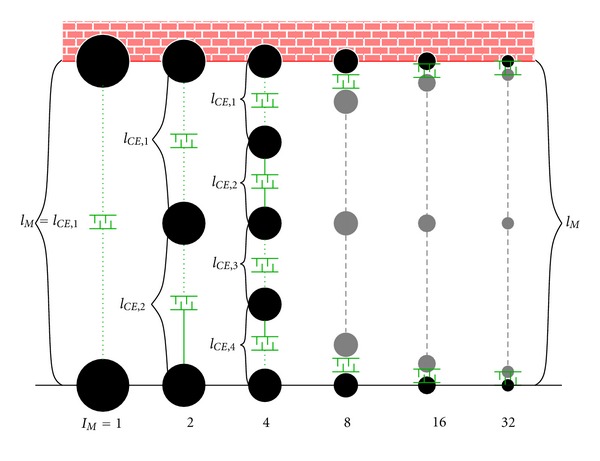
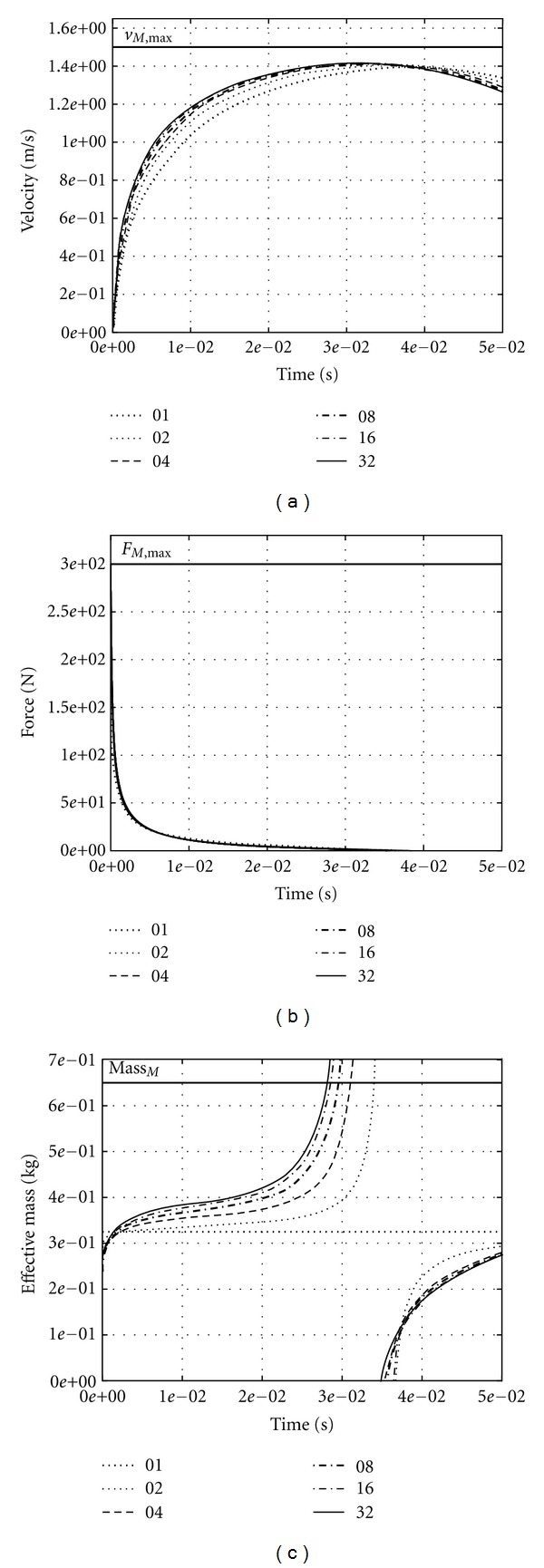
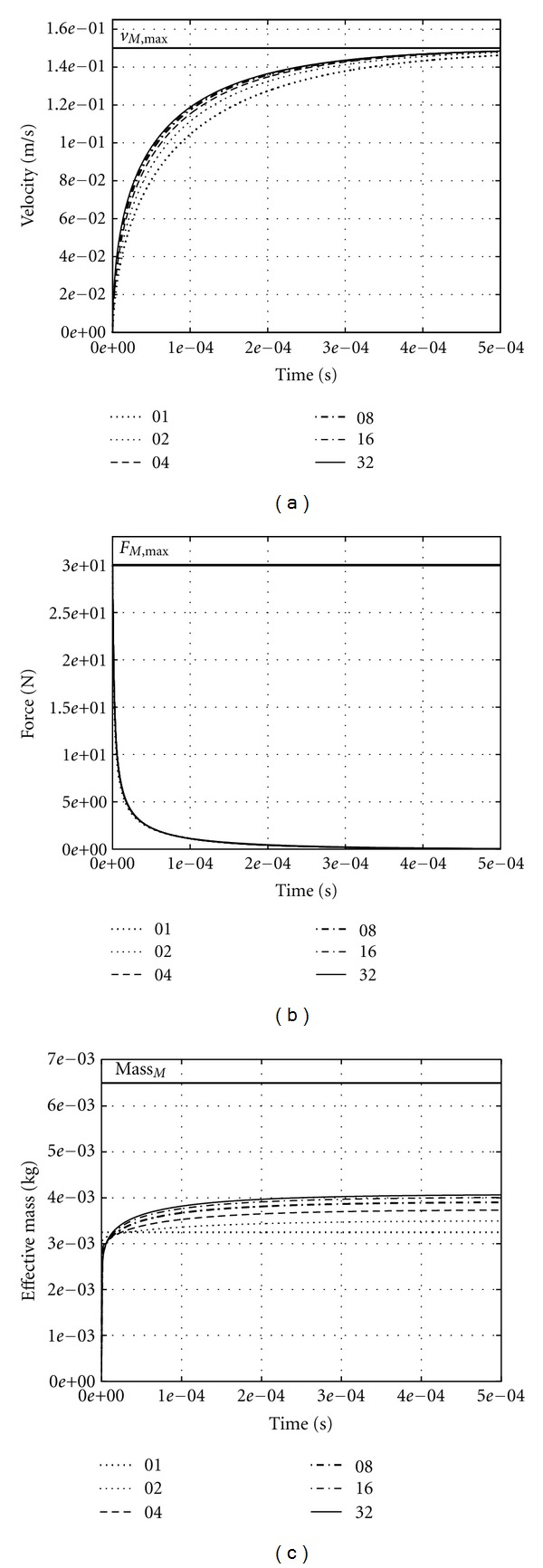
It is state of the art that muscle contraction dynamics is adequately described by a hyperbolic relation between muscle force and contraction velocity (Hill relation), thereby neglecting muscle internal mass inertia (first-order dynamics). Accordingly, the vast majority of modelling approaches also neglect muscle internal inertia. Assuming that such first-order contraction dynamics yet interacts with muscle internal mass distribution, this study investigates two questions: (i) what is the time scale on which the muscle responds to a force step? (ii) How does this response scale with muscle design parameters? Thereto, we simulated accelerated contractions of alternating sequences of Hill-type contractile elements and point masses. We found that in a typical small muscle the force levels off after about 0.2 ms, contraction velocity after about 0.5 ms. In an upscaled version representing bigger mammals' muscles, the force levels off after about 20 ms, and the theoretically expected maximum contraction velocity is not reached. We conclude (i) that it may be indispensable to introduce second-order contributions into muscle models to understand high-frequency muscle responses, particularly in bigger muscles. Additionally, (ii) constructing more elaborate measuring devices seems to be worthwhile to distinguish viscoelastic and inertia properties in rapid contractile responses of muscles.
肌肉收缩动力学可以用肌肉力和收缩速度之间的双曲关系(Hill 关系)充分描述,从而忽略肌肉内部质量惯性(一阶动力学),这是目前的研究现状。因此,绝大多数建模方法也忽略了肌肉内部惯性。如果假设这种一阶收缩动力学仍然与肌肉内部质量分布相互作用,那么本研究将探讨两个问题:(i)肌肉对力阶跃的响应时间尺度是多少?(ii)这种响应如何与肌肉设计参数相关?为此,我们模拟了交替的 Hill 型收缩元件和质点的加速收缩序列。研究发现,在典型的小肌肉中,力大约在 0.2ms 后达到稳定,收缩速度大约在 0.5ms 后达到稳定。在代表更大哺乳动物肌肉的放大版本中,力大约在 20ms 后达到稳定,且理论上预期的最大收缩速度并未达到。我们得出结论:(i)为了理解高频肌肉响应,特别是在更大的肌肉中,可能有必要在肌肉模型中引入二阶贡献。此外,(ii)构建更精细的测量设备似乎值得区分肌肉快速收缩响应中的粘弹性和惯性特性。