Department of Surgery, Cancer Institute/Hospital, Chinese Academy of Medical Sciences, Beijing, China.
PLoS One. 2012;7(12):e50035. doi: 10.1371/journal.pone.0050035. Epub 2012 Dec 5.
Primary hepatocellular carcinoma (HCC) is usually presented in inflamed fibrotic/cirrhotic liver with extensive lymphocyte infiltration. We examined the associations between the HCC early recurrence and alterations in serum levels of inflammatory cytokines.
A cohort of 105 HCC patients with chronic hepatitis B virus infection were included. Pre-therapy, we quantified their serum concentrations of Th1-, Th2-, Th17-, Treg-related, and other cytokines that have been reported to be associated with poor prognosis in human cancers. IL17-producing T-cells were generated in vitro from HCC patients and co-cultured with HCC cell lines separated by a 0.4 µM transwell.
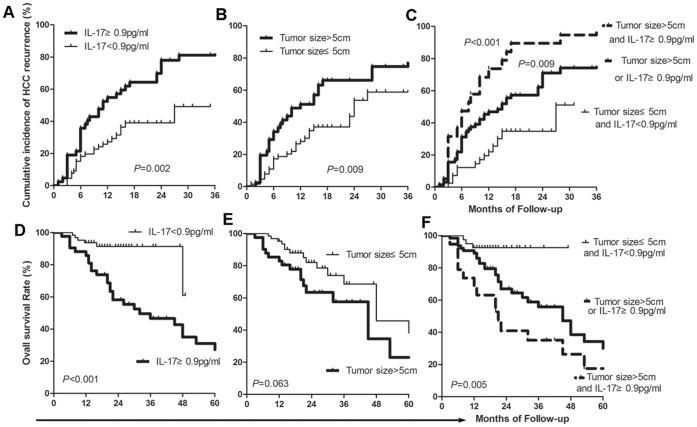
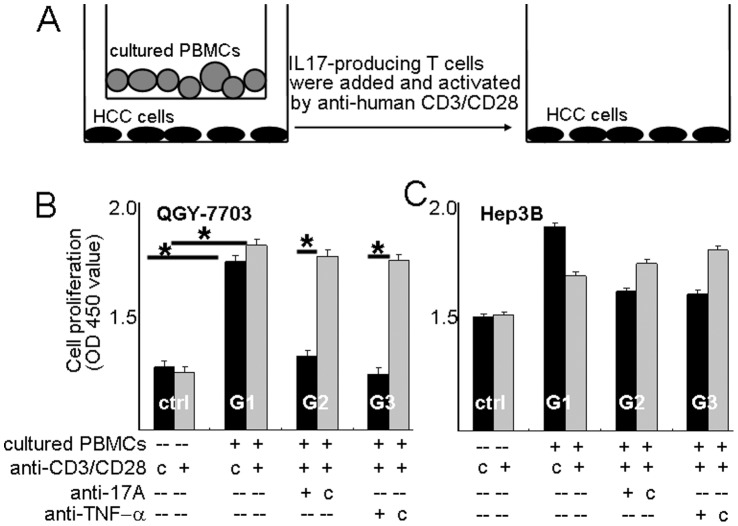
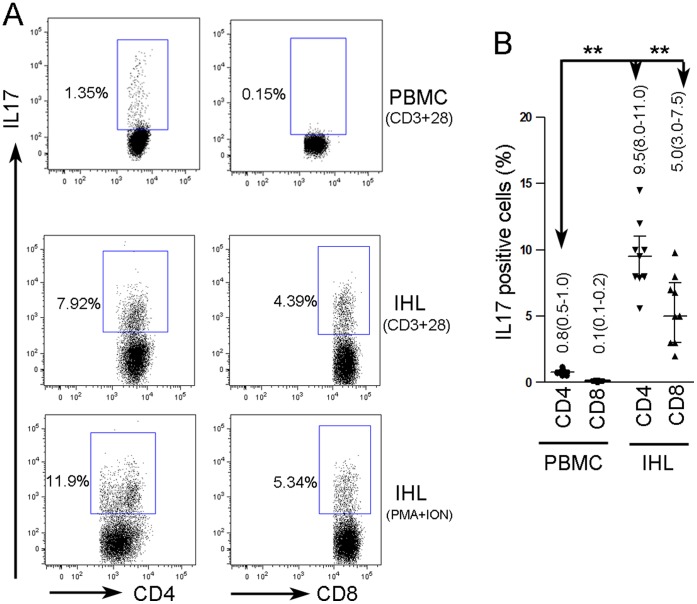
All the 105 cases of HCC patients had liver cirrhosis. The patients who suffered from HCC early recurrence had higher pre-therapy serum levels of IL17 and lower levels of IL10 than those who did not suffer from recurrence after curative hepatectomy. After adjustment for general tumor clinicopathological factors, elevated serum levels of IL17 (≥ 0.9 pg/ml) was found to be an independent risk factor for HCC early recurrence with a hazard ratio of 2.46 (95%CI 1.34-4.51). Patients with bigger tumors (>5 cm in diameter) and elevated serum levels of IL17 had the highest risk of early recurrence as compared to those with only one of these factors (P = 0.009) or without any (P<0.001). These factors showed similar effects on the HCC patient overall survival. Intrahepatic infiltrated T-cells in HCC patients were identified as the major IL17-producing cells. Proliferation of HCC cells, QGY-7703, was augmented QGY-7703, was augmented in the presence of IL17-producing T-cells. This effect diminished after neutralizing antibody against human IL17A or TNFα was included.
Both tumors and IL17 from liver infiltrated T-cells contributed to HCC early recurrence and progression after curative resection. Pre-therapy serum IL17 levels may serve as an additional indicator for predicting high-risk patients.
原发性肝细胞癌(HCC)通常发生在炎症性纤维化/肝硬化肝脏中,伴有广泛的淋巴细胞浸润。我们研究了 HCC 早期复发与炎症细胞因子血清水平变化之间的关系。
纳入了 105 例慢性乙型肝炎病毒感染的 HCC 患者。在治疗前,我们定量检测了他们的 Th1、Th2、Th17、Treg 相关及其他细胞因子的血清浓度,这些细胞因子已被报道与人类癌症的不良预后相关。从 HCC 患者中体外生成产生 IL17 的 T 细胞,并将其与 HCC 细胞系通过 0.4µM 转染器共培养。
所有 105 例 HCC 患者均患有肝硬化。与根治性肝切除术后未复发的患者相比,发生 HCC 早期复发的患者治疗前血清 IL17 水平较高,而 IL10 水平较低。在调整一般肿瘤临床病理因素后,发现血清 IL17 水平升高(≥0.9pg/ml)是 HCC 早期复发的独立危险因素,风险比为 2.46(95%CI 1.34-4.51)。与仅具有这些因素之一的患者(P=0.009)或没有任何因素的患者(P<0.001)相比,肿瘤较大(直径>5cm)和血清 IL17 水平升高的患者发生早期复发的风险最高。这些因素对 HCC 患者的总生存也有类似的影响。在 HCC 患者中,肝内浸润的 T 细胞被鉴定为主要的 IL17 产生细胞。在存在产生 IL17 的 T 细胞的情况下,HCC 细胞系 QGY-7703 的增殖被增强,当加入抗人 IL17A 或 TNFα 的中和抗体后,这种作用减弱。
肿瘤和来自肝浸润 T 细胞的 IL17 均有助于根治性切除术后 HCC 的早期复发和进展。治疗前的血清 IL17 水平可能作为预测高危患者的附加指标。