Laboratory of Plant Reproductive Genetics, Graduate School of Life Sciences, Tohoku University, Miyagi, Japan.
Proc Jpn Acad Ser B Phys Biol Sci. 2012;88(10):519-35. doi: 10.2183/pjab.88.519.
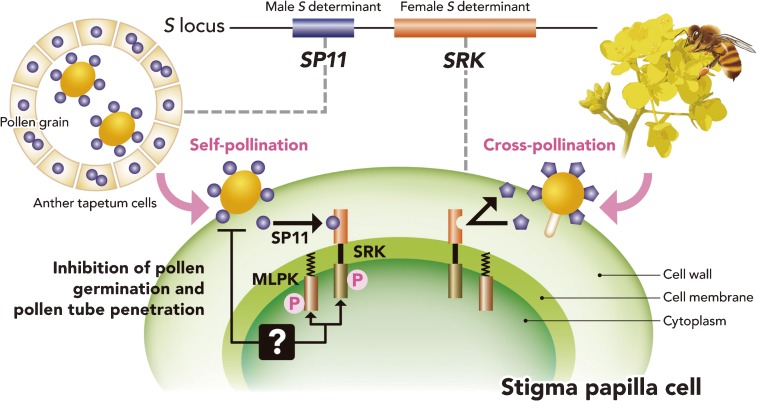
Self-incompatibility (SI) is defined as the inability to produce zygotes after self-pollination in a fertile hermaphrodite plant, which has stamens and pistils in the same flower. This structural organization of the hermaphrodite flower increases the risk of self-pollination, leading to low genetic diversity. To avoid this problem plants have established several pollination systems, among which the most elegant system is surely SI. The SI trait can be observed in Brassica crops, including cabbage, broccoli, turnip and radish. To produce hybrid seed of these crops efficiently, the SI trait has been employed in an agricultural context. From another point of view, the recognition reaction of SI during pollen-stigma interaction is an excellent model system for cell-cell communication and signal transduction in higher plants. In this review, we describe the molecular mechanisms of SI in Brassicaceae, which have been dissected by genetic, physiological, and biological approaches, and we discuss the future prospects in relation to associated scientific fields and new technologies.
自交不亲和性(SI)被定义为在同一朵花中具有雄蕊和雌蕊的可育雌雄同体植物中自花授粉后不能产生合子的现象。这种雌雄同体花的结构组织增加了自花授粉的风险,导致遗传多样性低。为了避免这个问题,植物已经建立了几种授粉系统,其中最优雅的系统肯定是 SI。SI 特性可在芸薹属作物中观察到,包括白菜、西兰花、萝卜和萝卜。为了有效地生产这些作物的杂交种子,SI 特性已在农业背景下得到应用。从另一个角度来看,SI 在花粉-柱头相互作用中的识别反应是高等植物中细胞-细胞通讯和信号转导的极好模型系统。在这篇综述中,我们描述了通过遗传、生理和生物学方法解析的芸薹属植物 SI 的分子机制,并讨论了与相关科学领域和新技术相关的未来前景。